Speed Up Arduino With Clever Coding

We love Arduino here at Hackaday; they’ve probably done more to make embedded programming accessible to more people than anything else in the history of the field. One thing the Arduino ecosystem is rarely praised for is its speed. That’s where [Playduino]  comes in, with his video (embedded below) that promises to make everyone’s favourite microcontroller run 50x faster.

You might be expecting an unstable overclocking setup, with swapped crystals, tweaked voltages and a hefty heat sink, but no! This is stock hardware. The 50x speedup comes from one simple hack: don’t use digitalWrite();

If you aren’t familiar, the digitalWrite() function is one of the key functions Arduino gives you to operate its boards– specify the pin and the value (high or low) to drive it. It’s very easy, but it’s also very slow. [Playduino] takes a moment to show just how much is going on under the hood when you call digitalWrite(), and shows you what you can do instead if you have a need for speed. (Hint: there’s no Arduino-provided code involved; hardware registers and the __asm keyword show up.)

If you learned embedded programming in an earlier era, this will probably seem glaringly obvious. If you, like so many of us, got started inside of the Arduino ecosystem, these closer-to-the-metal programming techniques could prove useful tools in your quiver. Big thanks to [Stephan Walters] for the tip.

Of course if you prefer to speed things up by hardware rather than software, you can overclock an Arduino– with liquid nitrogen, even.

Continue reading “Speed Up Arduino With Clever Coding” →

Christmas Comes Early With AI Santa Demo

With only two hundred odd days ’til Christmas, you just know we’re already feeling the season’s magic. Well, maybe not, but [Sean Dubois] has decided to give us a head start with this WebRTC demo built into a Santa stuffie.

The details are a little bit sparse (hopefully he finishes the documentation on GitHub by the time this goes out) but the project is really neat. Hardware-wise, it’s an audio-enabled ESP32-S3 dev board living inside Santa, running the OpenAI’s OpenRealtime Embedded SDK (as implemented by ExpressIf), with some customization by [Sean]. Looks like the audio is going through the newest version of LibPeer and the heavy lifting is all happening in the cloud, as you’d expect with this SDK. (A key is required, but hey! It’s all open source; if you have an AI that can do the job locally-hosted, you can probably figure out how to connect to it instead.)

This speech-to-speech AI doesn’t need to emulate Santa Claus, of course; you can prime the AI with any instructions you’d like. If you want to delight children, though, its hard to beat the Jolly Old Elf, and you certainly have time to get it ready for Christmas. Thanks to [Sean] for sending in the tip.

If you like this project but want to avoid paying OpenAI API fees, here’s a speech-to-text model to get you started.We covered this AI speech generator last year to handle the talky bit. If you put them together and make your own Santa Claus (or perhaps something more seasonal to this time of year), don’t forget to drop us a tip!

Casting Shade On “Shade-Tolerant” Solar Panels

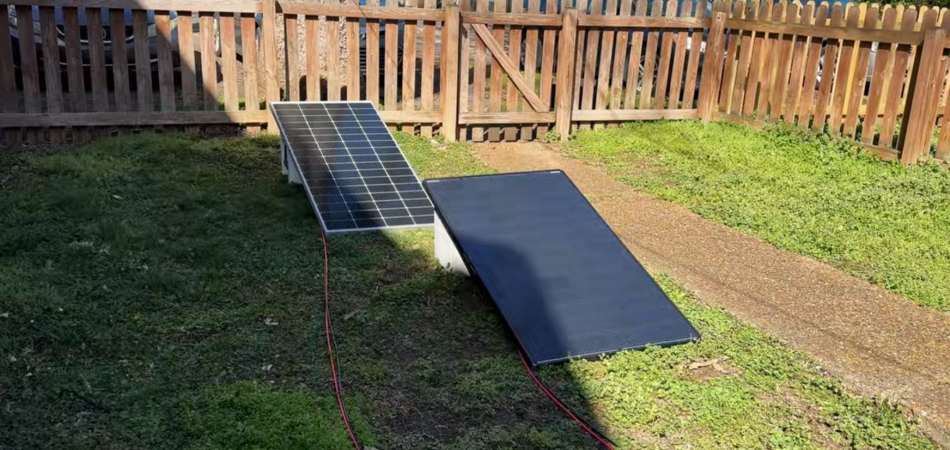
Shade is the mortal enemy of solar panels; even a little shade can cause a disproportionate drop in power output. [Alex Beale] reviewed a “revolutionary” shade-tolerant panel by Renology in a video embedded below. The results are fascinating.

While shading large portions of the panels using cardboard to cut off rows of cells, or columns of cells, the shade tolerant panel does very well compared to the standard panel– but when natural, uneven shading is applied to the panel, very little difference is seen between the standard and active panels in [Alex]’s test.  We suspect there must be some active components to keep power flowing around shaded cells in the Renology panel, allowing it to perform well in the cardboard tests. When the whole panel is partially shaded, there’s no routing around it, and it performs normally.

It’s hard to see a real-world case that would justify the extra cost, since most shading doesn’t come with perfect straight-line cutoffs. Especially considering the added cost for this “shade tolerant” technology (roughly double normal panels).

You might see a better boost by cooling your solar panels. Of course you can’t forget to optimize the output with MPPT. It’s possible that a better MPPT setup might have let the Renology panel shine in this video, but we’re not certain. Whatever panels you’re using, though, don’t forget to keep them clean.

Continue reading “Casting Shade On “Shade-Tolerant” Solar Panels” →

Escaping US Tech Giants Leads European YouTuber To Open Source

The video (embedded below) by [TechAltar] is titled “1 Month without US tech giants“, but it could have been titled “1 Month with Open Source Tools” — because, as it turns out, once you get out of the ecosystem set up by the US tech giants, you’re into the world of open source software (OSS) whether you want to be or not.

From a (German-made) Tuxedo laptop running their own Linux distro to a Fairphone with e/OS (which is French), an open version of Android, [TechAlter] is very keen to point out whenever Europeans are involved, which is how we learned that KDE has a physical headquarters, and that it’s in Berlin. Who knew?

He also gives his experiences with NextCloud (also German), can be used as an OSS alternative Google Workspaces that we’ve written about before, but then admits that he was the sole user on his instance. To which one must question: if you’re the sole user, why do you need a cloud-based collaborative environment? To try it out before getting collaborators involved, presumably.

Regardless what you think of the politics motivating this video, it’s great to see open source getting greater traction. While [TechAltar] was looking for European alternatives, part of the glory of open source is that it doesn’t matter where you’re from, you can still contribute. (Unless you’re Russian.) Have you found yourself using more open source software (or hardware) of late? Do you think the current political climate could lead to a broadening of its reach? Is this the year of the linux desktop? Let us know what you think in the comments. Continue reading “Escaping US Tech Giants Leads European YouTuber To Open Source” →

Determine Fundamental Constants With LEDs And A Multimeter

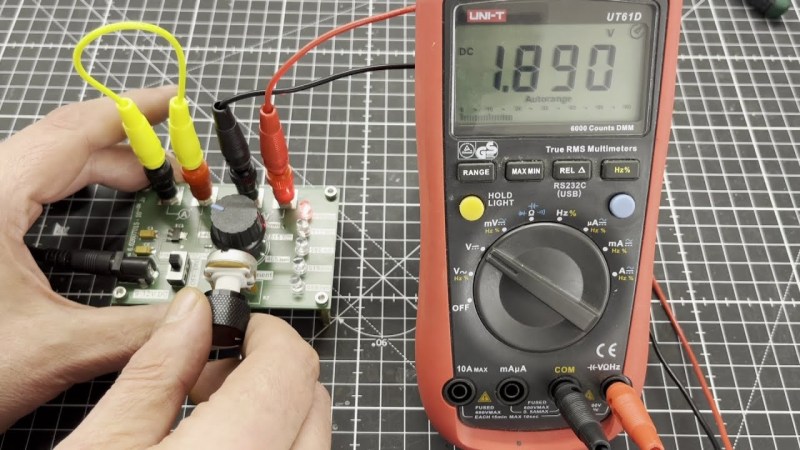
There are (probably) less than two dozen fundemental constants that define the physics of our universe. Determining the value of them might seem like the sort of thing for large, well funded University labs, but many can be determined to reasonable accuracy on the benchtop, as [Marb’s Lab] proves with this experiment to find the value of Planck’s Constant.

[Marv’s Lab] setup is on a nice PCB that uses a rotary switch to select between 5 LEDs of different wavelengths, with banana plugs for the multi-meter so he can perform a linear regression on the relation between energy and frequency to find the constant. He’s also thoughtfully put connectors in place for current measurement, so the volt-current relationship of the LEDs can be characterized in a second experiment. Overall, this is a piece of kit that would not be out of place in any high school or undergraduate physics lab. Continue reading “Determine Fundamental Constants With LEDs And A Multimeter” →

This Extra-Large, Two-Stage Fume Extractor Really Sucks

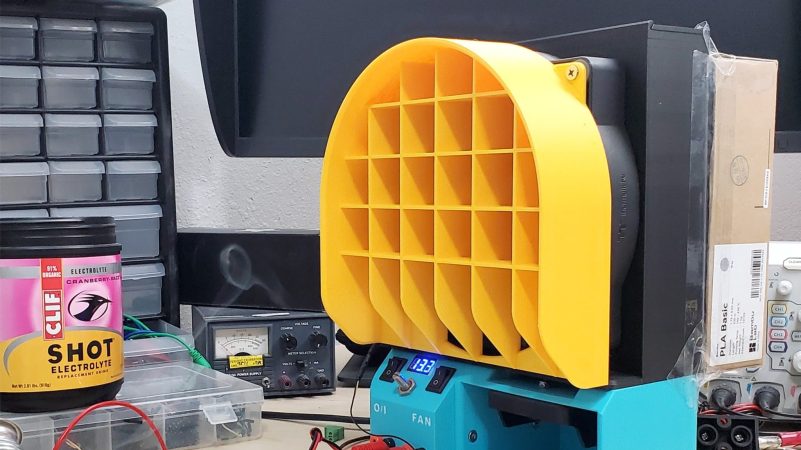
Solder fumes are not nice on the lungs; nor are fumes from superglue, epoxy, or a whole mess of other things we often find ourselves using on the bench. Some people might be able to go the fume hood route to toss that all outside, but for the rest of us, there’s fume extractors. [Raph] has produced an extra-large, carbon-filtering, two-stage fume extractor that by all accounts really sucks — it is effective at hoovering up solder fumes up to 10″ from its inlet.

Photo of fume extractor
Note the 18V tool battery in the base. That’ll go for a bit.

Even better, [Raph] built a battery box for an 18 V cordless tool battery, and broke out banana plugs so this doubles as a variable power supply via a cheap LM2596 based DC-DC converter. It also serves as a speed controller for the fans, which makes us wonder if you can adjust the PSU output and the fan speed independently…

Maximum suckage is achieved through careful baffle design. Check out the blog to see the trial-and-error process at work. Of course, having a 200 mm axial fan and 140 mm blower fan front and rear is going to move some air no matter what. Which is required to get air flow through the 38 mm thick activated carbon filter that should scrub all nasties quite nicely. We aren’t filtration experts but we can agree with [Raph]’s estimate that it will last “a while”.

If you want to roll your own, all of the STEP files are on GitHub, and [Raph]’s blog has an excellent step-by-step build guide. We’ve seen other hacks from [Raph] before, from his dovetailed modular breadboard to the machine that shaped his bed and automation for his camper van.

Hack Aims For Polaroid, Hits Game Boy Camera Sweet Spot

There’s just some joy in an instant camera. They were never quality cameras, even in the glory days of Polaroid, but somehow the format has survived while the likes of Kodachrome have faded away. [Mellow_Labs] decided he wanted the instacam experience without the Polaroid pricing, so he made his own in the video embedded after the break.

He says “Polaroid’ but we see Game Boy.

At its core, it’s a simple project: an ESP32-CAM for the image (these were never great cameras, remember, so ESP32 is fine– and do you really get to call it an instant camera if you have to wait for a Raspberry Pi to boot up?) and a serial thermal printer for the “instant photo”part. This admittedly limits the project to black and white, and pretty low res, but B/W is artistic and Lo-Fi is hip, so this probably gives the [Mellow Labs] camera street cred with the kids, somehow. Honestly, this reminds us more of the old Gameboy Camera and its printer than anything made by Polaroid, and we are here for it.

The build video goes through the challenges [Mellow Labs] found interfacing the serial printer to the ESP32–which went surprisingly well for what looks like mostly vibe coding, though we’re not sure how much time he spent fixing the vibe code off camera–as well as a the adventure of providing a case that includes the most absurdly beefy battery we’ve ever seen on a camera. Check out the full video below.

Instant cameras are no stranger to Hackaday: this one used e-ink; this one uses film, but is made of gingerbread. In 2022 we wondered if we’d ever shake the Polaroid picture, and the answer appears to be “no” so far.

Thanks to [Mellow] for tooting his own horn by submitting this project to the tip line. We love to see what our readers get up to, so please– toot away!

Continue reading “Hack Aims For Polaroid, Hits Game Boy Camera Sweet Spot” →