LCD Monitor Plays The Hits

In the old days, it wasn’t uncommon to put an AM radio near a computer or a monitor and deliberately cause interference to have a crude form of sound generation. Did you miss out on that? No! Thanks to [luambfb] you can now do the same trick with a common LCD monitor. You’ll need the horizontal refresh rate of the monitor in question.

Of course, doing it is somewhat less interesting than learning how it works. The effect relies on the fact that the LCDs emit signals as it refreshes a row. A black row emits relatively low energy while a white row emits more. Grayscale… well, you get the idea. Continue reading “LCD Monitor Plays The Hits”

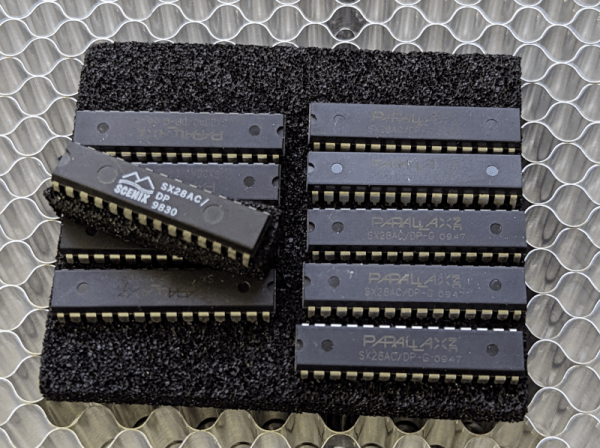
Chips Remembered: The Scenix/Ubicom/Parallax SX

If you are a bibliophile, going to a used bookstore is a distinctly pleasant experience. Sure, you might discover an old book that you want to read. But at least some of the endorphin rush comes from seeing old friends. Not humans, but books you read years or even decades ago. Most often, you don’t buy the book — you probably have one stashed in a box somewhere. But it is a happy feeling to see an old friend and maybe thumb through it reading a passage or two among shelves of musty books. I wish we had something like that for chips. Outside of a few notable exceptions, chips tend to have a short life span of popularity and then give way to other chips. This is especially true of CPUs. One that I especially miss is the Scenix/Ubicom/Parallax SX chip.

I had a bookstore-like experience with this processor the other day. I produced a few products based around these chips and I have a small stash of them left. I jealously guard the hardware needed to program them “just in case.” Well, naturally, someone needed a few for some reason so I had to dig it all up. Knowing these might be some of the last of the unprogrammed SX chips in the world made me a little nostalgic.

The Story

In the late 1990s, a company called Scenix started producing a microcontroller called the SX in a few footprint sizes. So the SX18 was, for example, an 18-pin part. By 1999, they were already in full swing with the SX18 and SX28 and they introduced the SX52.

Of course, a lot of companies produced microcontrollers. The Scenix offering was a bit special. In those days, the Microchip PIC was the king of the hill. The PIC is an odd beast that evolved from a very limited controller made to be small and inexpensive. Notably, while it could support relatively high clock frequencies — 20 MHz was common — each normal instruction took 4 clock cycles. So when your crystal said 20 MHz, you were running instructions at 5 MHz.

Continue reading “Chips Remembered: The Scenix/Ubicom/Parallax SX”

What’s That Scope Trace Saying? UPD And Wireshark

[Matt Keeter], like many of us, has a lot of network-connected devices and an oscilloscope. He decided he wanted to look into what was on the network. While most of us might reach for Wireshark, he started at the PCB level. In particular, he had — or, rather, had someone — solder an active differential probe soldered into an Ethernet switch. The scope attached is a Textronix, but it didn’t have the analyzer to read network data. However, he was able to capture 190+ MB of data and wrote a simple parser to analyze the network data pulled from the switch.

The point of probing is between a network switch and the PHY that expands one encoded channel into four physical connections using QSGMII (quad serial gigabit media-independent interface). As the name implies, this jams four SGMII channels onto one pair.

As is common in networking schemes, the 8-bit byte is encoded into a 10-bit code group to ensure enough bit transitions to recover the synchronous clock. The decoding software has to examine the stream to find framing characters and then synchronize to the transmitted clock.

What follows is a nice tour of the protocol and the Python code to decode it. It seems complex, but the code is fairly short and also executes quickly. The output? Pcap files that you can process with Wireshark. Overall, a great piece of analysis. He also points out there are other tools already available to do this kind of decoding, but what fun is that?

Wireshark can do a lot of different kinds of analysis, even if you aren’t usually capturing from a scope. You can even decrypt SSL if you know the right keys.

Testing A Laser Cut Wrench VS A Forged Wrench

It is easy to not think much about common tools like screwdrivers and wrenches. But not for [Torque Test Channel]. The channel does a lot of testing of tools and in the video, below, they test a new wrench that is, oddly enough, laser cut instead of forged like the usual wrench.

You would expect a machined wrench to be weaker than a forged wrench. We were impressed, though, that there is so much difference between wrenches when you start making measurements.

Speaking of measurements, we would like to see more details of the test setups shown both in the video and in some of the video clips included. We did enjoy seeing the examination of the internal grain structure of both wrenches.

Be forewarned. Watching this video is likely going to send you to the computer to buy some new wrenches, especially if you don’t have 30/60 head wrenches.

The real question is why laser cut a wrench? It doesn’t seem like it is actually better than the forged variant. It is more expensive, but the setup costs for forging are higher. Particularly for a tool made in the United States, forging is both expensive and it is difficult to find time on the limited number of large-scale forges left in the country.

Continue reading “Testing A Laser Cut Wrench VS A Forged Wrench”

Svelte VR Headsets Coming?

According to Standford and NVidia researchers, VR adoption is slowed by the bulky headsets required. They want to offer a slim solution. A SIGGRAPH paper earlier this year lays out their plan or you can watch the video below. There’s also a second video, also below, covers some technical questions and answers.

The traditional headset has a display right in front of your eyes. Special lenses can make them skinnier, but this new method provides displays that can be a few millimeters thick. The technology seems pretty intense and appears to create a hologram at different apparent places using a laser, a geometric phase lens, and a pupil-replicating waveguide.

Continue reading “Svelte VR Headsets Coming?”

Young Inventor Builds Motor Without Rare Earths

[Robert Sansone] is a 17-year-old from Florida and, like most of us, he likes to tinker. He’s apparently got the time for it because he’s completed at least 60 projects ranging from animatronic hands to a high-speed go-kart. However, his interest in electric vehicles coupled with his understanding of the issues around them led him to investigate synchronous reluctance motors — motors that don’t depend on expensive rare earth magnets. His experiments have led to a novel form of motor that has greater torque than existing designs.

Rare earths are powerful but expensive, costing much more than common metals like copper or steel. Traditionally, synchronous reluctance motors use steel rotors and air gaps and exploit the difference in reluctance — a term for magnetic resistance– to generate rotation. [Robert’s] idea was to replace the air gap with a different material to increase the ratio of reluctance between the rotor and the gap. Reconfiguring the motor to a more traditional configuration shows startling results: the new design generated almost 40% more torque and did so more efficiently, as well.

His work has earned him first prize, and $75,000, in this year’s Regeneron International Science and Engineering Fair. It took 15 tries to get the motor to its current state, something made easier with 3D printing. There are plans for a 16th version that [Robert] hopes will perform even better. We can’t wait to see what he’ll do next.

Electric vehicles have made people look into many motor design topologies. The reluctance motor has been around for a long time, but controlling them has become significantly easier. That’s true of many kinds of motors.

Continue reading “Young Inventor Builds Motor Without Rare Earths”

Hack Your Engine Virtually

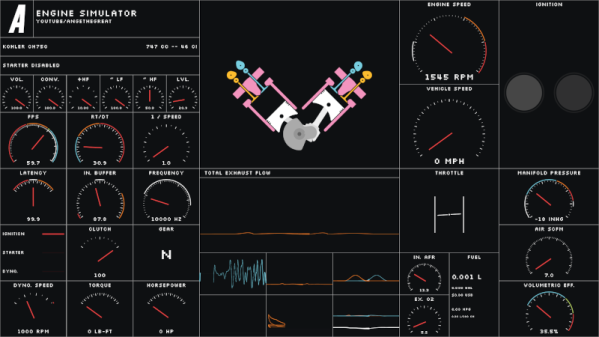
It is no secret that we like simulating circuits before we build something and there are plenty of great tools for that. But what about those of us who work on cars? Well, you might try engine-sim which is a real-time internal combustion engine simulation. Honestly, the program freely admits that it isn’t accurate enough to do engineering or engine tuning. But on the plus side, it has audio output and is at least good as an educational tool to show an engine running and how different parameters might affect it. You can see a video of the tool below.

[Ange-Yaghi] mentions that the code was primarily to power the YoutTube demo. However, the Readme hints that it might be better — or at least different — and collaboration to make it better is welcome.

Continue reading “Hack Your Engine Virtually”