[Kerry Wong] Is Really Into Scope Meters

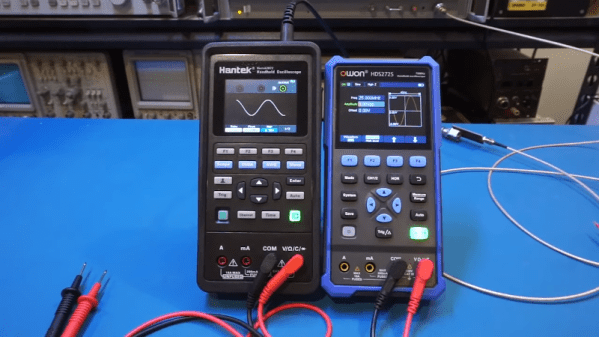
If a combination multimeter and oscilloscope is on your holiday shopping list this year, you might want to have a look at some of [Kerry Wong’s] recent videos on the subject. Over several videos he looks at — inside and out — an OWON HDS272S and a Hantek 2D72, both reasonably inexpensive entries in the field. Both instruments are similar and have a few variants depending on the frequency capability and the addition of a waveform generator.

There are several videos on the Hantek device that are a few months old, then some recent videos — like the one below — on the OWON device along with some comparison videos.
Continue reading “[Kerry Wong] Is Really Into Scope Meters”

Differential Probe Clocks At 100MHz And $200

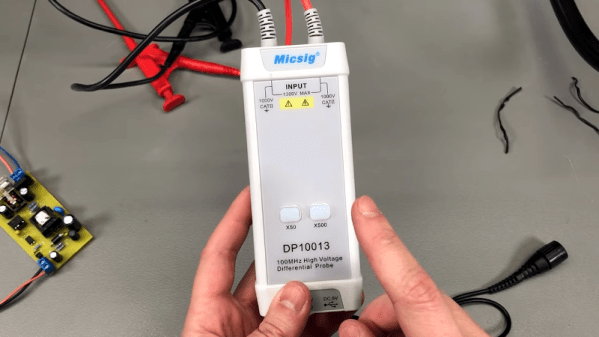
[Voltlog] often looks at interesting test equipment and in the video below he reviews something that isn’t very common in hobby labs: a differential oscilloscope probe. These are usually pretty expensive, but the Micsig probe in the video costs under $200. The question, of course, is what do you need with a differential probe?

A typical scope probe has a ground lead that connects directly to the actual grounding point. This can cause a problem if you try to measure across some component that has more voltage than you want to short to ground. It might hurt your device under test, your scope, or both.

Continue reading “Differential Probe Clocks At 100MHz And $200”

Customize These 3D Printed Cases

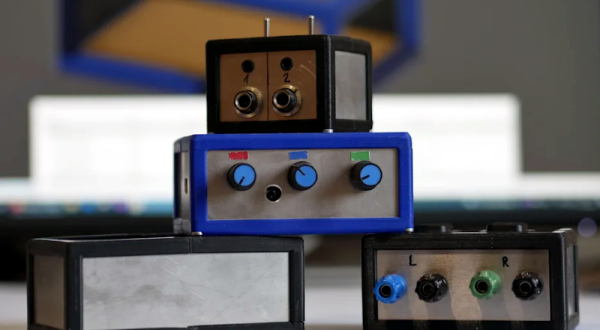
Building something, of course, requires your electronics skills. But packaging it is often an exercise in mechanics. You can buy off the shelf, of course, but sometimes it is hard to find just the right enclosure. You probably have a 3D printer, too, but sometimes 3D printing an entire case can be time consuming and isn’t always completely attractive. Enter [Johannes-Bosch] and Fusion 360. These 3D printed frames assemble into boxes and are easy to customize. The panels are aluminum, although we imagine you could substitute wood, acrylic, or even a 3D printed sheet of plastic, if you wanted to.

The video below shows some examples. If your German isn’t up to snuff, ask YouTube to automatically translate the subtitles and you’ll get the idea.

Continue reading “Customize These 3D Printed Cases”

We All Live In A PVC Submarine

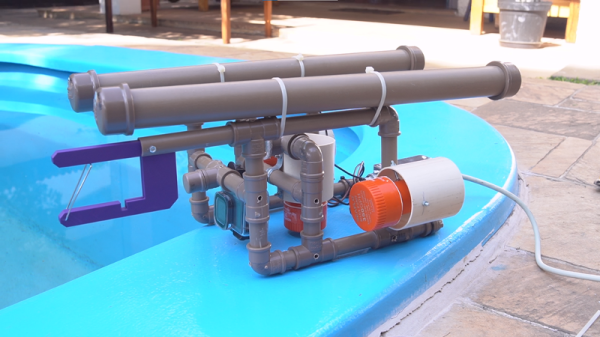
We doubt you could really live in [Pena’s] PVC submarine, but now the song’s stuck in our head anyway. Although the post is in Portuguese, you can get a pretty good idea of how it works, and translation software is better than ever. Transcending the language barrier, there are videos of just about every step of the construction. We didn’t, however, find a video of the vehicle in the water.

The plumber’s delight has modified motors for thrusters, and a camera as well. Epoxy potting keeps things waterproof. We’ve seen candle wax used for the same purpose in other builds.

Continue reading “We All Live In A PVC Submarine”

Arduino Drives Faux Spirograph

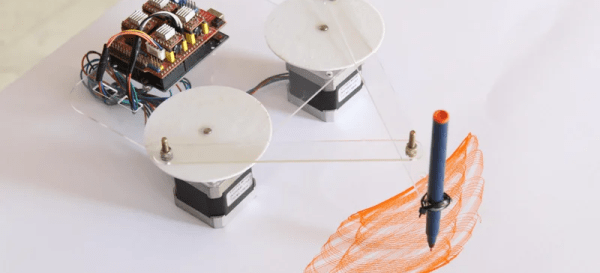
The holidays always remind us of our favorite toys from when we were kids. Johnny Astro, an Erector set, and — of course — a Spirograph. [CraftDiaries] has an Arduino machine that isn’t quite a Spirograph, but it sure reminds us of one. The Arduino drives two stepper motors that connect to a pen that can create some interesting patterns.

The build uses a few parts that were laser cut, but they don’t look like they’d be hard to fabricate using conventional means or even 3D printing. The author even mentions you could make them out of cardboard or foamboard if you wanted to.

Continue reading “Arduino Drives Faux Spirograph”

Build Your Own Submarine

If you are tried of building things that fly, why not try a submarine like [DIYPerks] did? As you can see in the video below, the key is to control buoyancy, and the mechanism used is impressive. The sub has two giant syringes fore and aft to compress or decompress water. The plungers are now 3D-printed actuators that travel on a lead screw. Two high-torque motors and some batteries sandwiched in acrylic disks make up the rest. This is a big vessel — you won’t be trying this in your bathtub and maybe not even your pool unless it is a big one.

Of course, everything needs to be watertight. Instead of trying to waterproof a power switch, this sub uses a reed switch so that a nearby magnet can turn it on. Not an original idea, but we always think it is more elegant than seals and potting compounds.

Continue reading “Build Your Own Submarine”

Lasers Make PCBs The Old Fashioned Way

There are many ways to create printed circuit boards, but one of the more traditional ways involves using boards coated with photoresist and exposing the desired artwork on the board, usually with UV light. Then you develop the board like a photograph and etch it in acid. Where the photoresist stays, you’ll wind up with copper traces. Hackers have used lots of methods to get that artwork ranging from pen plotters to laser printers, but commercially a machine called a photoplotter created the artwork using a light and a piece of film. [JGJMatt] sort of rediscovered this idea by realizing that a cheap laser engraver could directly draw on the photoresist.

The laser dot is about 0.2 mm in diameter, so fine resolution boards are possible. If you have a laser cutter or engraver already, you have just about everything you need. If not, the lower-power laser modules are very affordable and you can mount one on a 3D printer. Most people are interested in using these to cut where higher power is a must, but for exposing photosensitive film, you don’t need much power. The 500 mW module used in the project costs about fifty bucks.

Continue reading “Lasers Make PCBs The Old Fashioned Way”