The Linux X86 Journey To Main()

Have you ever had a program crash before your main function executes? it is rare, but it can happen. When it does, you need to understand what happens behind the scenes between the time the operating system starts your program and your first line of code in main executes. Luckily [Patrick Horgan] has a tutorial about the subject that’s very detailed. It doesn’t cover statically linked libraries but, as he points out, if you understand what he does cover, that’s easy to figure out on your own.

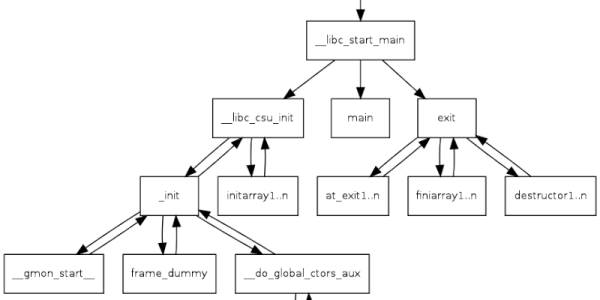
The operating system, it turns out, knows nothing about main. It does, however, know about a symbol called _start. Your runtime library provides this. That code contains some stack manipulation and eventually calls __libc_start_main which is also provided by the library. Continue reading “The Linux X86 Journey To Main()”

DIY CNC Uses Lots Of 3D-Printed Parts

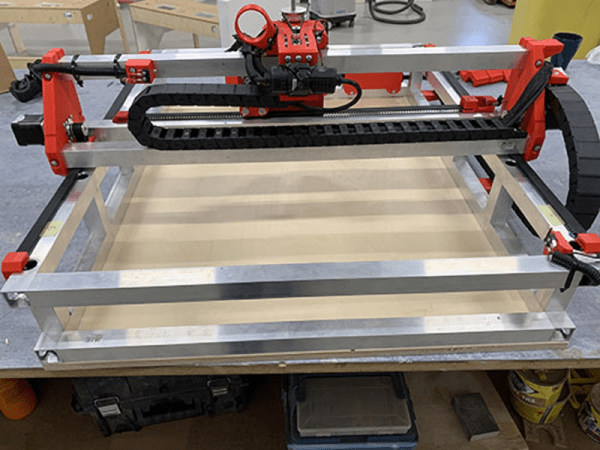
There are probably almost as many DIY CNC designs as there are DIY CNCs. And there’s nothing wrong with that! We really liked [maxvfischer’s] documentation on GitHub for a machine he made based on a design by [Ivan Miranada].

In addition to a complete bill of materials, there are Fusion 360 files and very good instructions. There are several tips that seemed like they would help even if you were building similar machines.

The machine uses HTD5M belts instead of the more prevalent lead screw design. Everything slides on MGN12H slides. There are detailed photographs covering not just the tricky parts but even how to extend the stepper motor wires.

The original design used a Makita RT0700C for the spindle, but [max] couldn’t find one of those, but found a similar version with the same dimensions.

The only tip we would add is to be careful using taps in a handheld drill. (Don’t ask us how we know that.) A drill press is safer, or you can even use a tap handle and do it the old-fashioned way.

The firmware is grbl on an Arduino, and there are complete instructions for setting that up, too. We were amazed at the number of pictures included along with the detailed description. If you were ever afraid you couldn’t duplicate a CNC project, this might be the one to tackle.

There are, of course, cheaper and simpler options with fewer capabilities. Some are even almost free courtesy of the local dumpster.

Brain Implant Offers Artificial Vision To The Blind

Nothing makes you appreciate your vision more than getting a little older and realizing that it used to be better and that it will probably get worse. But imagine how much more difficult it would be if you were totally blind. That was what happened to [Berna Gomez] when, at 42, she developed a medical condition that destroyed her optic nerves leaving her blind in a matter of days and ending her career as a science teacher. But thanks to science [Gomez] can now see, at least to some extent. She volunteered after 16 years to have a penny-sized device with 96 electrodes implanted in her visual cortex. The research is in the Journal of Clinical Investigation and while it is a crude first step, it shows lots of promise and uses some very novel techniques to overcome certain limitations.

The 96 electrodes were in a 10×10 grid with the four corner electrodes missing. The resolution, of course, is lacking, but the project turned to a glasses-mounted camera to acquire images and process them, reducing them to signals for the electrodes that may not directly map to the image.

Continue reading “Brain Implant Offers Artificial Vision To The Blind”

DC UPS Keeps The Internet Up

We occasionally get annoyed that so much gear takes the ubiquitous “wall wart” these days. But one advantage is that the devices operate on DC voltage. [TechRally] takes advantage of this to create an automatic DC UPS with dual outputs to power a router and modem in the event of a power outage. You can see two videos about the project below.

Some may say it would be better to use conventional UPS, but think about it. That UPS has a battery in it that gets converted to AC so the wall wart can convert it back to DC. Each conversion loses some energy, of course, and in the case of a cheap wall wart, you may even lose quite a bit.

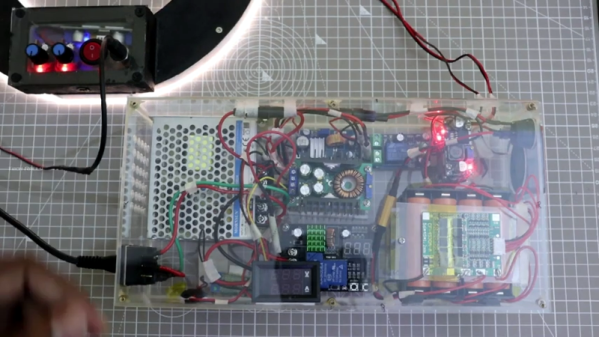
The project contains eight 18650 batteries, an off-the-shelf charge controller, and power converters. Could you do a more efficient custom design? Maybe, but the use of these inexpensive and commonly available modules makes it quick and easy to pull something like this together.

No one would mistake this UPS for a commercial unit, but it does have a certain hacker aesthetic. We wouldn’t carry it through an airport, though. With those digital displays and all the wiring, it looks like a bad TV show’s bomb prop.

If you don’t care about the automatic switchover, we hear that 5V will power a lot of equipment these days and that makes battery operation as simple as stripping a USB cable. This could probably drive some other gear like a connected Raspberry Pi. Or, you could do that job with some supercaps.

Continue reading “DC UPS Keeps The Internet Up”

ESP32 Internet Radio Is No Game

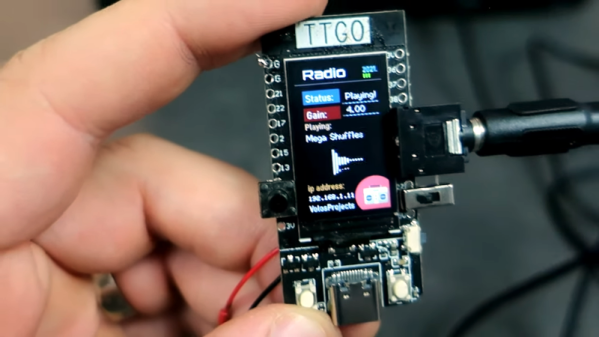
More than once, we’ve looked at a cool board like the TTGO T-Display and thought, “What can we build with this?” If you’re [Danko Bertović], the answer is the tiny Internet radio you can see in the Volos Projects video below.

Of course, the core Internet streaming code would be useful with any ESP32, but the display makes for a good-looking unit. The code is available on GitHub. With judicious use of network and audio libraries, the player only takes a few hundred lines of code. Pretty impressive considering it even shows a visualization on the tiny display screen.

What we’d really like to see is a nice case, power supply, and speaker option to make a tiny and portable unit. With a 3D printer, it is easy to make very professional-looking projects, as we often see. On the other hand, it does look better than the breadboard version you can see towards the end of the video. It is, though, a neatly done breadboard.

If you want a larger screen, you might enjoy the ESP32 internet radio we looked at before. Probably our favorite case for an Internet radio was this globe.

Continue reading “ESP32 Internet Radio Is No Game”

EMC Tutorial Puts You In The Loop

A student once asked his lab instructor why his amplifier was oscillating. After looking at it and noting the wild construction, the instructor remarked, “A better question would be why shouldn’t it oscillate?” The truth of it is, our circuits generate noise and especially if they are oscillating anyway. Distortion and nonlinearities generate harmonics and other component imperfections also contribute.

[FesZ Electronics] has a great video series about noise in switching power supplies and the latest talks about the hot loop. If you want to improve the noise performance of your next design, these videos are well worth watching. You can see the hot loop video below.

We really liked the homebrew noise probes. In addition to real-world probing. The video also observes circuit operation under simulation. Even if you don’t care about noise performance, there’s a lot of good information about basic switching power supply design here.

You can see the difference in a PCB that has a small hot loop versus a very small hot loop. Something to think about next time you are laying out a power supply board.

If you want to dive deeper into noise simulation, we have a good read on that for you. Or ditch simulation, and make your own cheap probe with an SDR dongle.

Continue reading “EMC Tutorial Puts You In The Loop”

Tech In Plain Sight: Air Conditioning

I’m always amazed that technology can totally wipe out industries. Sure, some people make a living making horseshoes, for example, but the demand for them is way down compared to what it would have been when horses were the normal mode of transportation. But even so, people still make horseshoes. But think about the ice harvesting business. Never heard of it? Turns out, before refrigeration, there was a huge business of moving ice from where it naturally occurred to other places and storing it, usually underground with a lot of insulation. As far as I know, that business — including the neighborhood ice man — is totally gone now except for some historical exhibitions. We take refrigeration and air conditioning for granted, but it hasn’t been that long ago that ice was a luxury and your own reprieve from the heat was a fan.

Early Cooling

The story starts a little earlier than you might expect. In the 1840s, physician John Gorrie was concerned about “the evils of high temperature.” His hospital in Florida imported ice using the aforementioned ice trade and it wasn’t cheap nor was it very effective.

Undeterred, he developed a machine that used a horse, a waterwheel, steam, or wind power to drive a compressor to create ice. He got a patent in 1851 but it failed to catch on before his financial backer died. In fact, Oliver Evans had the idea in 1805 but never built a working machine. Jacob Perkins patented the first compression cooler in 1834, again with little practical use.

When U.S. President Garfield was shot, Navy engineers built a cooling box using cloths soaked in ice water to cool the president’s hospital room by 20 degrees. Since the mortally wounded president survived 80 days after the shooting, we presume he appreciated the comfort.

Continue reading “Tech In Plain Sight: Air Conditioning”