ESP32 Internet Radio Is No Game

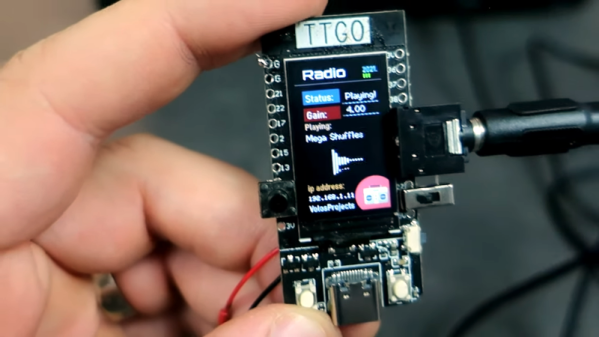
More than once, we’ve looked at a cool board like the TTGO T-Display and thought, “What can we build with this?” If you’re [Danko Bertović], the answer is the tiny Internet radio you can see in the Volos Projects video below.

Of course, the core Internet streaming code would be useful with any ESP32, but the display makes for a good-looking unit. The code is available on GitHub. With judicious use of network and audio libraries, the player only takes a few hundred lines of code. Pretty impressive considering it even shows a visualization on the tiny display screen.

What we’d really like to see is a nice case, power supply, and speaker option to make a tiny and portable unit. With a 3D printer, it is easy to make very professional-looking projects, as we often see. On the other hand, it does look better than the breadboard version you can see towards the end of the video. It is, though, a neatly done breadboard.

If you want a larger screen, you might enjoy the ESP32 internet radio we looked at before. Probably our favorite case for an Internet radio was this globe.

Continue reading “ESP32 Internet Radio Is No Game”

EMC Tutorial Puts You In The Loop

A student once asked his lab instructor why his amplifier was oscillating. After looking at it and noting the wild construction, the instructor remarked, “A better question would be why shouldn’t it oscillate?” The truth of it is, our circuits generate noise and especially if they are oscillating anyway. Distortion and nonlinearities generate harmonics and other component imperfections also contribute.

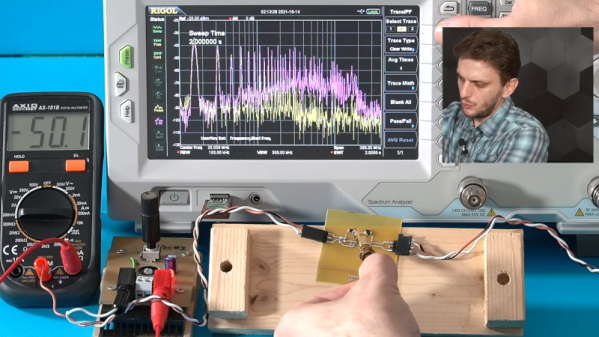
[FesZ Electronics] has a great video series about noise in switching power supplies and the latest talks about the hot loop. If you want to improve the noise performance of your next design, these videos are well worth watching. You can see the hot loop video below.

We really liked the homebrew noise probes. In addition to real-world probing. The video also observes circuit operation under simulation. Even if you don’t care about noise performance, there’s a lot of good information about basic switching power supply design here.

You can see the difference in a PCB that has a small hot loop versus a very small hot loop. Something to think about next time you are laying out a power supply board.

If you want to dive deeper into noise simulation, we have a good read on that for you. Or ditch simulation, and make your own cheap probe with an SDR dongle.

Continue reading “EMC Tutorial Puts You In The Loop”

Tech In Plain Sight: Air Conditioning

I’m always amazed that technology can totally wipe out industries. Sure, some people make a living making horseshoes, for example, but the demand for them is way down compared to what it would have been when horses were the normal mode of transportation. But even so, people still make horseshoes. But think about the ice harvesting business. Never heard of it? Turns out, before refrigeration, there was a huge business of moving ice from where it naturally occurred to other places and storing it, usually underground with a lot of insulation. As far as I know, that business — including the neighborhood ice man — is totally gone now except for some historical exhibitions. We take refrigeration and air conditioning for granted, but it hasn’t been that long ago that ice was a luxury and your own reprieve from the heat was a fan.

Early Cooling

The story starts a little earlier than you might expect. In the 1840s, physician John Gorrie was concerned about “the evils of high temperature.” His hospital in Florida imported ice using the aforementioned ice trade and it wasn’t cheap nor was it very effective.

Undeterred, he developed a machine that used a horse, a waterwheel, steam, or wind power to drive a compressor to create ice. He got a patent in 1851 but it failed to catch on before his financial backer died. In fact, Oliver Evans had the idea in 1805 but never built a working machine. Jacob Perkins patented the first compression cooler in 1834, again with little practical use.

When U.S. President Garfield was shot, Navy engineers built a cooling box using cloths soaked in ice water to cool the president’s hospital room by 20 degrees. Since the mortally wounded president survived 80 days after the shooting, we presume he appreciated the comfort.

Continue reading “Tech In Plain Sight: Air Conditioning”

3D Printer Bed Probing Using A Tact Switch And Coin Cell

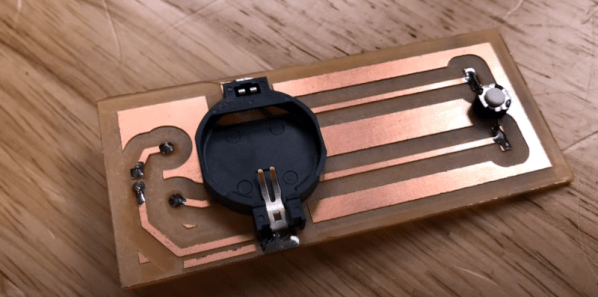
Inspired by his CNC’s leveling system, [Chuck] built a small PCB to help level his 3D printer and he shares the details in the video you can see below. The idea is simple, the nozzle pushes down on the PCB which has a tact switch underneath. When the switch closes, an LED lights.

In practice, you measure the height of the board and use that for your Z offset, and you are done. Our only concern would be how repeatable the switch is. Granted, most people use a piece of paper and that’s probably not totally repeatable or accurate either. Proper feeler gauges are the “right” way to do it, but we know only a few people who do that.

If you ever look into the repeatability of various Z probes like the proximity sensors or the little pins that drop out of a 3D Touch probe, they aren’t that repeatable. Some people use microswitches, too, which is pretty similar to this approach and is apparently good enough.

The board is available, but it is simple enough that you could create it — or an equivalent — with just about any method you use for your PCBs. [Chuck’s] prototype board was milled. We are always surprised more people don’t use the nozzle itself to sense the bed. Some people go to a lot more trouble than just electrical contact even for CNC.

Continue reading “3D Printer Bed Probing Using A Tact Switch And Coin Cell”

SuperSlicer Reviewed: Another 3DP Slicer?

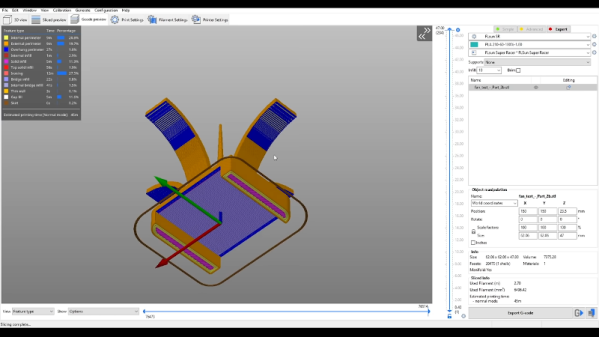
When you think of slicers for FDM 3D printing — especially free slicers — you probably think of Cura, Slic3r, or PrusaSlicer. There are fans of MatterControl and many people pay for Simplify3D. However, there are quite a few other slicers out there including the one [TeachingTech] has switched to: SuperSlicer. You can see his video review, below.

Of course, just as PrusaSlicer is a fork of Slic3r, SuperSlicer is a fork of the Prusa software. According to the project’s home page, the slicer does everything Prusa does but adds custom calibration tests, ironing, better thin wall support, and several other features related to infill and top surfaces. The software runs on Windows, Linux, or Mac.

Continue reading “SuperSlicer Reviewed: Another 3DP Slicer?”

Tackle The Monkey: Raspberry Pi Gets Round Screen

You could argue that the project to add a round screen to a Raspberry Pi from [YamS1] isn’t strictly necessary. After all, you could use a square display with a mask around it, giving up some screen real estate for aesthetics. However, you’d still have a square shape around the screen and there’s something eye-catching about a small round screen for a watch, an indicator, or — as in this project — a talking head.

The inspiration for the project was a quote from a Google quote about teaching a monkey to recite Shakespeare. A 3D printed monkey with a video head would be hard to do well with a rectangular screen, you have to admit. Possible with a little artistry, we are sure, but the round head effect is hard to beat. Honestly, it looks more like an ape to us, but we aren’t primate experts and we think most people would get the idea.

Continue reading “Tackle The Monkey: Raspberry Pi Gets Round Screen”

ESP32-Cam Makes A Dandy Motion Detector

Halloween is right around the corner and just about every Halloween project needs some kind of motion sensor. Historically, we’ve used IR and ultrasonic sensors but [Makers Mashup] decided to use an ESP32-Cam as a motion sensor in his latest animatronic creation. You can see a video of the device and how it works below.

The project is a skull that follows you around with a few degrees of motion on a stepper motor. There’s a 3D-printed enclosure to make the hardware assembly easy. The base software was borrowed from [Eloquent Arduino].

Continue reading “ESP32-Cam Makes A Dandy Motion Detector”