Grappling Hook Robot Swings Like Spiderman

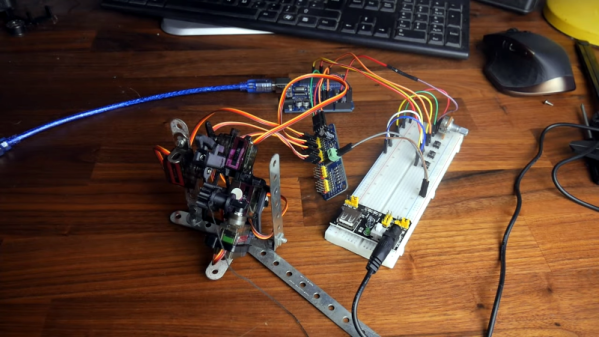
We’ll admit it is a bit of a gimmick, but [Adam Beedle’s] Spider-Bot did make us smile. The little robot can launch a “web” and use it to swing. It is hard to picture, but the video below will make it all clear. It can also use the cable to climb a wall, sort of.

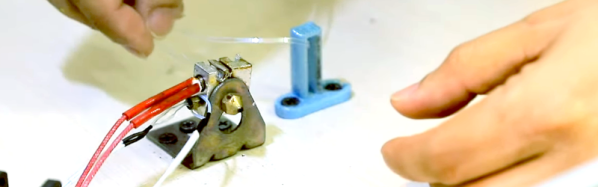
The bot’s ability to fling a 3D printed hook on a tether is remarkable. Details are scarce, but it looks like the mechanism is spring-loaded with a servo motor to release it. Even trailing a bit of string behind it, the range of the hook is impressive and can support the weight of the robot when it winches itself up. There’s even a release mechanism that reminds us more of Batman than Spiderman.

If we were going full autonomous, we’d consider a vision system. On the other hand, you could probably tell a lot by the tension on the cable and some way to measure the angle of it coming out of the robot. If you come up with a practical use for any of this, we’d love to see it.

We’ve seen robots that fly, jump, and can climb walls before. We don’t remember one that swings like Tarzan.

Continue reading “Grappling Hook Robot Swings Like Spiderman”
Welcome To Our New Robot… Nurses

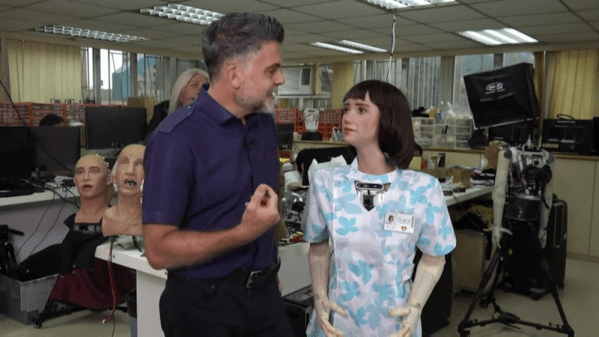
Hanson robotics wants to make robots, but not “Lost in Space” [Robby] robots. Think more [Data] from Star Trek robots. They’ve announced [Grace], a lifelike robot made to take on nursing duties for doctors and the elderly. In conjunction with Singularity Studio, the robot resembles the company’s [Sophia] robot which is made to be as realistic as possible given current technology and, apparently, has Saudi citizenship.

The robot has heat-sensitive cameras and other sensors so it can read data from patients directly. It uses the company’s Frubber for the face. The company says:

[Frubber is] a proprietary nanotech skin that mimics real human musculature and skin. This allows our robots to exhibit high-quality expressions and interactivity, simulating humanlike facial features and expressions.

Continue reading “Welcome To Our New Robot… Nurses”

Bar code shown in a 3D plain in Vaporwave Aesthetic

Tech In Plain Sight: Check Digits And Human Error

Computers in working order and with correct software don’t make mistakes. People, however, make plenty of mistakes (including writing bad software or breaking computers). In quality circles, there’s a Japanese term, poka yoke, which roughly means ‘error avoidance’. The idea is to avoid errors by making them too obvious for them to occur. For example, consider a SIM card in your phone. The little diagonal corner means it only goes in one way. If you put it in the wrong way, it is obviously wrong.

To be successful at poka yoke, you have to be able to imagine what a user might do wrong and then come up with some way to make it obvious that it is wrong. There are examples of this all around us and we sometimes don’t even know it. For example, what do your credit card number, your car’s VIN code, and a UPC code on a can of beans have in common?

Continue reading “Tech In Plain Sight: Check Digits And Human Error”

Deceptively Simple Process Turns Bottles Into Filament

If you know that most soda bottles are made from PET plastic, you’ve probably thought about how you could make filament from them and have an endless supply of cheap printing material. [Mr3DPrint] says he has a method and shares a few videos that make it look easy. We wonder if the quality of the filament is up to par with commercial products, but assuming the videos are accurate, it appears that the resulting filament gets the job done.

The details are a little sketchy, but it looks simple enough. THe first step is to get any indentations out of the bottle. He has several demonstrations of this some using pressurized air in the bottle and some without. In each case, though, a drill holds the bottle through the cap and spins it over a flame until the surface is smooth.

Continue reading “Deceptively Simple Process Turns Bottles Into Filament”

Eavesdropping By LED

If you ever get the feeling someone is watching you, maybe they are listening, too. At least they might be listening to what’s coming over your computer speakers thanks to a new attack called “glow worm.” In this novel attack, careful observations of a power LED on a speaker allowed an attacker to reproduce the sound playing thanks to virtually imperceptible fluctuations in the LED brightness, most likely due to the speaker’s power line sagging and recovering.

You might think that if you could see the LED, you could just hear the output of the speaker, but a telescope through a window 100 feet away appears to be sufficient. You can imagine that from a distance across a noisy office you might be able to pull the same trick. We don’t know — but we suspect — even if headphones were plugged into the speakers, the LED would still modulate the audio. Any device supplying power to the speakers is a potential source of a leak.

Continue reading “Eavesdropping By LED”

Automatic Nut Sorter For A Tidy Workspace

We all have that one drawer or box full of random hardware. You don’t want to get rid of anything because as soon as you do, that’s the one thing you’ll need. But, honestly, you’ll be lucky to find what you need in there, anyway. EnterĀ  [Mr. Innovative’s] nut sorting machine. As you can see in the video below, it will make order out of the chaos, at least for nuts.

You might think the device would need optical recognition software or some other high-tech mechanism. But, in fact, it is nothing more than a motor with a speed controller. The sorting is done by a plastic piece built like stairs. When a nut is too tall to fit under the next step, it slides out into the output hopper. You could probably turn the whole thing with a crank and no electricity at all if you wanted to.

Drilling out the shaft required a bit of machine tool usage, so this might not be a great weekend project without a lathe. Like many of the commenters on the video mentioned, we probably wouldn’t have used a rod holder as a rotating bearing, either, but for as little as something like this would probably operate, it is likely to last a fair amount of time. It would be easy to replace it or even affix a shaft to the motor with a coupler, sidestepping several issues.

Apparently, the device isn’t perfect. You do get some missorts. We imagine that’s from a larger nut pushing a smaller nut on the way to the hopper. The Thingiverse files seem to be missing, but this is something you’d probably adapt to your own design, anyway.

It isn’t as automated, but we’ve seen a gadget that can help sort drill bits, too. Sometimes you want to sort little parts by color, too.

Continue reading “Automatic Nut Sorter For A Tidy Workspace”

Sad clown holding melted ice cream cone

Freezing Out Ice Cream Machine Competition

We always knew that McDonald’s soft serve (you can’t really call it ice cream) machines are known to be finicky. There’s even a website that tracks where the machines are broken and, apparently, it is usually about 10% or more of them at any given time. But when we saw a news article about a judge issuing a restraining order, we knew there must be more to the story. Turns out, these $18,000 soft serve machines are in the heart of something we are very interested in: when do you own your own technology?

Cold Tech

There are apparently 13,000 or so of these machines and they are supposedly high-tech marvels, able to produce soft serve and milkshakes at the same time. However, they are also high maintenance. Cleaning the machine every two weeks (try not to think about that) involves a complete teardown. Worse, if anything breaks, you need a factory-authorized service person.

Continue reading “Freezing Out Ice Cream Machine Competition”