Tiny Transmitters Track Monarch Butterflies

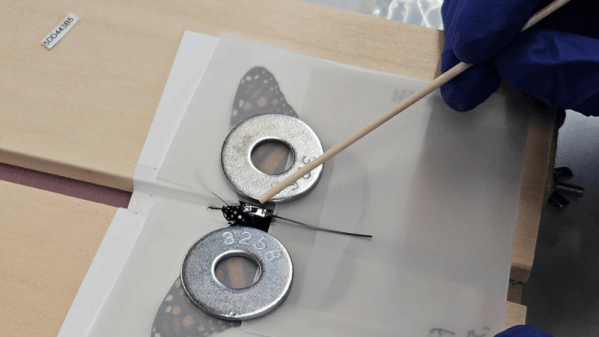
Miniaturization is one thing, but how would you like to design a transmitter that attaches to a butterfly? That’s what the BlūMorpho transmitter is made to do, according to [Tom Jokinen] writing for Be Giant. Apparently, most of these butterflies have a two- to six-week life, but periodically a “super generation” spawns and lives up to nine months. This is enough time to migrate from Canada and the United States to Mexico. In Mexico, they spend the winter, and then return when the weather is more hospitable. Scientists wanted to study this migration pattern, and the tiny transmitter is exactly what they needed.

You can even download an app to track the butterflies yourself. The transmitter looks like a tadpole and weighs 60 milligrams. There’s no battery, but there is a tiny solar cell. The transmitter emits a Bluetooth signal that your phone’s location services can relay.

To affix the transmitter, researchers put a glassine envelope over the butterfly, weigh its wings down with something slightly heavy, and then apply eyelash glue to the transmitter. You can see the process in the video below.

What else could you do with a virtually weightless Bluetooth tracker? It is possible that dedicated tracking stations could have a longer range.

Continue reading “Tiny Transmitters Track Monarch Butterflies” →
CHIP 8: The Pong Game’s Afoot!

Writing a computer game has always been hard. It is only the nature of the difficulty that changes. A modern game is as much about graphics, sound, and storytelling as it is about programming. But in the early days of computers, writing a game was a challenge because of limited graphics, slow CPUs, and tiny memory capacity. If you wanted to write a game for an early microcomputer, you generally wrote it in assembly language. BASIC was available on many machines, but it was usually too slow for anything requiring fast animation. Assembly language was fast, but it was also difficult to write, debug, and port to another machine.

RCA — in particular [Joseph Weisbecker], the architect of the 1802 — introduced the COSMAC VIP into the primordial 1977 home video game market. In addition to using ready-made games, the idea was that you could create your own. But writing games in 1802 assembly language would be beyond most of RCA’s customers. [Weisbecker] devised CHIP-8, a tiny virtual machine. It wasn’t quite a programming language. Instead, it was a simple instruction set implemented by an interpreter running on a real computer. You wrote programs for the imaginary CHIP-8 processor, and the interpreter made them run on the actual hardware. CHIP-8 is perfect for the kind of games you’d see in those days and still has a following among those who love retro games. Continue reading “CHIP 8: The Pong Game’s Afoot!” →

Radon Active

When you think about nuclear radiation, you often think about power plants, but it turns out there’s radioactive stuff all over the place: smoke detectors, granite counters, bananas, and potatoes can all be mildly radioactive. Even some old tape dispensers. But those are all puny sources.

Radon is a colorless, odorless gas that is heavier than air. It is a byproduct of uranium decay, amonth other pathways, decays by emitting an alpha particle, and has a half-life of just about four days. As a gas, it escapes from rocks or soil. Usually, there isn’t much of it, so it vents harmlessly to the atmosphere. But it can easily get trapped in a house and accumulate. You might think your house is solid, but there are plenty of cracks, joints, and pipes where gas can weasel through, especially if your inside pressure is slightly lower than the pressure in the soil below, which is common.

As the radon decays, it can produce more radioactive material, including tiny amounts of polonium. With or without dust particles, these tiny bits of radioactive material can go airborne and end up in your lungs. There, they can further decay, and alpha particles damage cells and DNA. According to the EPA, radon exposure is the second leading cause of lung cancer in the United States, next to smoking.

Not So Speedy

If you get enough carbon monoxide in your home, you probably won’t see the next sunrise. But radon works very slowly. It is odorless and colorless. You won’t show any general symptoms to warn you that you might get lung cancer.

The effect can take years or decades. Of course, you can also have a house that has very little radon. However, nearly all homes have some radon. The EPA estimates that about 7% of homes have elevated radon levels.

Some areas are more prone to radon than others, but even if your area has low risk, there’s no guarantee that your house is safe. If you are lucky enough to not have a radon problem, you have nothing to worry about. But how do you know? Like anything, you need to test.

Continue reading “Radon Active” →

Lillith Tells Your Future

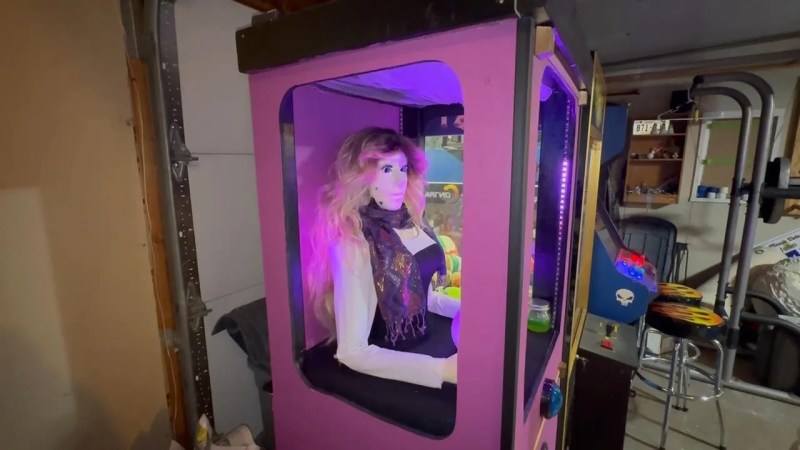
Maybe you are old enough to remember Zoltar in an arcade, or perhaps you’re just a fan of the movie Big. Either way, maybe you’d like to build an animated fortune teller. [Oh Well Why Not] did just that and gives you a roadmap for you to make your own. It took four months to build, but with the road already mapped, you can probably do it in less. Then again, who can predict the future?

The fortune teller, Lillith, uses servos and some voice generation to provide the same experience. If you dare to hit the button, you’ll get a glimpse into your future that’s at least as good as a fortune cookie from your local takeaway place.

Lillith doesn’t hide behind windows since it isn’t in a public venue, but if you were going to put it out in the wild, you’d probably want to encase it a little better. While waiting, the servos provide some small animations to attract the next user.

If you remember Bullwinkle more fondly than Zoltan, you might prefer this project.

Continue reading “Lillith Tells Your Future” →

A 1982 Modem For $100

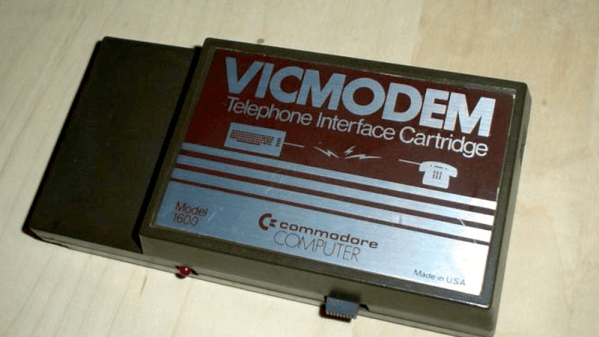
[Dave Farquhar] takes a walk down memory lane about the Commodore 1600 VICModem, perhaps the first phone modem to sell for less than $100. Commodore, of course, was famous for making cheaper computers like the VIC20, the Commodore 64, and lower-cost peripherals like disk drives. But how did they hit the $100 price point with the modem when competing 300 baud modems sold for at least twice that, and a 1200 baud unit would set you back at least $600?

First, Commodore didn’t handle the design themselves. Instead, they outsourced to Anchor Automation, a well-known modem manufacturer. It used a Motorola MC14412 modem on a chip, along with six other chips. The chip could, in theory, do 600 baud, but the modem was rated for 300. But it did make some interesting design choices.

Continue reading “A 1982 Modem For $100” →

A Modern Smalltalk

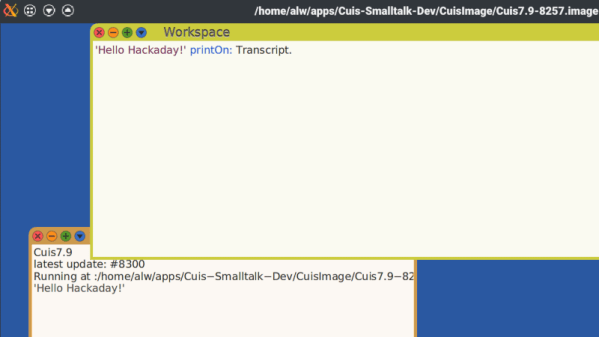
In the history of object-oriented (OO) computer languages, Smalltalk has a special place. It wasn’t the first OO language, and it hasn’t spread as well as some others. But it was the first OO language many people encountered, and it influenced many other languages you’ve probably seen. Developed at the famed Xerox PARC, it also introduced many people to the “model/view/controller” (MVC) architecture. Cuis Smalltalk is a free and portable modern Smalltalk-80 environment. It replaces the traditional MVC framework with Morphic, but otherwise, it would be very familiar to someone who used Smalltalk in the 1990s. The project’s goal is to stay simple at the core, although you can add complexity via packages.

The software has been around for a while, but it is on a rolling release model, so the install page suggests you clone the Git repo. You can, however, get a stable release, which might be important if you were deploying applications. Running the program results in a Cuis desktop where you can open various things like workspaces, help documents, and the transcript.

Smalltalk throws some people because it takes OO to an extreme. For example, you don’t add two and three using an operator. You send the object two a message that includes another object, three. You can think of sending a message as calling a method on an object. As with virtual functions in C++, different objects can respond differently to the same request. For example, an Animal class might have a speak message that causes a cow to print “moo” and a chicken to print “cluck.”

You get used to it, and there’s a very nice class browser that lets you examine classes and what you can do with them. There are even packages to work with an Arduino over a serial port. They haven’t been updated lately, so they might (or might not) need a little work.

We’ve looked at GNU Smalltalk before. We’ve also seen a version that runs directly on a Raspberry Pi.

Continue reading “A Modern Smalltalk” →

Robot Picks Up Othello

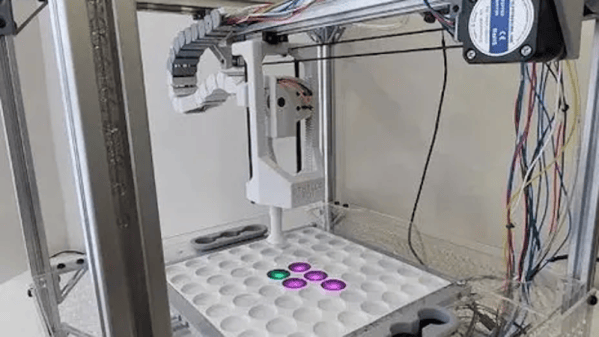
Experience is a great teacher. Ask [Jeneus], who, in high school, tried to make a program that played Othello. It didn’t go well. But years later, the idea produced an impressive Othello robot. At first glance, the robot looks a bit like a 3D printer with an aluminum extrusion XYZ motion system. But there’s a lot more to it, not to mention the software to play the game. Check it out in the video below.

The Z-axis has a vacuum system that can pick up clear tokens and place them on the board. If you know the game, you might remember that on a real board, players have to flip the tokens as they “capture” pieces. The robot has a smarter way to go. The tokens are clear because they are lit with one of two colors. So flipping the token is a simple LED color change. The LEDs also flash a different color to show you where you can move.

The device uses laser-cut components and 3D printed parts in PLA and TPU. Of course, there is a camera for the computer — a Raspberry Pi — to see the board. Overall, a very nicely done project. We’ve seen several checker and chess robots. We wonder if some of them could also play Othello?

Continue reading “Robot Picks Up Othello” →