Engineering The Less Boring Way

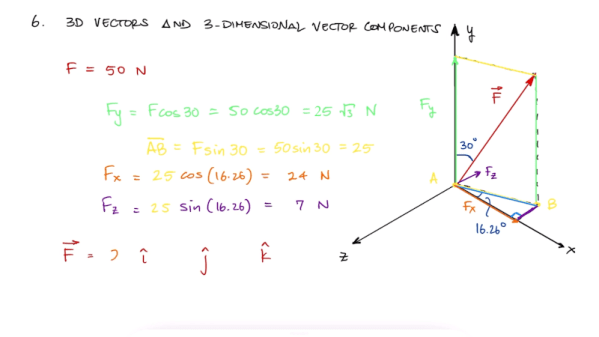
We have to admire a YouTube channel with the name [Less Boring Lectures]. After all, he isn’t promising they won’t be boring, just less boring. Actually though, we found quite a few of the videos pretty interesting and not boring at all. The channel features videos about mechanical engineering and related subjects like statics and math. While your typical electronics project doesn’t always need that kind of knowledge, some of them do and the mental exercise is good for you regardless. A case in point: spend seven minutes and learn about 2D and 3D vectors in two short videos (see below). Or spend 11 minutes and do the whole vector video in one gulp.

These reminded us of Kahn Academy videos, although the topics are pretty hardcore. For example, if you want to know about axial loading, shear strain, or free body diagrams, this is a good place to look.

Continue reading “Engineering The Less Boring Way”

Linux Fu: Shell Script File Embedding

You need to package up a bunch of files, send them somewhere, and do something with them at the destination. It isn’t an uncommon scenario. The obvious answer is to create an archive — a zip or tar file, maybe — and include a shell script that you have to tell the user to run after unpacking.

That may be obvious, but it assumes a lot on the part of the remote user. They need to know how to unpack the file and they also need to know to run your magic script of commands after the unpack. However, you can easily create a shell script that contains a file — even an archive of many files — and then retrieve the file and act on it at run time. This is much simpler from the remote user’s point of view. You get one file, you execute it, and you are done.

In theory, this isn’t that hard to do, but there are a lot of details. Shell scripts are not compiled — at least, not typically — so the shell only reads what it needs to do the work. That means if your script is careful to exit, you can add as much “garbage” to the end of it as you like. The shell will never look at it, so it’s possible to store the payload there.

Continue reading “Linux Fu: Shell Script File Embedding”

Hacking The Classroom

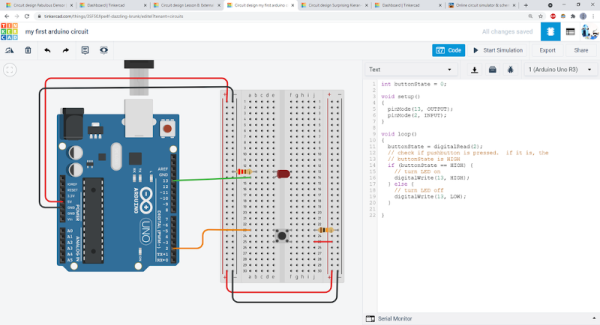
With so many students attending class virtually these days, how can you give kids — or adults — some hands on experience with electronics projects? [Ben Finio] says you can by moving your lab to the virtual world using — of all things — Tinkercad. [Ben] should know something about a classroom since he is a lecturer at Cornell.

Of course, you could do this trick with any online simulator, but Tinkercad is nice because it is easy to use, looks real, and doesn’t cost the students a dime. [Ben] mentions there are some scenarios where it is especially useful like large classes or online classes. There are probably some cases where it doesn’t make sense, like teaching RF design, for example. Even then, maybe you just need a different tool.

Continue reading “Hacking The Classroom”

CNC Chainsaw

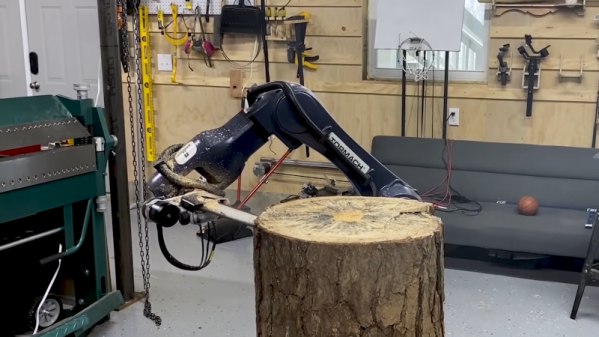
You can spend a lot of time trying to think of a clever title for a post about a CNC chainsaw. But you’ll finally realize, what else can you say but “CNC Chainsaw?” [Stuff Made Here] actually built such a beast, and you can watch it go in the video embedded below. A custom chainsaw on a Tormach robotic arm. So it is more like a robot using a chainsaw than a conventional CNC machine.

Instead of an XY motion, the machine uses what the video calls an “apple peeler” method and uses the Minkowski algorithm to adjust for the size of the chainsaw. The video is an odd juxtaposition of advanced topics like the Minkowski and basic things like G code.

Continue reading “CNC Chainsaw”

Electric Vehicle 1900’s Style: New Leases On Old Tech

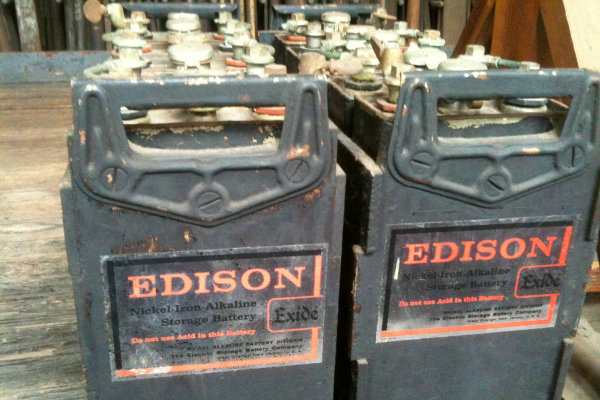
Excited about your new electric vehicle? Thomas Edison would be, too. He tried to produce electric vehicles for Ford around 1900. Petroleum-based vehicles dashed his dreams of the electric car, and the battery he wanted to use languished as a technological dead end. The batteries were long-lasting, sure, but they were expensive and had other problems, not the least of which was producing hydrogen gas. But that battery technology is receiving renewed interest today, because some of the things that made it a bad car battery make it good for alternate energy projects.

You wouldn’t think a century-old battery technology that was never very popular would make a comeback. But then again, who thought we’d see the return of bell-bottom pants or vinyl records? Continue reading “Electric Vehicle 1900’s Style: New Leases On Old Tech”

Hydraulics Made Simple

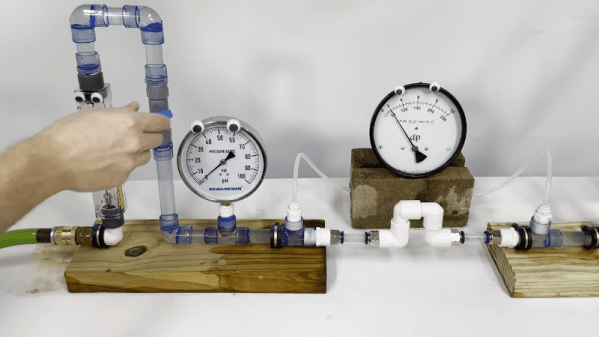
Corralling electrons is great and what most of us are pretty good at, but the best projects have some kind of interface to the real world. Often, that involves some sort of fluid such as water or air moving through pipes. If you don’t grasp hydraulics intuitively, [Practical Engineering] has a video you’ll enjoy. It explains how flow and pressure work in pipes.

Granted, not every project deals with piping, but plumbing, sprinkler systems, cooling systems, and even robotics often have elements of hydraulics. In addition, as the video points out, fluid flow in a pipe is very similar to electrical current flowing through wires.

Continue reading “Hydraulics Made Simple”

3D Printer As Robot: The Functograph

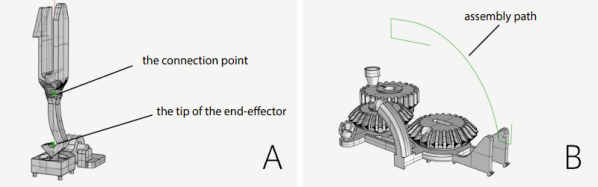
A 3D printer is really a specialized form of robot. Sure, it isn’t exactly Data from Star Trek, but it isn’t too far from many industrial robots. Researchers from Meiji University made the same observation and decided to create a 3D printer that could swap a hot end for other types of robotic manipulators. They call their creation the Functgraph. (Video, embedded below.)

Some of the tasks the Functgraph can do including joining printed parts into an assembly, breaking support material, and more. The surprise twist is that — unlike traditional tool change schemes — the printer prints its own end effectors together with the print job and picks them up off the build plate.

Continue reading “3D Printer As Robot: The Functograph”