Truck Bed Liners Improve 3D Prints

There are at least two kinds of 3D printer operators: those who work hard to make their prints look better after they come off the bed and those who settle for whatever comes off the printer. If you are in the latter camp, you probably envy people who have smooth prints with no visible layer lines. But the sanding and priming and multiple coats of paint can put you off.

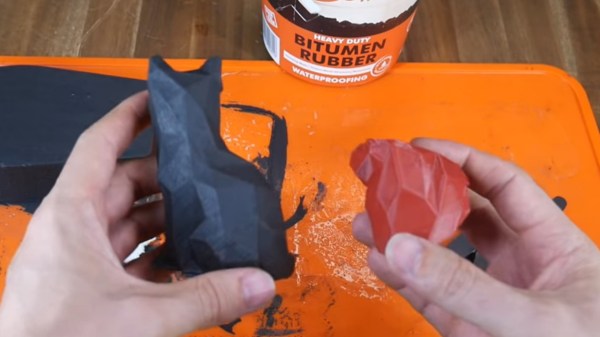
[Teaching Tech] has a few tricks that might change your mind. He shares his technique for using different coatings for 3D prints that provide good quality with a lot less effort. The coatings in question are polyurethane used for coating pickup truck beds and bitumen rubber used for waterproofing. In the United States, bitumen is known as asphalt, and both materials are relatively cheap, available, and safe to use.

According to the video you can see below, there’s no need to sand or prime the print. In addition to covering imperfections and sealing gaps, it produces watertight prints that have UV resistance and some measure of protection against heating.

Continue reading “Truck Bed Liners Improve 3D Prints”

Everything Old Is New Again: Another 6502 Board Is Born

[Jeff] says that designing your own 6502 computer is a rite of passage, and he wanted the experience. His board can accept a real 6502 or the newer CMOS variant that is still available. There are a few modern conveniences such as USB power and provisions for using a USB serial port.

We are spoiled today with microcontrollers having everything in one package, but with this class of CPU you need your own memory, I/O devices, and other support chips. [Jeff] took a traditional approach, but picked components that are still easy to obtain. Some designs now push all the support functions to a more modern processor like an Arduino, which is very simple to do, but doesn’t feel as authentic, somehow.

Continue reading “Everything Old Is New Again: Another 6502 Board Is Born”

MIT Prints Robots With Lasers

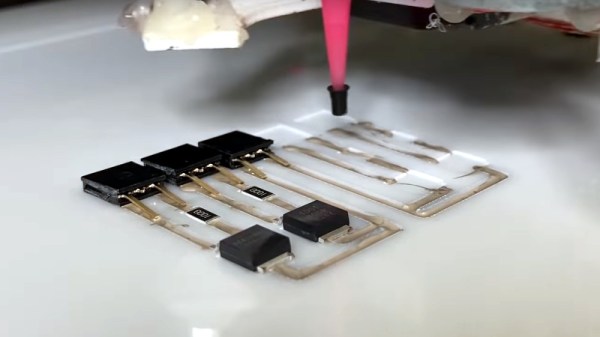
MIT’s Computer Science and Artificial Intelligence Lab (CSAIL) wants to convert laser cutters into something more. By attaching a head to a commercial laser cutter and adding software, they combine the functions of a cutter, a conductive printer, and a pick and place system. The idea is to enable construction of entire devices such as robots and drones.

The concept, called LaserFactory, sounds like a Star Trek-style replicator, but it doesn’t create things like circuit elements and motors. It simply picks them up, places them, and connects them using silver conductive ink. You can get a good idea of how it works by watching the video below.

Continue reading “MIT Prints Robots With Lasers”

Your Own 11.2 GHz Radio Telescope

Modern life has its conveniences. Often, those conveniences lead to easier hacks. A great example of that is the rise of satellite television and the impact it has had on amateur radio telescopes. There was a time when building a dish and a suitable low noise amplifier was a big deal. Now they are commodity parts you can get anywhere.

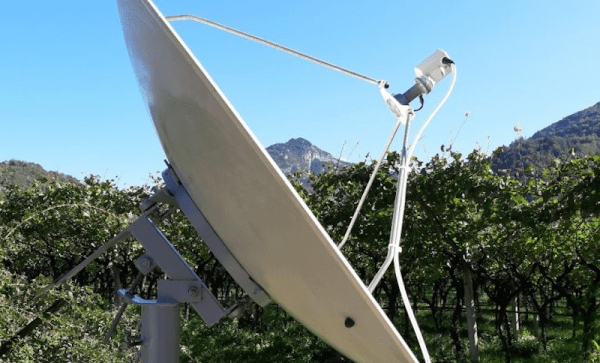
The antenna in use is a 1.2-meter prime focus dish. Some TV dishes use an offset feed, but that makes it harder to aim for use in a radio telescope. In addition to off-the-shelf antenna and RF components, an AirSpy software-defined radio picks up the frequency-shifted output from the antenna. There is more about the software side of the build in a follow-up post. We liked that this was a pretty meaty example of using GNU Radio.

Continue reading “Your Own 11.2 GHz Radio Telescope”

Nanotube Yarn Makes Strong Bionic Muscles

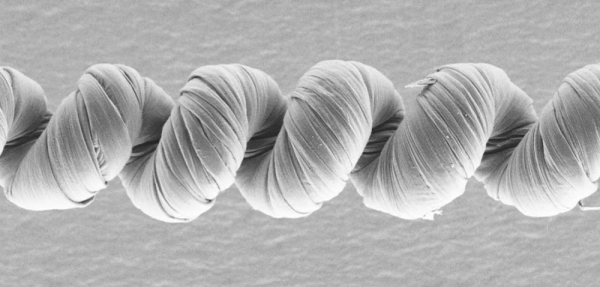
What’s just a bit thicker than a human hair and has ten times the capability of a human muscle? Polymer-coated carbon nanotube yarn. Researchers at the University of Texas at Dallas created this yarn using carbon nanotubes coated with a polymer and coiled with a diameter of about 140 microns.

Passing a voltage through the fiber causes the muscle yarn to expand or contract. Previous similar fibers have to do both actions. That is, they expand and then contract in a bipolar movement. The polymer coating allows for unipolar fibers, critical to using the fibers as artificial muscles.

Continue reading “Nanotube Yarn Makes Strong Bionic Muscles”

PC Overclocking With An Air Conditioner

We never insist that a hack be practical. [Tech Ingredients] is living proof as they modded a computer case to use a window air conditioner for overclocking a computer. They think they haven’t hit the ceiling yet, and got their AMD Ryzen 8-core processor up to 4.58 GHz.

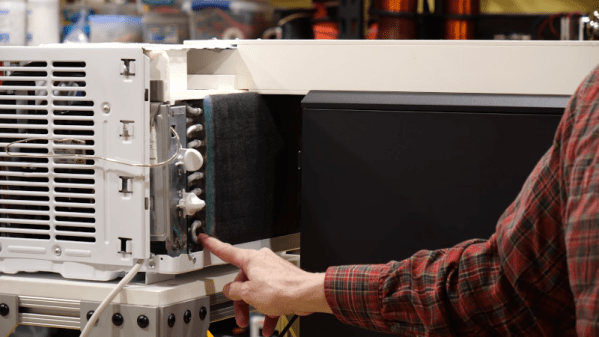
An advantage of forcing air from an air conditioner is that the air forced into the system is quite dry and clean. The trick is to create a simple duct to attach to a 5,000 BTU air conditioner. It doesn’t actually interface with the CPU cooling block, instead it just forces cool air into the case and this tends to cool everything inside. Admittedly, it isn’t any worse than plunging your computer in liquid nitrogen, and we’ll admit that air conditioning units are made to keep large areas cold and work at high duty cycles. With the air conditioning running, they disconnected at least some of the stock fans. The temperatures stayed cool even at high speeds.

Continue reading “PC Overclocking With An Air Conditioner”

Linux Fu: Serial Untethered

Serial ports used to be everywhere. In a way, they still are since many things that appear to plug in as a USB device actually look like a serial port. The problem is that today, the world runs on the network. Sure, you can buy a terminal server that converts a serial port to an Ethernet port, but what fun is that? In this article, I’m going to show you how to stream serial ports over the network using some available Linux tools. It isn’t perfect, and it won’t work for every case, but when it works it works well.

Everything is a File, Until it Isn’t

At some point in the past, Unix — the progenitor of Linux — treated virtually everything as a file, and all files were created more or less equal. Programs didn’t care if a file was local, on the network, from a tape drive, or arriving over a named pipe.

But things started to change. Even though a serial port is just a file under Linux, it has some special attributes that let you set, for example, baud rates. Worse, some programs “know” too much about files and insist on certain naming conventions. So, in theory, you should be able to create a network socket, connect one end to a serial port and the other end to a program, and be done with it. In theory.

Continue reading “Linux Fu: Serial Untethered”