SOUL Wants To Process Your Audio

Abstraction is the core of nearly all progress in computing. Unless you are fabricating your own semiconductors and drawing wire, we all create with building blocks ranging from components like CPUs, to operating system functions, to specialized libraries. Just as you wouldn’t want to spend your time deblocking disk records or rendering fonts for output devices, you probably shouldn’t have to think too much about audio data. While there are some powerful audio processing libraries out there, a new embeddable language called SOUL (SOUnd Language) is now in version 1.0 and wants to help you create efficient code for processing audio.

The goal of SOUL is to target a runtime that can run on CPUs, but is better on DSPs. The code aims to be secure and real time with no pointers, garbage collection, and other things that typically interfere with audio processing or security.

Continue reading “SOUL Wants To Process Your Audio”

3D Printing An Ion Propulsion System

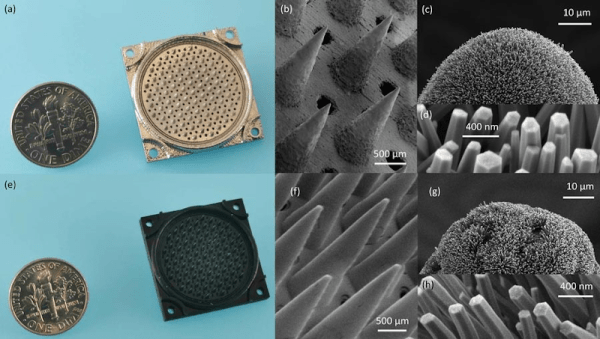
As much as we love Star Trek, we have to admit there are some continuity problems. For example, in Spock’s Brain, the alien-of-the-week’s ion drive gave Scotty engineering envy. However, in The Menagerie, the computer identifies a Starfleet shuttlecraft as having ion propulsion. Either way, ion propulsion is real and NASA has toyed with it for ages and many satellites use it for maintaining orbit. Now researchers from MIT and the Monterrey Institute of Technology and Higher Studies 3D printed tiny ion engines.

The engine is about the size of a dime and, like all ion engines, produces tiny amounts of thrust. In fact, the researchers liken it to half the weight of one sesame seed from a hamburger bun. However, in space, these tiny thrusts add up and over time can produce significant acceleration.

Continue reading “3D Printing An Ion Propulsion System”

Before Google, There Was The Reference Librarian

I know it is a common stereotype for an old guy to complain about how good the kids have it today. I, however, will take a little different approach: We have it so much better today when it comes to access to information than we did even a few decades ago. Imagine if I asked you the following questions:

  • Where can you have a custom Peltier device built?
  • What is the safest chemical to use when etching glass?
  • What does an LM1812 IC do?
  • Who sells AWG 12 wire with Teflon insulation?

You could probably answer all of these trivially with a quick query on your favorite search engine. But it hasn’t always been that way. In the old days, we had to make friends with three key people: the reference librarian, the vendor representative, and the old guy who seemed to know everything. In roughly that order. Continue reading “Before Google, There Was The Reference Librarian”

Arduino Learns The Martial Arts With Nunchucks Input Device

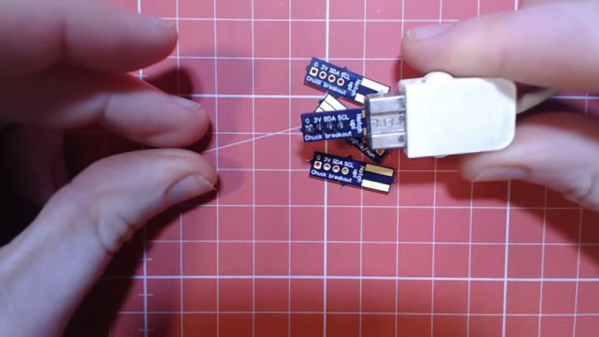
There is a boring part of every computer introduction class that shows how a computer is made up of input, output, and processing. Maybe it wouldn’t be so boring if the input device was a nunchuck. [Brian Lough] thinks so and he belligerently asserts that nunchucks are the best input device ever. With a simple connection to a Wii controller and an associated library, you get access to an analog joystick, two buttons, and an accelerometer.

The nunchuck is meant to plug into a Wii controller and the connection is I2C, so that’s trivial to interface to an Arduino or other small microcontroller. The only issue is making the connection. We might have just snipped the wires, but [Brian] prefers to use a small breakout board that plugs into the stock connector and provides solder points for your own cable. There are options for the breakout boards, and [Brian] has his own design that you can get from OSHPark for about a buck for three boards. You can also just jam wire into the connector, but that’s not always robust.

Continue reading “Arduino Learns The Martial Arts With Nunchucks Input Device”

Dreaming Of A Transparent (PCB) Christmas

[Carl] wanted to put his force sensors on a transparent PCB and had to ask his board vendor for a special sample. Flexible PCBs are available on transparent substrates made of PET, but they are not as common as polyimide boards. As [Carl] found out, these boards are a bit thicker, a bit less flexible, and don’t hold up to very high heat as well as the standard boards. Undeterred, he designed a 3D Christmas tree using the clear boards. The result that you can see in the video below looks pretty good and would have been hard to duplicate with conventional means.

When you build the board it is as a flat spiral, but lifting it in the center allows it to expand into a conical tree shape. The circuit itself is just an LED blinker, but the flexible board is the interesting part.

Continue reading “Dreaming Of A Transparent (PCB) Christmas”

How Does A Circuit Breaker Break?

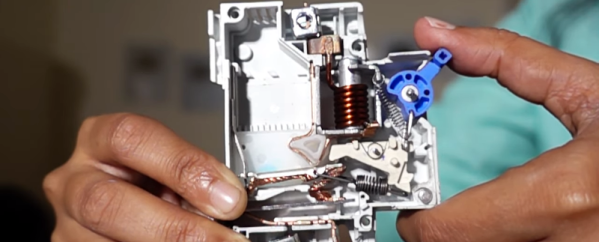
Even if you aren’t an electronics person, you probably have a working knowledge of circuit breakers. When the lights go out, you find the circuit breaker and flip it back to the on position. Most people understand, too, that the breaker will trip if you overload the circuit with too many things plugged in or with an accidental short circuit. But how does this common device actually work? Keep in mind, circuit breakers need to be super reliable and have been around long enough that you can imagine they are pretty low tech. [Learn Engineering] has a very clear video about what goes on inside a circuit breaker that’s worth the eight minutes to watch. You can see the video below.

The handle is a mechanical engineering marvel, using two springs and a special design so that even a tiny force will cause it to snap to the off position. That takes care of a human tripping it. However, you have two other cases where you want to turn it off: overload and short circuit.

Continue reading “How Does A Circuit Breaker Break?”

3D Printed Box Gets Bigger

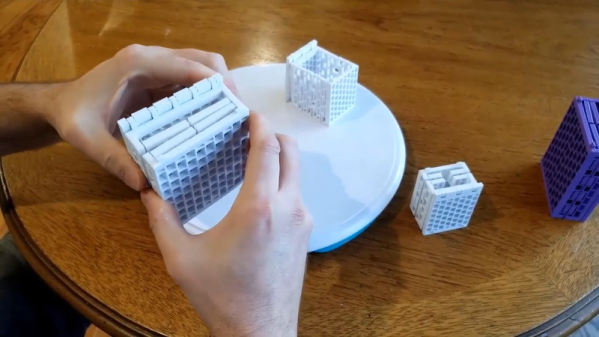
If you ever watched Dr. Who, you probably know that the TARDIS looked like a police call box on the outside, but was very large on the inside. When asked, the Doctor had some explanation of how something can look small when it is far away and large when it is close up, which never made much sense. However, [iQLess] has been 3D printing boxes in a small area, that fold out to be much larger boxes. (Video, embedded below.) The design comes from someone called [Cisco] who has a lot of interesting print in place designs.

You can find the design on the Prusa site or Thingiverse. The boxes do take a while to print, according to the video below. What was interesting to us, though, is that you should be able to print a design like this to create a box larger than your printer.

Continue reading “3D Printed Box Gets Bigger”