TV Output From Arduino — 1980s Style!

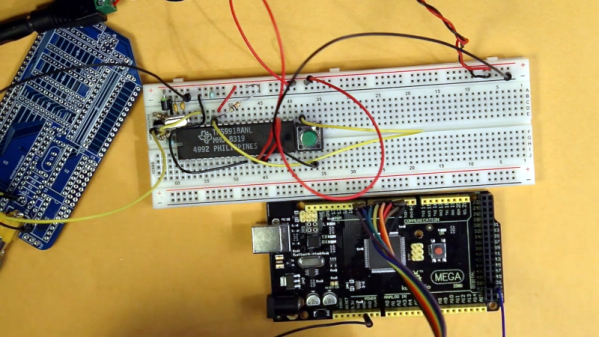
We’ll admit it, we’re all spoiled. A few bucks can now buy a computer that would have been the envy of everyone back in the late 1970s or early 1980s. So it’s no surprise that [krallja] was able to use an old-style video output chip to drive a TV with an Arduino. The TMS9918A is a venerable output device, and if the old computers could drive it then it makes sense that a modern computer could too. You can see a video of the whole experiment, below.

The Internet has also spoiled us, in that it’s dead simple to find datasheets for nearly anything, even these old chips. The only real problem with such aged silicon is that they typically expect a processor with a data and address bus, but most microcontrollers now keep all of that internal. But with enough fast I/O you can simulate a bus just fine. For now, the experiment just cycles through the color output.

Continue reading “TV Output From Arduino — 1980s Style!”

Linux Fu: Literate Regular Expressions

Regular expressions — the things you feed to programs like grep — are a bit like riding a bike. It seems impossible until you learn to do it, and then it’s easy. Part of their bad reputation is because they use a very concise and abbreviated syntax that alarms people. To help people who don’t use regular expressions every day, I created a tool that lets you write them in something a little closer to plain English. Actually, I’ve written several versions of this over the years, but this incarnation that targets grep is the latest. Unlike some previous versions, this time I did it all using Bash.

Those who don’t know regular expressions might freak out when they see something like:

[0-9]{5}(-[0-9]{4})?

How long does it take to figure out what that does? What if you could write that in a more literate way? For example:

digit repeat 5 \

start_group \

   - digit repeat 4 \

end_group optional

Not as fast to type, sure. But you can probably deduce what it does: it reads US Zipcodes.

I’ve found that some of the most popular tools I’ve created over the years are ones that I don’t need myself. I’m sure you’ve had that experience, too. You know how to operate a computer, but you create a menu system for people who don’t and they love it. That’s how it is with this tool. You might not need it, but there’s a good chance you know someone who does. Along the way, the code uses some interesting features of Bash, so even if you don’t want to be verbose with your regular expressions, you might pick up a trick or two.

Continue reading “Linux Fu: Literate Regular Expressions”

ISS Ham Radio Repeater

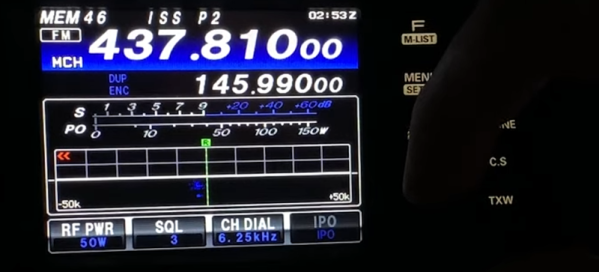
There is a long history of spacecraft carrying ham radio gear, as the Space Shuttle, Mir, and the ISS have all had hams aboard with gear capable of talking to the Earth. However, this month, the ISS started operating an FM repeater that isn’t too dissimilar from a terrestrial repeater. You can see [TechMinds] video on the repeater, below.

The repeater has a 2 meter uplink and a 70 centimeter downlink. While you can use a garden variety dual-band ham transceiver to use the repeater, you’ll probably need a special antenna along with special operating techniques.

Continue reading “ISS Ham Radio Repeater”

New Zealand To Test Wireless Power Transmission

Nikola Tesla wanted to beam power without wires. NASA talked about building power-generating satellites that would do the same thing. But now New Zealand’s second-largest power utility — Powerco — is working with a start-up company to beam energy to remote locations. There have been several news releases, but possibly the most technical detail is from an interview [Loz Blain] did with the founder of the startup company.

It isn’t really news that you can send radio waves somewhere and convert the signal back into power. Every antenna does that routinely. The question is how efficient is the power transmission and — when the power levels are high — how safe is it? According to [Greg Kushnir], the founder of Emrod, the technology is about 70% efficient and uses ISM frequencies.

Continue reading “New Zealand To Test Wireless Power Transmission”

Upgraded Infotainment Options On A 14 Year Old Mercedes

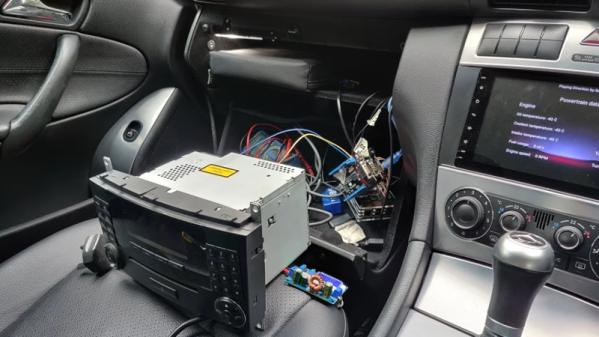
It used to be that upgrading a car stereo was fairly simple. There were only a few mechanical sizes and you could find kits to connect power, antennas, and speakers. Now, though, the car stereo has interfaces to steering wheel controls, speed sensors, rear-view cameras, and more. [RND_ASH] was tired of his 14-year-old system so he took an Android head unit, a tablet, and an Arduino, and made everything work as it was supposed to.

The key is to interface with the vehicle’s CAN bus which is a sort of local area network for the vehicle. Instead of having lots of wires running everywhere, today’s cars are more likely to have less wiring all shared with many devices.

Continue reading “Upgraded Infotainment Options On A 14 Year Old Mercedes”

Paper Keyboard Is Self-Powered

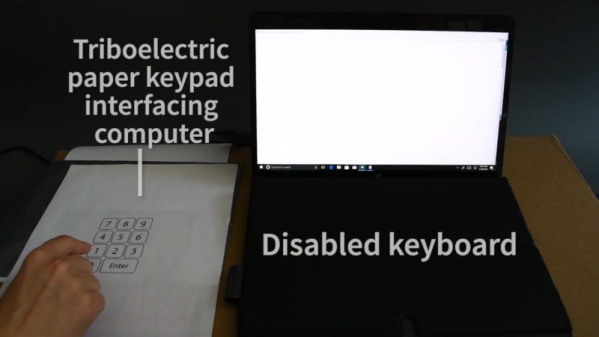
Building a keyboard isn’t a big project these days. Controller chips and boards are readily available, switches are easy to find, and a 3D printer can do a lot of what used to be the hard parts. But engineers at Purdue have printed a self-powered Bluetooth keyboard on an ordinary sheet of paper. You can see videos of the keyboards at work below.

The keyboards work by coating paper with a highly fluorinated coating that repels water, oil, and dust. Special inks print triboelectric circuits so that pressing your finger on a particular part of the paper generates electricity. We were skeptical that the Bluetooth part is self-powered, although maybe it is possible if you have some very low-power electronics or you manage the power generated very carefully.

Continue reading “Paper Keyboard Is Self-Powered”

Tutorial For Setting Up Raspberry Pi For Ham Radio Use

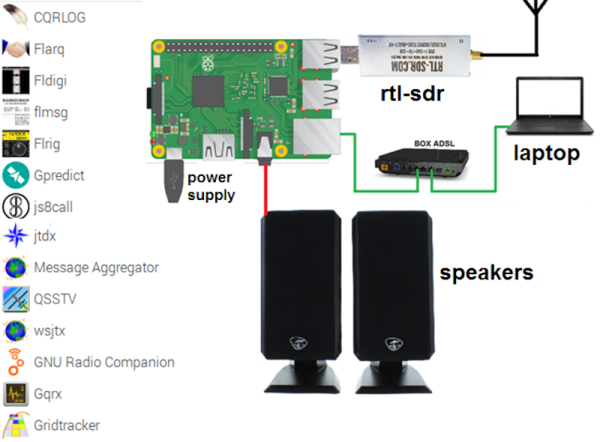
There was a time when a ham radio set up sported many dials and switches and probably quite a few boxes as well. Computers have changed all that. Some transceivers now have just a few buttons or are even totally computer-controlled. Where a ham, at one time, might have a TeleType machine, a slow-scan TV monitor, and a fax printer for receiving satellite images, now that can all be on a single computer which can even be a Raspberry Pi. [F4GOH] has a post that takes you from the fundamentals to installing everything from an SDR to many common ham programs for digital modes, APRS, SSTV, and more. You can download the seven-part tutorial as separate PDF files, too.

Even if you aren’t a ham, you might find some of the software interesting. OpenWebRX lets you listen to your software defined radio on the road. You can use other software to pick up weather satellite data.

Continue reading “Tutorial For Setting Up Raspberry Pi For Ham Radio Use”