FPGA 6800 Uses Python Toolbox

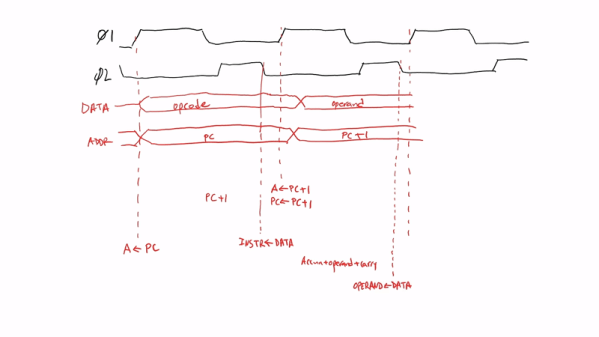
Usually, when you think of designing — or recreating — a CPU on an FPGA, you assume you’ll have to use Verilog or VHDL. There are other options, as well, but those are the biggest two players in FPGA configuration. [Robert Baruch] has a multipart series where he uses nMigen — a Python toolbox — to recreate a 6800 CPU like the one used in many vintage video games and pinball machines.

Unlike some tools that try to convert software written in some language to an FPGA configuration, nMigen uses Python as a scripting language to create code in FHDL. This is similar in concept to VHDL or Verilog, but gives up the event-driven paradigm, opting instead to allow designers to explicitly call out synchronous and combinatorial logic.

Continue reading “FPGA 6800 Uses Python Toolbox”

3D Printed Pulsejet Uses Tesla Valve

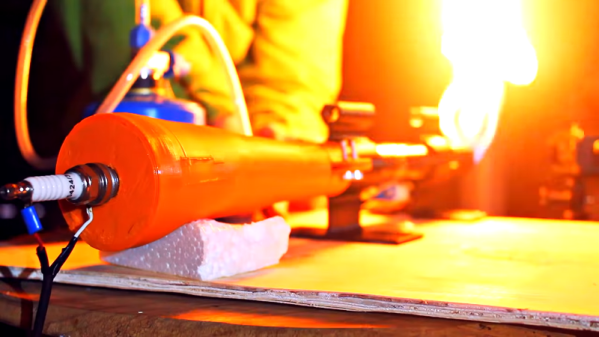
For most people, a jet is a jet. But there are several different kinds of jet engines, depending on how they operate. You frequently hear about ramjets, scramjets, and even turbojets. But there is another kind — a very old kind — called a pulsejet. [Integza] shows how he made one using 3D printed parts and also has a lot of entertaining background information. You can see the video below. (Beware, there is a very little bit of off-color language and humor in the video, so you might not want to watch this one at work.)

They are not ideal from a performance standpoint, but they are easy to make. How easy? A form of pulsejet was accidentally discovered by a young Swiss boy playing with alcohol in the early 1900s. Because of their simplicity, they’ve been built by lots of different people, including rocket pioneer Robert Goddard, who mounted one to a bicycle.

Continue reading “3D Printed Pulsejet Uses Tesla Valve”

3D Printing Paper — Sort Of

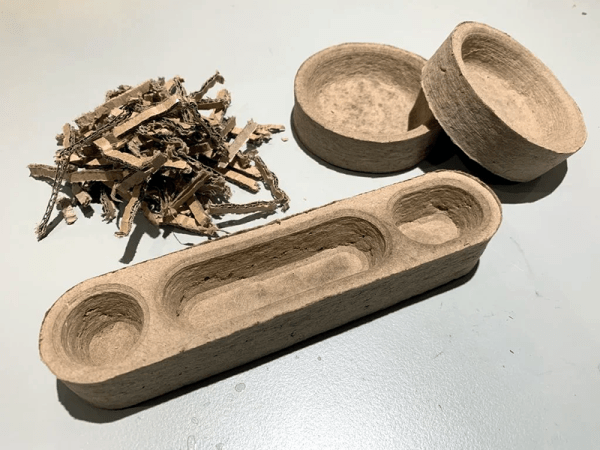
There are only a few truly ancient engineered materials, and among the oldest is paper. Traditionally, paper is flat and can be bent into shapes. However, paper can be molded into for example packing material or egg cartons. [XYZAidan]  has a process that can recycle paper into 3D cardboard-like objects. You need a 3D printer, but it doesn’t actually print the paper. Instead, you use the printer to create a mold that can form paper pulp you make out of recycled paper and a blender.

[Aidan] provides seven different molds ranging from a desk tray and a dish to simple cubes and coasters. The molds are made in three parts to assist in removing the finished product.

Continue reading “3D Printing Paper — Sort Of”

Ask Hackaday: Drone Swarms Replace Fireworks; Where Are The Hackers?

Your mom always warned you that those fireworks could put an eye out. However, the hottest new thing in fireworks displays is not pyrotechnic at all. Instead, a swarm of coordinated drones take to the sky with different lighting effects. This makes some pretty amazing shows possible, granting full control of direction, color, and luminosity of each light source in a mid-air display. It also has the side benefit of being safer — could this be the beginning of the end for fireworks accident videos blazing their way across social media platforms?

For an idea of what’s possible with drone swarm displays, check out the amazing pictures found on this site (machine translation) that show off the 3D effects quite well. Note that although it appears the camera is moving during many of these, the swam itself could be rotated relative to a stationary viewer for a similar effect.

What I couldn’t find was much going on here in the hobby space. Granted, in the United States, restrictive drone laws might hamper your ability to do things like this. But it seems that in a purely technical terms this wouldn’t be super hard to do — at least for simple designs. Besides, there must be some way to do this in US airspace since drone performances have been at the Super Bowl, Los Angeles, New York, Miami, and Folsom, CA.

So if the regulations were sorted, what would it take to build a swarm of your own performing drones?

Continue reading “Ask Hackaday: Drone Swarms Replace Fireworks; Where Are The Hackers?”

Finishing FDM Prints With SLS Resin

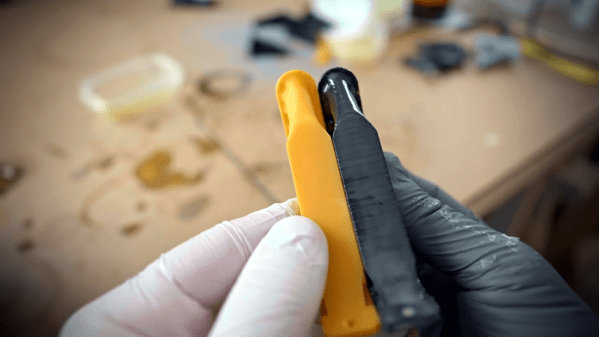
[Thomas Sanladerer] has a filament-based 3D printer and a resin one. Can the two types of raw material combine to make something better? [Thomas] did some experiments using some magnets to suspend the parts and a hot air soldering gun to heat things up.

The trick turns out to be cutting the resin with alcohol. Of course, you also need to use a UV light for curing.

The parts looked pretty good, although he did get different results depending on a few factors. To see how it would work on a practical part, he took a very large printed alien egg. The problem is, the egg won’t fit in the curing station. A few minutes with a heat sink, a drill press, and an LED module was all it took to build a handheld UV curing light.

The good news is you don’t need a resin printer to take advantage of the process — just the resin. He also points out that if you had parts which needed to maintain their dimensions because they mate with something else, you could easily mask the part to keep the resin away from those areas.

If this video (and the results it shows) has you interested, then you’ll love the in-depth account that [Donald Papp] wrote up last year about his own attempts to smooth 3D printed parts with UV resin.

Continue reading “Finishing FDM Prints With SLS Resin”

LuaRadio Gives Insight Into SDR

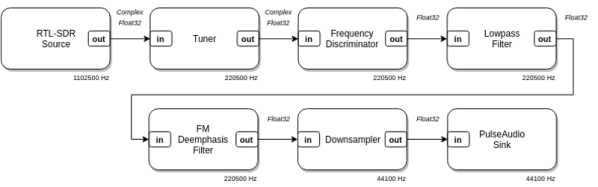
In theory, you shouldn’t need any help to develop a software-defined radio (SDR) application. But in real life you really don’t want to roll your own code every time to read the IQ samples, perform various transformations on them, and then drive audio output. At worst, you’ll use some libraries (perhaps GNU Radio) but usually, you’ll use some higher-level construct such as GNU Radio Companion (GRC). GRC is a bit heavyweight, though, so if you’ve found it daunting before, you might check out some of the material on the LuaRadio website.

We’ve looked at LuaRadio several years ago, but it has undergone a lot of changes since then and has some excellent documentation. Like Lua itself, LuaRadio emphasizes fast scripting. It supports quite a few pieces of common hardware and nearly anything that feeds data through a soundcard.

Continue reading “LuaRadio Gives Insight Into SDR”

Robot Insect Survives Swatting

There is an old saying, that ‘the hand is quicker than the eye;, but somewhat slower than the fly.” However, with a little practice you can swat a fly, although it sometimes doesn’t seem to faze the fly. École polytechnique fédérale de Lausanne (EPFL) has announced they have used nanotech to build a 1 gram possibly untethered, autonomous robotic insect that has enough processing power and sensors to recognize black and white patterns. Artificial muscles provide propulsion. But there’s the kicker: it can survive a strike with a fly swatter.

In the video you see below, the robots can move at 3 centimeters per second and there are two different versions. The first is a tethered system using ultra-thin wires. This is the version that can be folded, smacked, or even squashed by a shoe and continue moving.

Continue reading “Robot Insect Survives Swatting”