Linux Fu: WSL Tricks Blur The Windows/Linux Line

We have to admit, we have an odd fascination with WSL — the Windows subsystem for Linux. On the one hand, it gives us more options on Windows 10 for running the software we love. On the other hand, we wonder why we aren’t just running Linux. Sometimes it is because our cool laptop doesn’t work well on Linux. Other times we are using someone else’s computer that we aren’t allowed to reload or dual boot. Still, as long as we have to use Windows, we are glad to have WSL. A recent blog post by [Hanselman] shows some very cool tricks for using WSL that make it even better.

Exploring WSL

Did you know you can use WSL to run Linux commands in a Windows command shell? For example, you have a long directory and you want to run grep:

dir c:\archive\* | wsl grep -i hackaday

Of course, from bash you could access the same directory:

ls /mnt/c/archive | grep -i hackaday

Continue reading “Linux Fu: WSL Tricks Blur The Windows/Linux Line”
Is That Cheap Multimeter As Good As A Fluke? Let’s Find Out

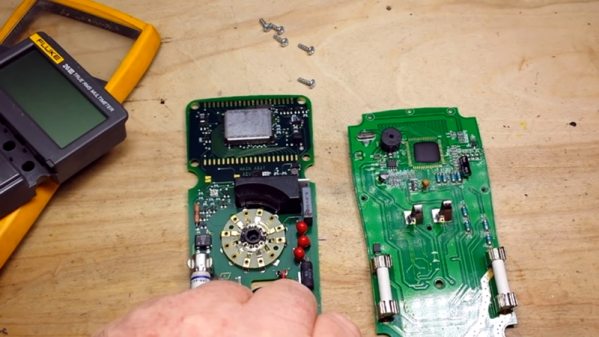
When [learnelectronics] talks about cheap meters, he always says, “If you are doing this for a living, get yourself a Fluke.” But he realized he’s never shown the inside of a Fluke meter, so he rectified that in his most recent post. For comparison, he opens up a Fluke 26-III and an Aneng AN870 (retailing at about $500 and $30, respectively).

The initial opening shows that the Fluke has hefty brand name fuses, but the Aneng has little generic fuses. In addition, the Fluke has an internal case that helps keep you away from live voltage. The Fluke also has a proper rotary switch, while the cheap meter has a switch that is etched on the PC board; a cost-cutting trick that’s often a point of failure on these cheap meters.

The Fluke also has a significantly larger number of protection devices and heftier components, you presume can take more punishment. Of course, if you don’t have a few hundred volts running through your meter, it probably doesn’t matter. The cheap meters are certainly good enough, even though you do get what you pay for, as you might expect.

As long as you have a meter open, you might as well hack it to have WiFi. Or, if you prefer, a serial port.

Continue reading “Is That Cheap Multimeter As Good As A Fluke? Let’s Find Out”

Diving With An Unlimited Air Supply

If you want to explore underwater, you have a few options. You can hold your breath. You can try to recycle your air. You can carry your breathing air with you as in SCUBA. You can stick a tube up like a snorkel, or you can have air sent down to you from the surface. EXOlung falls into this last category, but unlike many other surface solutions, it has a twist: it never runs out of power before you do. Watch the video below and you’ll see how it works.

A buoy puts a snorkel up out of the water, and a tube lets you dive up to 5 meters away. There’s a small tank on your chest, and your body’s motion serves to fill the tank from the outside air supply. As your legs extend and retract, you fill the tank and then put the tank’s air at ambient pressure so you can breathe. As a bonus, by varying how you inhale and exhale, you can control your buoyancy and, therefore, your depth.

The system does require you to strap your legs up to the apparatus. However, other similar systems have compressors or batteries which can fail or run down, meaning there can be a limit on how long you can stay under. EXOlung claims there is no limit to how long you can stay under.

The cost looks to be around 300 Euro, although for a bit more you can get one that uses different materials to withstand higher pressures. That one has a 7-meter hose.

Another approach is to just carry a little air and remove the CO2 from it and rebreathe it. We’ve also seen a risky surface air pump that uses wind power.

Continue reading “Diving With An Unlimited Air Supply”

Tiny Bubbles In The Clock

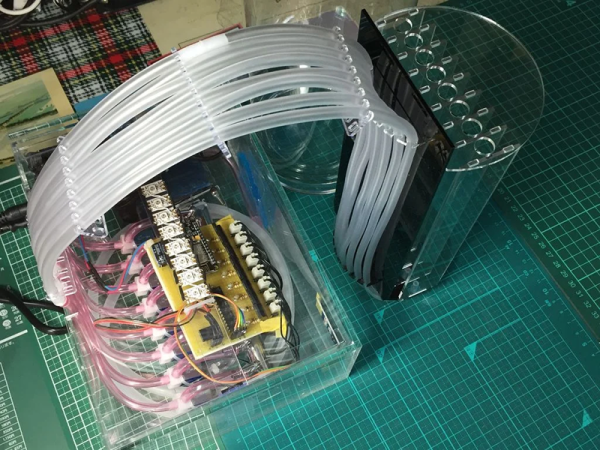
When [DonHo] sang about tiny bubbles, he probably wasn’t thinking of them embedded in glycerine. But that’s where the bubbles in [ShinodaY]’s clock reside. The viscous fluid holds the bubbles better allowing the time to be read more easily. You can watch the relaxing display in the video below.

The theory of operation is simple and reminds us somehow of a reverse Tetris game. Solenoid valves at the base release air bubbles to form a row of the display. The bubbles rising makes room for the next row. The display has as many columns as there are air outlets at the bottom. Spacing the bubble pixels is as simple as adjusting the timing between air bubbles.

Continue reading “Tiny Bubbles In The Clock”

atom drawing

What’s An Exciton?

If you read the scientific literature, you see the familiar subatomic particles you learned about in school: protons, neutrons, and electrons. If you are young enough, you see others you probably heard about, too, like quarks and gluons. But recently there has been a lot of buzz about excitons and even some transistor circuits demonstrated that use them. But what is an exciton?

It actually sounds like a subatomic particle, but it is a little more complicated than that. An exciton is a bound state of an electron and an electron hole and is technically a boson. You are probably familiar with the idea of an electron hole from semiconductor physics. Technically, it is a quasiparticle. The reason scientists are interested in the beast is that it can transport energy without transporting net electric charge. That is, the state itself is neutral, but also contains energy. Continue reading “What’s An Exciton?”

You May Trust Driverless Cars, But Do You Trust Driverless Barbers?

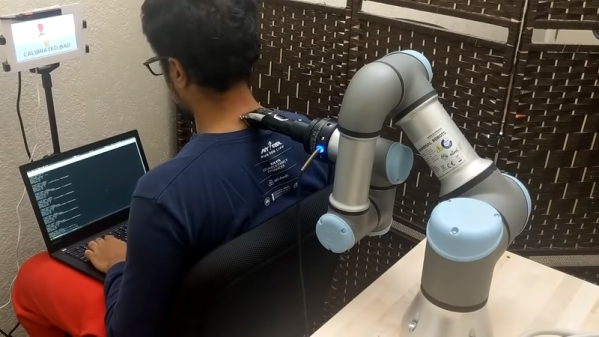
Although it is getting more common to have self-driving cars on the road, we have to admit we are still a bit uneasy. After all, we know first hand how hard it is to think of every case and how unreliable things can be. But what about having your hair cut by a robot? At least a car can have airbags and automatically stop at any sign of trouble. But letting a robot hold a sharp instrument up to your head? That’s what Buzz Robotics wants to do and they are starting with a neck trim that you can see in the video below.

Honestly, since the trimmers are probably not that dangerous, we feel a little better. But the fact that the screen says “Calibrated Bad” doesn’t install confidence. While the robobarber might not be able to cut your head off, it could certainly ruin your coiffure.

Continue reading “You May Trust Driverless Cars, But Do You Trust Driverless Barbers?”

Annealing 3D Prints: A Scientific Approach

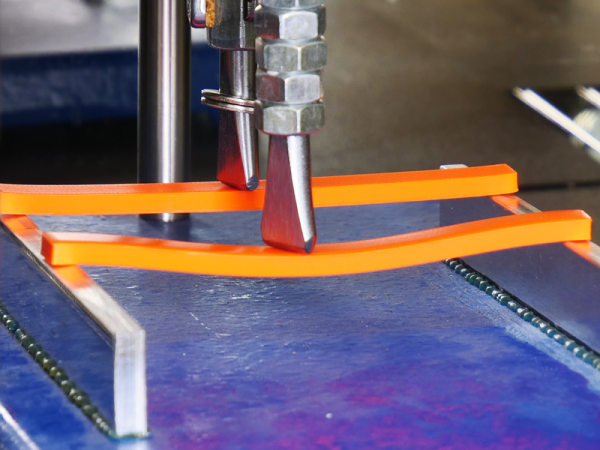
We’ve all been taught the scientific method: Form a hypothesis, do some experiments, gather some data, and prove or disprove the hypothesis. But we don’t always do it. We will tweak our 3D prints a little bit and think we see an improvement (or not) and draw some conclusions without a lot of data. Not [Josef Prusa], though. His team printed 856 different parts from four different materials to generate data about how parts behaved when annealed. There’s a video to watch, below.

Annealing is the process of heating a part to cause its structure to reorganize. Of course, heated plastic has an annoying habit of deforming. However, it can also make the parts firmer and with less inner tension. Printed parts tend to have an amorphous molecular structure. That is to say, they have no organization at all. The temperature where the plastic becomes soft and able to reorganize is the glass transition temperature.

Continue reading “Annealing 3D Prints: A Scientific Approach”