Top Off A Dry Electrolytic

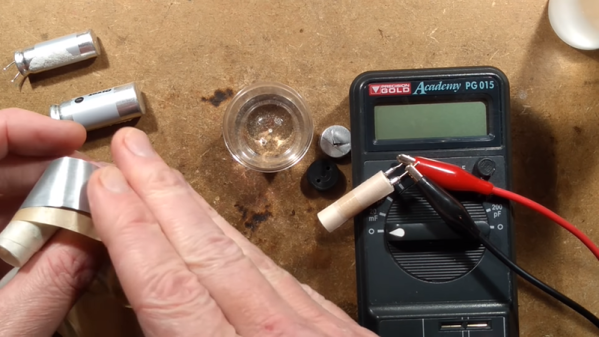
Making a capacitor is pretty easy. Just get two conductors close together. The bigger area you can get and the closer you can get them, the bigger the capacitor you can make. [BigClive] found some fake capacitors that were supposed to be very high value, but weren’t. Taking them apart revealed the capacitors didn’t have the electrolyte inside that gives these units both their name and their high values. What did he do? Mixed up some electrolyte and filled them back up to see what would happen. You can see the video below.

Electrolytic capacitors have a secret weapon to get the two electrodes as close as possible to each other. The electrolyte forms a very thin insulating layer on one electrode and the capacitance is between the conductive fluid and that electrode — not between the two electrodes. This allows for a very narrow gap between the conductors and explains why a small electrolytic can have a much greater capacitance than most other technologies in similar form factors.

Continue reading “Top Off A Dry Electrolytic”

Arm Allows Custom Instructions

We’re surrounded by ARM processors, which enjoy a commanding foothold in the consumer market, especially with portable electronics. However, Arm Holdings has never focused its business model on manufacturing chips, instead licensing its CPUs to others who make the physical devices. There is a bit of a tightrope to walk, though, because vendors want to differentiate themselves while Arm wants to keep products as similar as possible to allow for portability and reuse of things like libraries and toolchains. So it was a little surprising when Arm announced recently that for the first time, they would allow vendors to develop custom instructions. At least on the Armv8-M architecture.

We imagine designs like RISC-V are encroaching on Arm’s market share and this is a response to that. Although it is big news, it isn’t necessarily as big as you might think since Arm has allowed other means to do similar things via special coprocessor instructions and memory-mapped accelerators. If you are willing to put in some contact information, they have a full white paper available with a pretty sparse example. The example shows a population count function hand-optimized into 12 Arm instructions. Then it shows a single custom instruction that would do the same job. However, they don’t show the implementation nor do they offer any timing data about speed increases.

Continue reading “Arm Allows Custom Instructions”

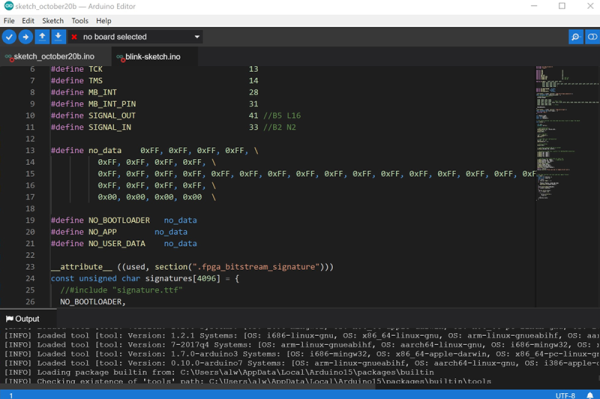
The Arduino IDE Finally Grows Up

While the Arduino has a very vocal fan club, there are always a few people less than thrilled with the ubiquitous ecosystem. While fans may just dismiss it as sour grapes, there are a few legitimate complaints you can fairly level at the stock setup. To address at least some of those concerns, Arduino is rolling out the Arduino Pro IDE and while it doesn’t completely address every shortcoming, it is worth a look and may grow to quiet down some of the other criticisms, given time.

For the record, we think the most meaningful critiques fall into three categories: 1) the primitive development environment, 2) the convoluted build system, and 3) the lack of debugging. Of course, there are third party answers for all of these problems, but now the Pro IDE at least answers the first one. As far as we can tell, the IDE hides the build process just like the original IDE. Debugging, though, will have to wait for a later build.

Continue reading “The Arduino IDE Finally Grows Up”

The True Cost Of Multimeters

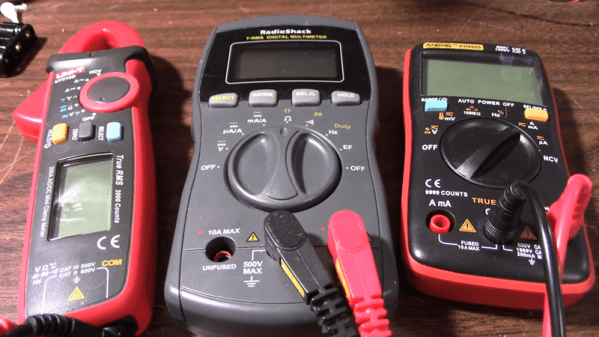
If you are building a home shop, it is common to try to get the cheapest gear you can possibly get. However, professionals often look at TCO or total cost of ownership. Buying a cheap car, for example, can cost more in the long run compared to buying an expensive car that requires less maintenance. Most consumers will nod sagely and think of ink jet printers. That $20 printer with the $80 cartridges might not be such a deal after all. [JohnAudioTech] bought a few cheap multimeters and now has problems with each of them. Maybe that $120 meter isn’t such a bad deal, after all.

The problems he’s seen are the same ones we’ve all seen: noisy selector switches, suspect display readings, and worn off lettering. You can see the whole story in the video below.

Continue reading “The True Cost Of Multimeters”

Bluetooth Control With Chrome

All the cool projects now can connect to a computer or phone for control, right? But it is a pain to create an app to run on different platforms to talk to your project. [Kevin Darrah] says no and shows how you can use Google Chrome to do the dirty work. He takes a garden-variety Arduino and a cheap Bluetooth interface board and then controls it from Chrome. You can see the video below.

The HM-10 board is cheap and could connect to nearly anything. The control application uses Processing, which is the software the Arduino system derives from. So how do you get to Chrome from Processing? Easy. The p5.js library allows Processing to work from within Chrome. There’s also a Bluetooth BLE library for P5.

Continue reading “Bluetooth Control With Chrome”

Endless Electronic Problems For Solving

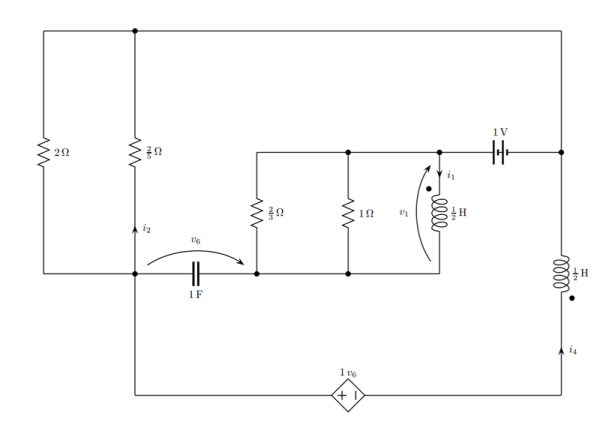
We know not everyone who likes to build circuitry wants to dive headfirst into the underlying electrical engineering that makes everything work. However, if you want to, now is a great time. Many universities have most or all of their material online and you can even take many courses for free. If you want an endless pool of solved study problems, check out autoCircuits. It can create many different kinds of electronics problems and their solutions.

You can get a totally random circuit, or choose if you want to focus on DC, AC, two-ports, or several other types of problems. You can also alter the general form of the problem. For example, for a DC analysis, you can have it assign circuit values so that the answer is a value such as 45 ohms, or you can have it just use symbols so that the answer might be i4=V1/4R. You even get to pick the difficulty level and pick certain types of problems to avoid. Just be fast. After the site generates a problem, you have 10 seconds to download it before it is gone forever.

Continue reading “Endless Electronic Problems For Solving”

Coffee Makes 3D Printing Better

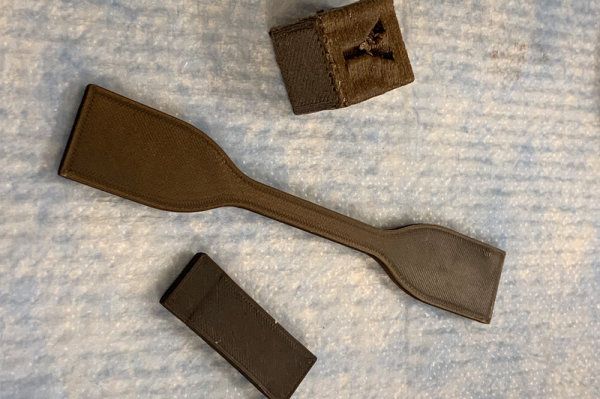
While we know some 3D printer operators who need coffee, Washington State University is showing an improved PLA material that incorporates used coffee waste. Regular PLA is not known for being especially strong, though It isn’t uncommon for vendors to add things to their PLA to change its characteristics.

The new material containing about 20% coffee waste showed an over 400% increase in toughness (25.24 MJ/m3) versus standard PLA. Why coffee waste? We aren’t sure. They didn’t add grounds, but rather a dry and odorless material left over after coffee grounds are processed for biodiesel production.

Continue reading “Coffee Makes 3D Printing Better”