Learn Morse Code, Clockwork Orange Style

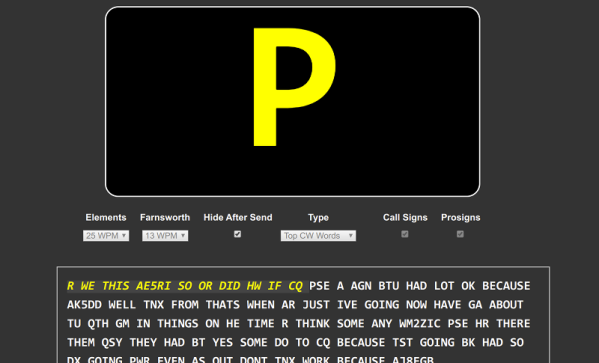
You might have to provide your own wrist straps and eye clamps, but if you want to learn Morse code, [Seth] has a web site for you. You can get code practice using the Farnsworth method and each letter is flashed before you as it is sent, which we assume will burn it into your brain.

Why learn Morse code now? Just about all countries now have at least some no code ham licenses and many have taken code off the tests completely. However, there are still many hams that use the code even today. Why? The personal challenge is part of it and perhaps nostalgia. However, it is also true that Morse code transmitters and receivers are dead simple to build and can get through where other simple radios can’t.
Continue reading “Learn Morse Code, Clockwork Orange Style”

BST-863 Hot Air Rework Station Teardown

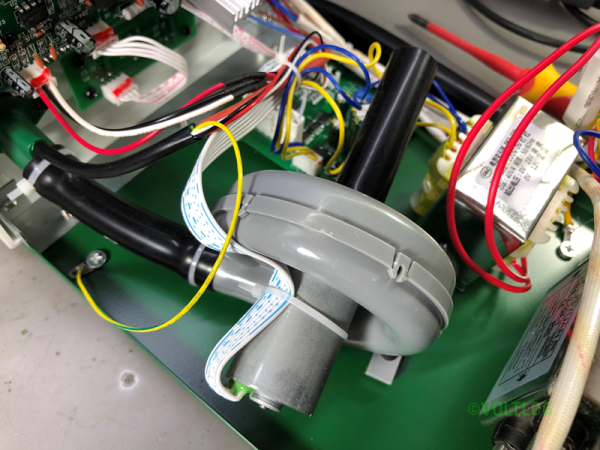
[Voltlog] has had a 952 hot air rework station for a long time. You’ll recognize it when you see it — they are the ubiquitous soldering iron and hot air gun combination from China sold under numerous brand names. He didn’t think the old station was as good as some of the newer devices available, and did a teardown and review of the BST-863 station that can be had for well under $200. You can see the video below.

He was impressed with the build quality of the workpiece holder. It lets you store the hot air gun and keep it in standby mode. He liked the touchscreen, too, although the beeping seemed a bit annoying. However, in general, the operating noise was less than the older unit it replaced.

Continue reading “BST-863 Hot Air Rework Station Teardown”

How’s That 2.5D Printer Working For You?

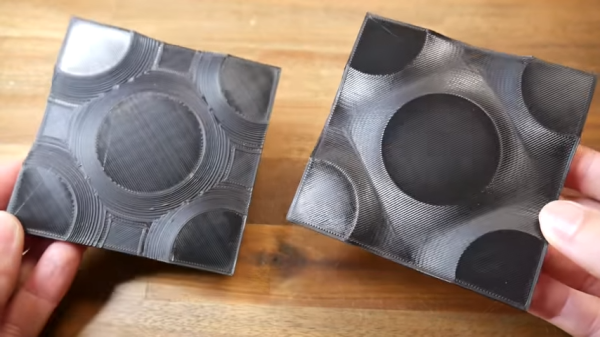
We’ve noticed a trend lately that advanced 3D printing people are calling their normal print setup as 2.5D, not 3D. The idea is that while the machine has 3 axes, the actual geometry generation is typically only in the X and Y axis. The Z axis simply lifts up to the next layer unless you are working in vase mode. [Teaching Tech] wanted to experiment with real 3D printing where the Z axis actually helps build the shape of the printed object, not just advancing with each step.

As it turns out his first investigation linked back to one of our early posts on the topic. There’s been more recent work though, and he found that too. It took a little surgery to get more Z clearance, but nothing too serious — just a movement of a fan.

Continue reading “How’s That 2.5D Printer Working For You?”

Cheap Stereo Microscope Helps With SMD

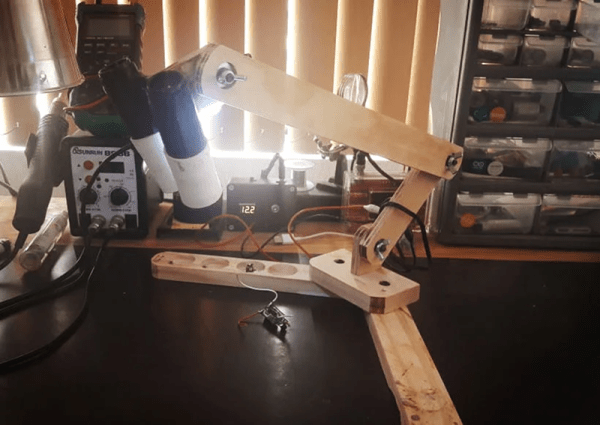
Soldering is best done under magnification. Parts become ever smaller and eyes get weaker, so even if you don’t need magnification now, you will. [Makzumi] didn’t want to shell out $400 or more for a good microscope so he hacked one from some cheap binoculars from the toy section on Amazon.

A lot of magnifiers aren’t really good for soldering because the distance between the work and the lens isn’t very large. The hacked ‘scope has about 4 inches of working distance, which is plenty of room to stick some solder and a hot iron under there. The resulting magnification is about 12 or 15X and he claims that the cell phone pictures he’s included aren’t as good as really looking through the eyepieces yourself.

Continue reading “Cheap Stereo Microscope Helps With SMD”

An RFID Ring For The Body Mod Squeamish

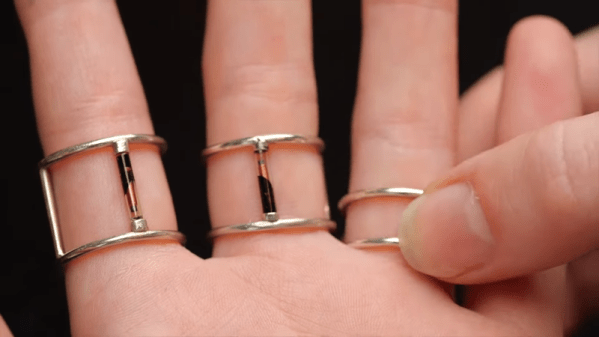
Some people get inked, while others get henna or those water transfer tattoos you might find in a box of Cracker Jack. [Becky] wanted the benefits of having an RFID tag in her finger — unlock doors or log into your computer with a swipe of your finger — but wasn’t ready to get an implant. Her solution: make an artistic ring that conceals a tiny glass capsule RFID tag.

Besides not having to shove some tech under your epidermis, there are a few other advantages: you can change out tags as easy as changing rings, for one. You can also easily loan your ring to someone just as you might give them keys to your door.

Continue reading “An RFID Ring For The Body Mod Squeamish”

Linux Fu: Interactive SSH Applications

[Drew DeVault] recently wrote up some interesting instructions on how to package up interactive text-based Linux commands for users to access via ssh. At first, this seems simple, but there are quite a few nuances to it and [Drew] does a good job of covering them.

One easy way — but not very versatile — is to create a user and make the program you want to run the default shell. The example used is to make /usr/bin/nethack the shell and now people can log in as that user and play nethack. Simple, right? However, there are better ways to get there.

Continue reading “Linux Fu: Interactive SSH Applications”

Ham Radio Company Wins Big

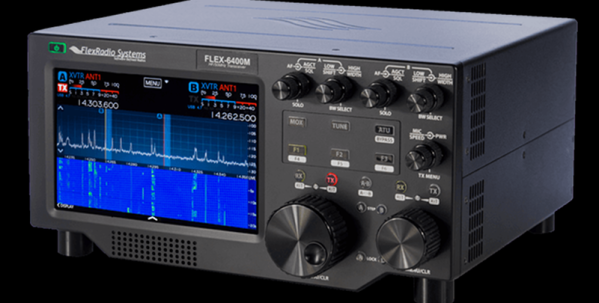
It is sort of the American dream: start a company in your garage and have it get crazy big. After all, Steve Jobs, Bill Gates, and even Bill Hewlett and Dave Packard did it. Seems hard to do these days, though. However, one ham radio company that has been pushing the edge of software defined radio appears to be well on the way to becoming more than its roots. FlexRadio has teamed with Raytheon to undertake a major project for the United States Air Force.

The Air Force has given Raytheon and FlexRadio $36 million to develop an HF radio based on the existing SmartSDR/Flex-6000. ARRL news reports quote FlexRadio’s CEO as saying that the investment in the military radios will pay dividends to the firm’s ham radio customers.

Continue reading “Ham Radio Company Wins Big”