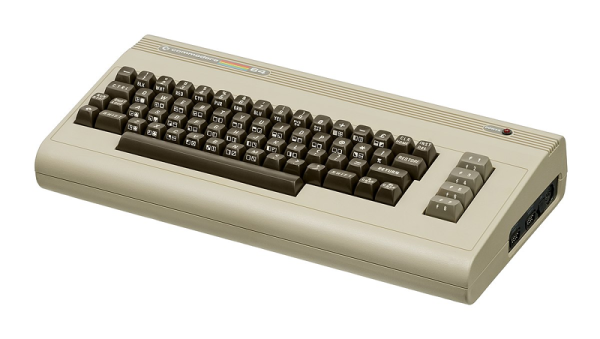
Dirty Tricks For 6502 Programming

We know the 6502 isn’t exactly the CPU of choice for today’s high-performance software, but with the little CPU having appeared in so many classic computers — the Apple, the KIM-1, The Commodores, to name a few — we have a real soft spot for it. [Janne] has a post detailing the eight best entries in the Commodore 64 coding competition. The goal was to draw an X on the screen using the smallest program possible. [Janne] got 56 bytes, but two entrants clocked in at 34 bytes.

In addition to the results, [Janne] also exposes the tricks people used to get these tiny programs done. Just looking at the solution in C and then 6502 assembly is instructive. Naturally, one trick is to use the existing ROM code to do tasks such as clearing the screen. But that’s just the starting point.

Continue reading “Dirty Tricks For 6502 Programming”

Circuit VR: Advanced Falstad Logic With Geniac

I find that if I’m trying to make a point with a student or a colleague about a circuit, sometimes the Falstad online simulator is worth a few thousand words. You can draw the circuit, play with the values, and even see the current flow in an intuitive way as well as make traditional measurements. The simulator not only handles analog but also digital circuits. At first glance, though, the digital functions appear limited, but if you dig deeper, there is a custom logic block that can really help. I dug into this — and into how switches work in the simulator — the other day in response to a Hackaday post. If you use Falstad, read on!

Continue reading “Circuit VR: Advanced Falstad Logic With Geniac”

Sensor Lets Gestures And An Arduino Control The Tunes

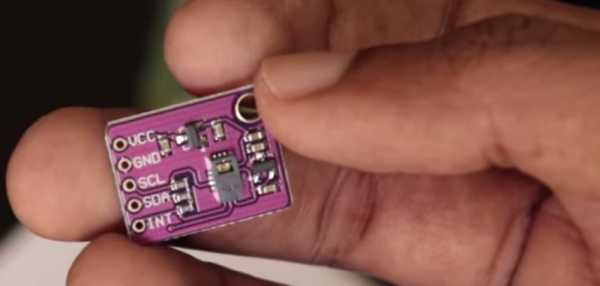
Every time we watch Minority Report we want to make wild hand gestures at our computer — most of them polite. [Rootsaid] wanted to do the same and discovered that the PAJ7620 is an easy way to read hand gestures. The little sensor has a serial interface and can recognize quite a bit of hand waving. To be precise, the device can read nine different motions: up, down, left, right, forward, backward, clockwise, anticlockwise, and wave.

There are plenty of libraries to read it for common platforms. If you have an Arduino that can act as a keyboard for a PC, the code almost writes itself. [Rootsaid] uses a specific library for the PAJ7620 and another — Nicohood — for sending media keys.

Continue reading “Sensor Lets Gestures And An Arduino Control The Tunes”

An (Almost) Free Apollo-Era Rocket

According to recent news reports, NASA’s Marshall Space Flight Center in Huntsville Alabama wants to give away a piece of history — an engineering test article of a Saturn I Block I booster. The catch? You’ll need to pay to haul it off, which will cost about $250,000. According to C|Net, the offer appears to be for museums and schools, but it’s likely that price tag would probably scare most private buyers off anyway.

On the other hand, if you are a museum, library, school, or university, you can score cheap or free NASA stuff using their GSAXcess portal. In general, you do have to pay shipping. For example, a flexible thermal blanket from the shuttle costs $37.28. A heat tile runs about $25.

Continue reading “An (Almost) Free Apollo-Era Rocket”

Fail Of The Week: Supercapacitor Spot Welder

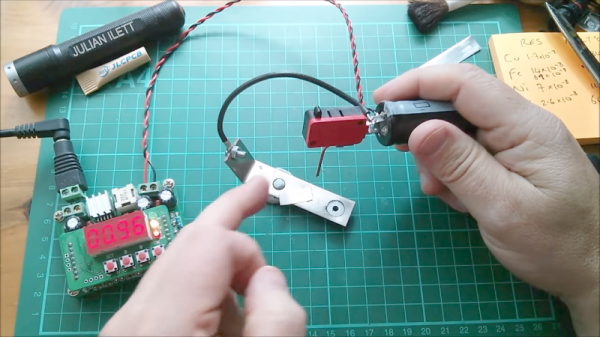
[Julian] needed to weld a bit of nickel to some steel and decided to use a spot welding technique. Of course he didn’t have a spot welder sitting around. Since these are fairly simple machines so [Julian] set out to build a spot welder using a charged supercapacitor. The fundamentals all seem to be there — the supercap is a 100 Farad unit and with a charge of 2.6V, that works out to over 300 joules — yet it simply doesn’t work.

The problem is in how the discharge energy is being directed. Just using the capacitor would cause the charge to flow out as a spark when you got near the point to discharge. To combat this, [Julian] put a microswitch between the capacitor and the copper point he expected to use as the welding tip. The microswitch, of course, is probably not the best for carrying a large surge of current, so we suspect that may be part of why he didn’t get great results.

The other thing we noticed is that he used a single point and used the workpiece as a ground return. Most spot welders use two points near each other or on each side of the workpiece. The current from the capacitor is probably just absorbed by the relatively large piece of metal.

The second video below from [American Tech] shows a 500F capacitor doing spot welding with little more than two wires and it seems to work. Hackaday’s own [Sean Boyce] even made one out of some whopping 3000F caps. It did work, although he’s been pursuing improvements.

Continue reading “Fail Of The Week: Supercapacitor Spot Welder”

[Jessica] Is Soft On Robot Grippers

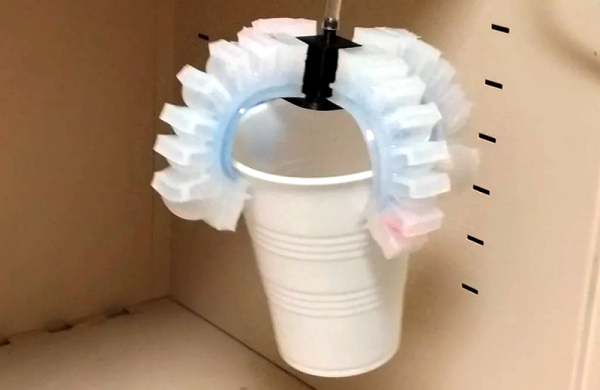
It is an old movie trope: a robot grips something and accidentally crushes it with its super robot strength. A little feedback goes a long way, of course, but futuristic robots may also want to employ soft grippers. [Jessica] shows how to build soft grippers made of several cast fingers. The fingers are cast from Ecoflex 00-50, and use air pressure.

A 3D-printed mold is used to cast the Ecoflex fingers, which are only workable for 18 minutes after mixing, so it’s necessary to work fast and have everything ready before you start.

Continue reading “[Jessica] Is Soft On Robot Grippers”

Print Your Own Heat Shrink Labels For Factory-Chic Wire Naming

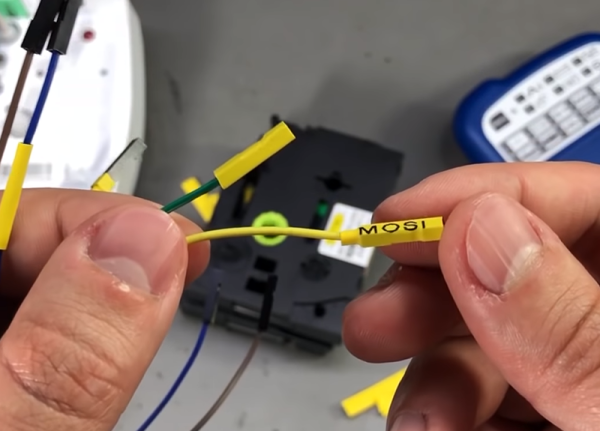
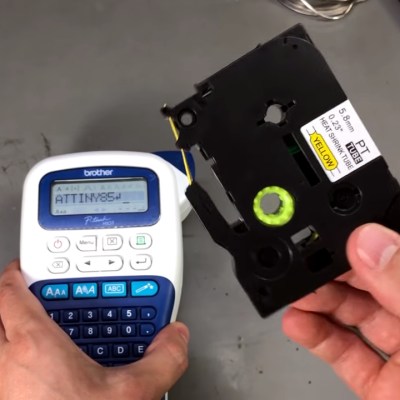
Heat shrink tubing is great for insulating wires. Labeling wires in a bundle is always useful, too. [Voltlog] has a cheap Brother label printer and discovered he can buy knock off label cassettes for a lot less from China. However, he also found something else: cassettes with heat shrink tubing in them made for the same kind of printer. Could he use the heat shrink cassettes to make neat wire labels? In his first video the answer was sort of, but not really. However, he later had a breakthrough and made a second video explaining how to do it. You can see both videos, below.

At first, the printer didn’t even want to recognize the cassette. It seems like Brother doesn’t want you using exotic tapes with cheap printers. No worry, this isn’t sophisticated DRM, just a sense hole that you need to cover with tape. This discovery was made using the extremely scientific trick of covering all the holes that were not on a regular cassette.



Continue reading “Print Your Own Heat Shrink Labels For Factory-Chic Wire Naming”