Learn Digital Logic By Alien Abduction

Some of the best educational material we’ve seen tells a story. There’s something more fun about reading a story than just absorbing a bunch of dry facts. That’s the idea behind Adventures in Logic Land. In the first episode, you are abducted by aliens trying to decide if humans are intelligent. To prove that, you have to work a series of logic puzzles.

The approach is a little unorthodox. You are shown a live logic simulation (spoiler: it is a NOR gate) and you have to fill in a truth table. The gates use alien symbols which contributes to the storyline but perhaps isn’t the best choice from an educational perspective. Besides, they already use red for zero and green for one which seems a little culturally-specific. The next test shows you how to build your own little simulations and run tests to see if they meet the alien’s criteria.


Continue reading “Learn Digital Logic By Alien Abduction”

Expert Says Don’t Teach Kids To Code

I was a little surprised to see a news report about Andreas Schleicher, the director of education and skills at OECD — the Organization for Economic Cooperation and Development. Speaking at the World Innovation Summit for Education in Paris, Schleicher thinks that teaching kids to code is a waste of time. In particular, he seems to think that by the time a child today grows up, coding will be obsolete.

I can’t help but think that he might be a little confused. Coding isn’t going away anytime soon. It could, of course, become an even deeper specialty, and thus less generally applicable. But the comments he’s made seem to imply that soon we will just tell smart computers what we want and they will just do that. Somewhat like computers work on Star Trek.

What is more likely is that most people will be able to find specific applications that can do what they want without traditional coding. But someone still has to write something for the foreseeable future. What’s more, if you’ve ever tried to tease requirements out of an end user, you know that you can’t just blurt out anything you want to a computer and expect it to make sense. It isn’t the computer’s fault. People — especially untrained people — don’t always make sense or communicate unambiguously.

Continue reading “Expert Says Don’t Teach Kids To Code”

Quadcopter Uses Bare Metal STM32

[Tim Schumacher] got a Crazepony Mini quadcopter and has been reprogramming it “bare metal” — that is to say he’s programming the STM32 without using an operating system or do-it-all environment. His post on the subject is a good reference for working with the STM32 and the quadcopter, too.

If you haven’t seen the quadcopter, it is basically a PC board with props. The firmware is open source but uses the Keil IDE. The CPU is an STM32 with 64K of program memory. In addition, the drone sports a wireless module, a digital compass, an altimeter, and a gyro with an accelerometer.

Although the post is really about the quadcopter, [Tim] also gives information about the Blue Pill which could be applied to other STM32 boards, as well. On the hardware side, he’s using a common USB serial port and a Python-based loader.

On the software side, he shows how to set up the linker and, using gcc, control output ports. Of course, there’s more to go to work the other peripherals, and Tim’s planning to investigate CMSIS to make that work easier. Our earlier post on STM32 prompted [Wassim] over on Hackaday.io to review a bunch of IDEs. That could be helpful, too.

DIY Reflow Oven Is Heavily Documented

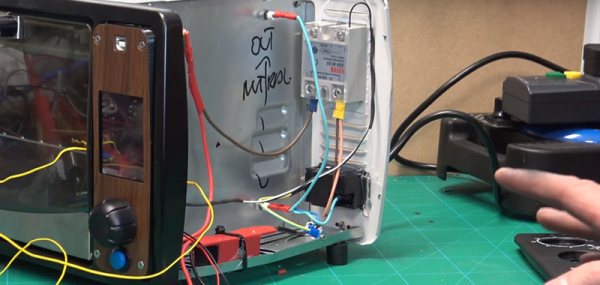
[DJ Legion] decided he wanted a reflow oven so he bought a toaster oven and an assortment of parts including a solid state relay, a Teensy, a display, and a thermocouple. What makes this a different project is the amount of video documentation. The four videos below encompass about 50 minutes of information and he’s promising more to come.

We haven’t found his software — probably because he’s still working on it, but we’re watching his GitHub page expectantly. We really liked the 3D printed faceplate that integrated the controller into the oven. It almost looks like a commercial unit. The use of the woodgrain paper over the 3D printed parts was a nice touch.

[DJ] is not done, though. He wants to increase the heat up time and possibly add convection. He’s also planning on a new video that will show actually making a board and how he has refined the calibration curves.

We are impressed but would have been tempted to just grab a Reflowduino. The work’s already done, and you get wireless control and lots of other goodies. Of course, we also get the urge to do it yourself, so we can’t really throw stones. If you don’t want to mess with an oven, you can always raid the hair salon.

Continue reading “DIY Reflow Oven Is Heavily Documented”

Bash Pipeline Puzzle: Green, Blue, Or Blue Green?

[Marek Gibney] poses an interesting puzzle. What does the following bash command line print?

( echo red ; echo green 1>&2 ) | echo blue

You’d like to think it prints three lines: red, green, and blue. But would you be surprised to find out that it can sometimes output “blue green” and sometimes just output blue. The first surprise is that it isn’t deterministic. But the second thing that is surprising is the sometimes the entire left-hand part of the line doesn’t do anything. [Chris Siebenmann] did the analysis and explains what’s going on in a recent blog post.

Before you click the link or read further, you might want to see if you can deduce what’s going on. Give up? Here’s a hint: Part of the solution hinges on the fact that echo is built into the shell.

Continue reading “Bash Pipeline Puzzle: Green, Blue, Or Blue Green?”

Graphene Desalinates Sea Water

Even though the majority of the Earth is covered in water, a surprising number of people around the world don’t have easy access to clean drinking water. The oceans of course are full of salt, and it is difficult to filter that salt out. Researchers at the University of Manchester have found a way to improve a graphene-based filter mechanism that could help convert sea water to potable water.

Pure graphene can do the job, but it is difficult to manufacture in commercial quantities. In addition, the membrane requires the creation of tiny holes, further complicating the production. The new method uses graphene oxide, which is very simple to make and deploy.

Continue reading “Graphene Desalinates Sea Water”

Car Alarm Hacks 3 Million Vehicles

Pen testing isn’t about evaluating inks. It is short for penetration testing — someone ensuring a system’s security by trying to break in or otherwise attack it. A company called Pen Test Partners made the news last week by announcing that high-end car alarm systems made by several vendors have a critical security flaw that could make the vehicles less secure. They claim about three million vehicles are affected.

The video below shows how alarms from Viper/Clifford and Pandora have a simple way to hijack the application. Once they have access, they can find the car in real time, control the door locks, and start or stop the car engine. They speculate a hacker could set off the alarm from a nearby chase car. You’d probably pull over if your alarm started going off. They can then lock you in your car, approach, and then force you out of the car.

Continue reading “Car Alarm Hacks 3 Million Vehicles”