COB LED Teardown

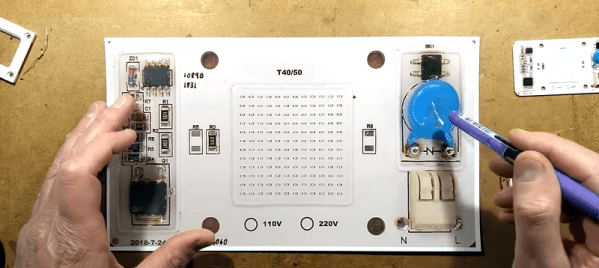
[Big Clive] picked up some chip-on-board (COB) LEDs meant for hydroponics that were very unusual and set out to examine them on video. Despite damaging the board almost right away, he managed to do some testing on these arrays and you can see the results in the video below. He also compares it to older LED modules.

The 144 LEDs produce a lot of light. In addition to powering the device up, he also looks at the construction of the LEDs under a magnification, comparing the older style that used tiny bond wires to make connections versus the new version soldered on the board directly.

Continue reading “COB LED Teardown”

FPGA Makes Digital Analog Computer

When you think of analog computing, it’s possible you don’t typically think of FPGAs. Sure, a few FPGAs will have specialized analog blocks, but usually they are digital devices. [Bruce Land] — a name well-known to Hackaday — has a post about building a digital differential analyzer using an FPGA and it is essentially an analog computer simulated on the digital fabric of an FPGA.

Whereas traditional analog computers use operational amplifiers to do mathematical integration, on the FPGA [Land] uses digital summers The devices simulate a system of differential equations, which can be nonlinear.

Continue reading “FPGA Makes Digital Analog Computer”

Text Projector With — You Know — Lasers

We missed [iliasam’s] laser text projector when it first appeared, perhaps because the original article was in Russian. However, he recently reposted in English and it really caught our eye. You can see a short video of it in operation, below.

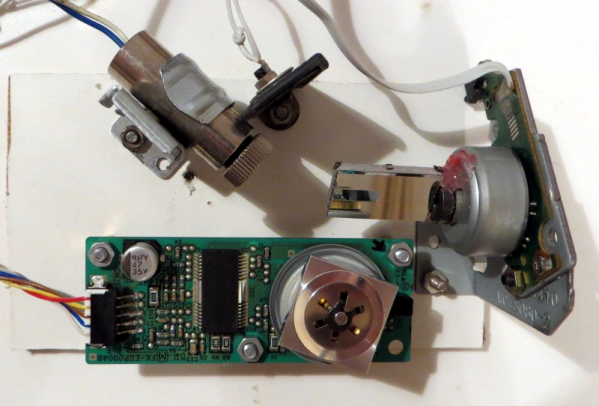
The projector uses raster scanning where the beam goes over each spot in a grid pattern. The design uses one laser from a cheap laser pointer and a salvaged mirror module from an old laser printer. The laser pointer diode turned out to be a bit weak, so a DVD laser was eventually put into service. A DVD motor also provides the vertical scan which is just a slight wobble of a mirror. A Blue Pill CPU provides all the smarts. You can find the code on GitHub.

Continue reading “Text Projector With — You Know — Lasers”

The Vedolyzer Was High Tech Repair Gear For 1939

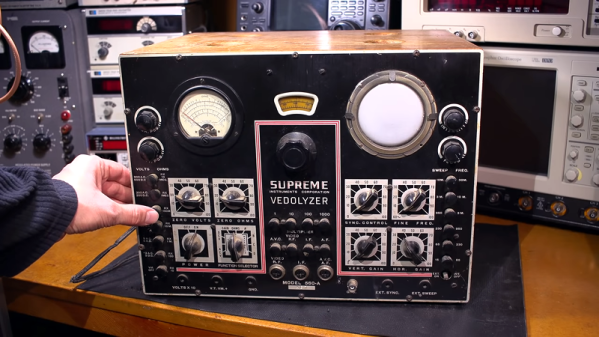
There’s an old joke that all you need to fix TVs is a cheater, a heater, and a meter. If you don’t remember, a cheater was a cord to override the interlock on TVs so you could turn them on with the back removed. Of course, in real life, pro repair techs always had better equipment. In 1939 that might have meant the Supreme Vedolyzer which combined a meter, a ‘scope, and a wavemeter all in one device. [Mr Carlson] acquired one that was in fair shape and made a few videos (see below) of the teardown and restoration.

[Mr Carlson] wasn’t restoring this as an art project, by the way. He plans on using it, so he was less concerned with authenticity and more worried about usability. That led him to do things like remove the input jacks and replace them with BNCs. The video series is a bit of a time investment. Part one is about 82 minutes long! But if you are interested in old gear, this is a chance to peer inside an unusual specimen.

Continue reading “The Vedolyzer Was High Tech Repair Gear For 1939”

Love Songs To The Microphone

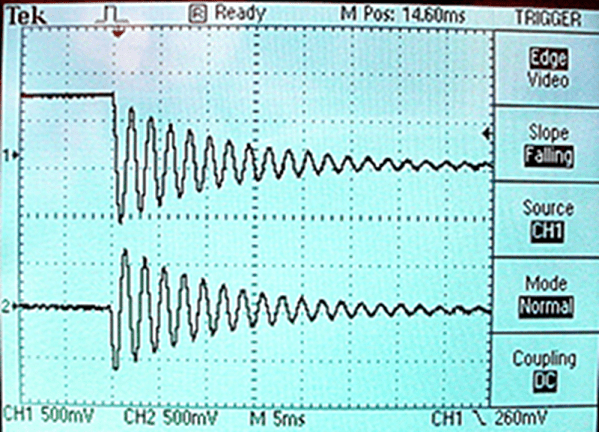
A biographer of Frank Sinatra once commented that for singers like Sinatra, their instrument is the microphone. We tend to think of microphones as ideal transducers, picking up sound faithfully. But like most electronic components, microphones are imperfect. They have a varying frequency response. They pick up popping noises when we say words like “popcorn” that are normally lost to someone listening live.

[Cheddar] has an interesting video (see below) that covers how performers like Sinatra, Bing Crosby, and Billie Holiday learned to use the microphone to their advantage. They suggest that the microphone changed the way humans sing, and they are right.

Continue reading “Love Songs To The Microphone”

EF50: The Tube That Changed Everything

From today’s perspective, vacuum tubes are pretty low tech. But for a while they were the pinnacle of high tech, and heavy research followed the promise shown by early vacuum tubes in transmission and computing. Indeed, as time progressed, tubes became very sophisticated and difficult to manufacture. After all, they were as ubiquitous as ICs are today, so it is hardly surprising that they got a lot of R&D.

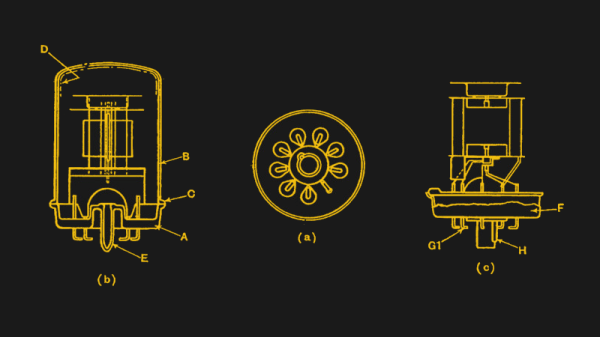
Prior to 1938, for example, tubes were built as if they were light bulbs. As the demands on them grew more sophisticated, the traditional light bulb design wasn’t sufficient. For one, the wire leads’ parasitic inductance and capacitance would limit the use of the tube in high-frequency applications. Even the time it took electrons to get from one part of the tube to another was a bottleneck.

There were several attempts to speed tubes up, including RCA’s acorn tubes, lighthouse tubes, and Telefunken’s Stahlröhre designs. These generally tried to keep leads short and tubes small. The Philips company started attacking the problem in 1934 because they were anticipating demand for television receivers that would operate at higher frequencies.

Dr. Hans Jonker was the primary developer of the proposed solution and published his design in an internal technical note describing an all-glass tube that was easier to manufacture than other solutions. Now all they needed was an actual application. While they initially thought the killer app would be television, the E50 would end up helping the Allies win the war.

Continue reading “EF50: The Tube That Changed Everything”

Learn About BGP With The Internet Of EvE

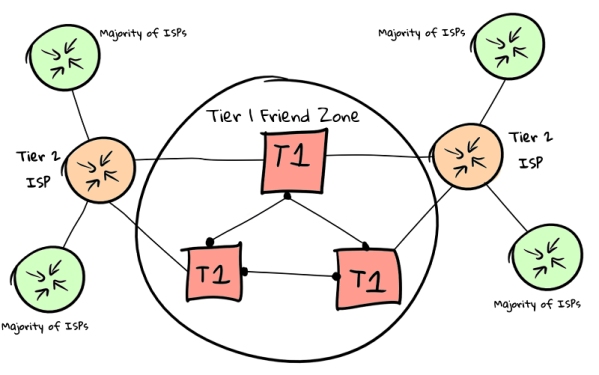
When we first saw [Ben Jojo’s] post about the Internet inside EvE Online, we didn’t think we’d be that interested. We don’t play EvE — a massively multiplayer game. But it turns out, the post is really about understanding BGP (Border Gateway Protocol) and how it helps route traffic in large networks. The best part? He actually simulates a network with 8,000 nodes to test out what he’s talking about.

Obviously, you wouldn’t want to fire up 8,000 Raspberry Pi computers for such an experiment. Using Buildroot, he set up a very small Linux image that had the bare minimum required to run the tests. The qemu provided virtualization, including an obscure feature that allows you to transfer data between virtual machines using UDP. The whole thing ran on some pretty beefy hardware in the cloud. Sure, you could have provisioned 8,000 cloud instances, but that would run into some serious money pretty fast, we imagine. As a wrap-up, he even uses BGP to model his local mass transit system.

Continue reading “Learn About BGP With The Internet Of EvE”