There Are 200 Electronic Kits In That Box

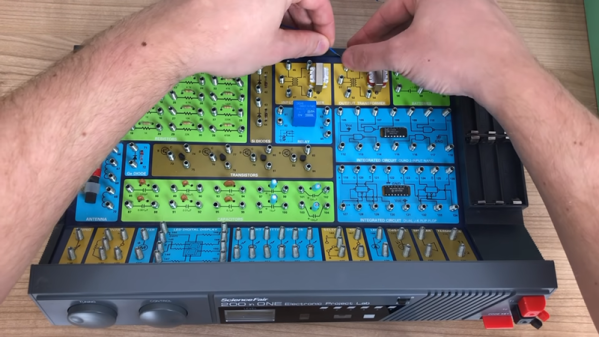
If you grew up in the latter part of the 20th century, you didn’t have the Internet we have today — or maybe not at all. What you did have, though, was Radio Shack within an hour’s drive. They sold consumer electronics, of course, but they also sold parts and kits. In addition to specific kits, they always had some versions of a universal kit where lots of components were mounted on a board and you could easily connect and disconnect them to build different things. [RetoSpector78] found a 200-in-1 kit at a thrift store that was exactly like the one he had as a kid and he shares it with us in the video below.

This was a particularly fancy model since it has a nice looking front panel with a few knobs and displays. The book shows you how to make the 200 different projects ranging from metronomes to rain detectors. The projects really fell into several categories. There were practical circuits like radio receivers, test equipment, and transmitters. Then there were games or circuits even the manual called “silly.” In addition, there were circuits to build simply to understand how they work, like flip flops or counters.

Continue reading “There Are 200 Electronic Kits In That Box”

Play Chess Like Harry Potter

If you are a Harry Potter fan, you might remember that one of the movies showed an Isle of Lewis chess set whose pieces moved in response to a player’s voice commands. This feat has been oft replicated by hackers and [amoyag00] has a version that brings together a Raspberry Pi, Arduino, Android, and the Stockfish chess engine in case you want to play by yourself. You can see a video of the game, below.

Interestingly, the system uses Marlin — the 3D printing software — to handle motion using the Arduino. We suppose moving chess pieces over a path isn’t much different than moving a print head. It is certainly a novel use of GCode.

Continue reading “Play Chess Like Harry Potter”

In Soviet Russia, Computer Programs You

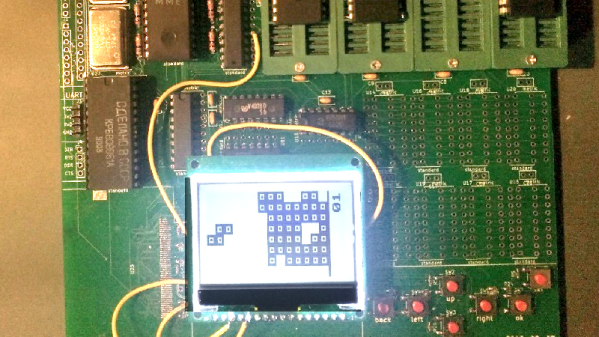
We admire [Alex Studer’s] approach to schoolwork. His final assignment in his history class was to do an open-ended research project on any topic and — this is key — using any medium. He’d recently watched a video about how Tetris came from the former Soviet Union, and adding in a little eBay research set out to build a period-accurate Soviet computer replica. The post covers the technical details, but if you want to read the historical aspects the school paper is also online.

The first decision was what CPU to use and [Alex] picked the U880 which is a Soviet Z80. All the usual parts you would use with a Z80 have U880 equivalents, so that fleshed out the rest of the design. There were a few concessions made. Instead of a bulky analog monitor, the replica uses an LCD display. Instead of an audio cassette recorder, the new machine uses a CompactFlash socket. We don’t think those are bad decisions. He also replaced the Soviet EPROMs with modern parts. Although the original parts appeared to program correctly, they were unreliable in operation. [Alex] theorizes that his programmer did not generate enough programming voltage to fully program the cells, so they would pass at the low speeds used by the programmer, but not work in the actual circuit.

Continue reading “In Soviet Russia, Computer Programs You”

Arduino Enters The Cloud

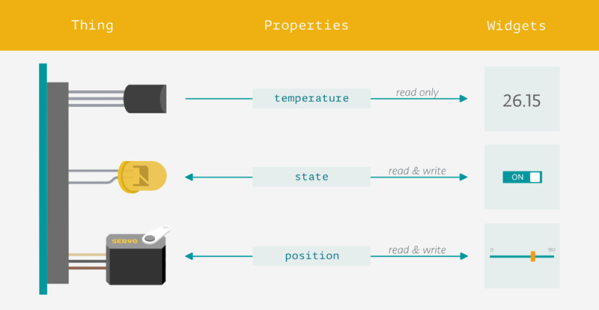
Love it or hate it, for many people embedded systems means Arduino. Now Arduino is leveraging its more powerful MKR boards and introducing a cloud service, the Arduino IoT Cloud. The goal is to make it simple for Arduino programs to record data and control actions from the cloud.

The program is in beta and features a variety of both human and machine interaction styles. At the simple end, you can assemble a dashboard of controls and have the IoT Cloud generate your code and download it to your Arduino itself with no user programming required. More advanced users can use HTTP REST, MQTT, Javascript, Websockets, or a suite of command line tools.

Continue reading “Arduino Enters The Cloud”

Portable Ham Antenna Gets A Workout

Ham radio isn’t just one hobby. It is a bunch of hobbies ranging from chatting to building things, bouncing signals off the moon, and lots of things in between. Some of these specialties, such as supporting disaster relief or putting odd locations “on the air”, require portable operation. To encourage disaster readiness, hams participate in Field Days which is a type of contest that encourages simulated emergency conditions. So how do you erect an antenna when you just have a few hours to set up a temporary station? [KB9VBR] shows how he and his friend used a Chameleon Emcomm III portable HF antenna for Winter Field Day. You can see the video review, below.

Unlike some portable antennas, this one is almost 100 feet of wire (73 feet of radiator and a 25 foot counterpoise). The entire affair is meant to be put up and taken down repeatedly.

Continue reading “Portable Ham Antenna Gets A Workout”

Those Voices In Your Head Might Be Lasers

What if I told you that you can get rid of your headphones and still listen to music privately, just by shooting lasers at your ears?

The trick here is something called the photoacoustic effect. When certain materials absorb light — or any electromagnetic radiation — that is either pulsed or modulated in intensity, the material will give off a sound. Sometimes not much of a sound, but a sound. This effect is useful for spectroscopy, biomedical imaging, and the study of photosynthesis. MIT researchers are using this effect to beam sound directly into people’s ears. It could lead to devices that deliver an audio message to specific people with no hardware on the receiving end. But for now, ditching those AirPods for LaserPods remains science fiction.

There are a few mechanisms that explain the photoacoustic effect, but the simple explanation is the energy causes localized heating and cooling, the material microscopically expands and contracts, and that causes pressure changes in the sample and the surrounding air. Saying pressure waves in air is just a fancy way of explaining sound.

Continue reading “Those Voices In Your Head Might Be Lasers”

A Science Lab In Your Pocket?

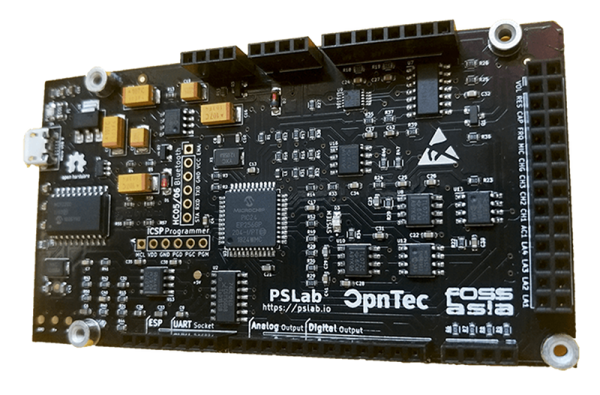
Since even the cheapest phone or computer now has plenty of horsepower, there’s been a move to create instruments that can do everything, using a reasonably simple front end and crunching data back on the host device. This is one of those tasks that seems easy, but doing it well turns out to be a lot of effort. One we recently noticed was Pocket Science Lab — a board that connects to your PC or Android phone and provides an oscilloscope, a logic analyzer, a wave generator, a power supply, a multimeter, and a few odd items such as an accelerometer, barometer, compass, and lux meter. The cost is about $65, so it isn’t a big investment. But what can it do? Read on, or you can watch the video below from Geekcamp Singapore.

The datasheet shows a reasonable device, although nothing amazing. The oscilloscope has 4 channels but only does 2 MSPS, so assuming the front end can handle it, you might visualize 1 MHz sine waves. There’s also a 12-bit voltmeter, three 12-bit power supplies with different ranges, a 4 MHz 4 channel logic analyzer, two sine or triangle wave generators, 4 PWM outputs, and the ability to measure capacitance. Finally, there’s a frequency counter that’s good to 16 MHz.

Continue reading “A Science Lab In Your Pocket?”