A $4 Ultrasonic Theremin Looks Cheesy On Purpose

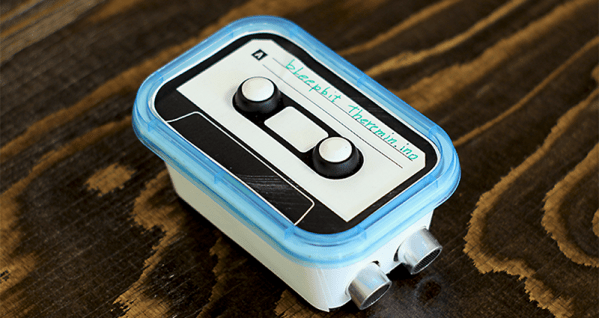
We don’t think [bleepbit] will take offense when we say the “poor man’s theremin” looks cheesy — after all, it was built in a cheese container. Actually, it isn’t a bad case for a simple device, as you can see in the picture and the video below. Unlike a traditional theremin, the device uses ultrasonics to detect how far away your hand is and modifies the sound based on that.

There are also two buttons — one to turn the sound off and another to cycle through some effects. We liked how it looked like a retro cassette, though. The device uses a cheap Arduino clone, but even with a real Arduino, the price wouldn’t be too bad. However, the price tag quoted doesn’t include a few connectors or the speaker that appears in the schematic. There’s a note that the model built uses a jack instead of a speaker, but it would be nice to include both and use the kind of jack that disconnects the speaker when you plug speakers or headphones in.

Continue reading “A $4 Ultrasonic Theremin Looks Cheesy On Purpose”

Back To School Online

In 1961, FCC Commissioner [Newt Minow] famously described TV as a “vast wasteland.” But TV can do great things; educational programming, news coverage, and great performances do appear, just not all that often. You can draw the same parallels to the Internet. Sure, it’s mostly cat pictures, snarky comments, and posts of what your friends had for dinner. But it can also be a powerful tool, especially for education. Recently, top-name schools and other institutions have posted courses online for everything from Python to Quantum Mechanics to Dutch. The problems are finding these classes and figuring out which ones are gems and which are duds. A site called Class-Central aims to solve these problems.

The site aggregates class descriptions from a variety of sources like edX, Coursea, and more. Users can rate the classes. Many of these courses are free to take. The recent trend is to offer the content for free, but charge for people who want an assessment, such as a certificate of completion or even a full-blown degree. Even then, the cost is typically far less than traditional college costs.

There’s also news about courses. For example, a recent post highlighted that edX now offers nine online master’s degrees in conjunction with major schools. A computer science masters from the University of Texas, for example, runs about $10,000. A Georgia Tech cybersecurity masters degree costs even less. There are another seven not ready yet, including one for electrical engineering.

Continue reading “Back To School Online”

E-Mail Service Claims It Doesn’t Store Your Mail

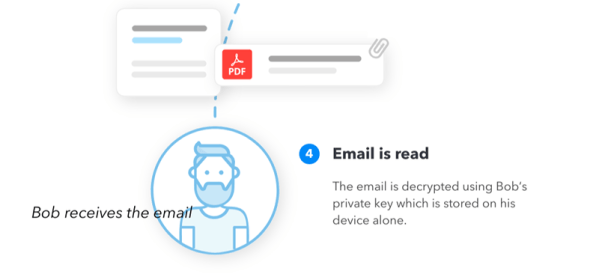
There have been many news stories lately about companies misusing your data, including your e-mails. What’s more, these giant repositories of data are favorite targets for hackers. Even if you trust the big corporations, you are also betting on their security. Criptext claims they have (possibly) the most private e-mail service ever. It uses the open Signal protocol and stores private keys and encrypted mail only on your device. All the applications to access your mail are open source, so presumably, someone would eventually spot any backdoors or open holes.

At the moment the service is free and the company reports that even when a paid offering is ready, there will still be a free tier. Of course, you can send and receive normal e-mail, too. You can also use a passphrase you send to someone else (presumably not by e-mail) so they can read an encrypted message.

Continue reading “E-Mail Service Claims It Doesn’t Store Your Mail”

Using E-Paper Displays For An Electronic Etch A Sketch

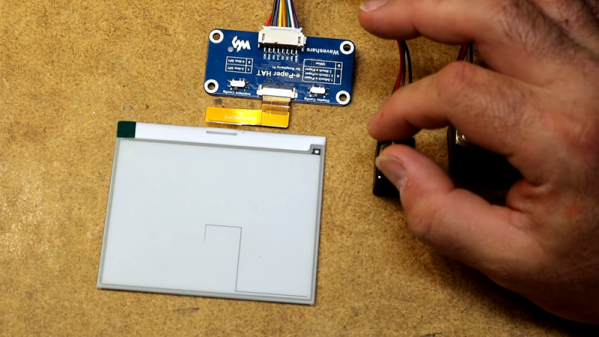
Electronic things are often most successful when they duplicate some non-electronic thing. Most screens, then, are poor replacements for paper. Except, of course, for E-paper. These displays have high contrast even in sunlight and they hold their image even with no power. When [smbakeryt] was looking at his daughter’s Etch-a-Sketch, he decided duplicating its operation would be a great way to learn about these paper-like displays.

You can see a video of his results and his findings below. He bought several displays and shows them all, including some three-color units which add a single spot color. The one thing you’ll notice is the displays are slow which is probably why they haven’t taken over the world.

The displays connect to a Raspberry Pi and many of the displays are meant to mount directly to a Pi. The largest display is nearly six inches and some of the smaller displays are even flexible. It appears the three color displays were much slower than the ones that use two colors. To combat the slow update speeds, some of the displays can support partial refresh.

The drawing toy uses optical encoders connected to the Raspberry Pi. The Python code is available. Even if you don’t want to duplicate the toy, the comparison of the displays is worth watching. We were really hoping he’d included an accelerometer to erase it by shaking, but you’ll have to add that feature yourself. By the way, in the video, he mentions the real Etch-a-Sketch might work with magnets. It doesn’t. It is an aluminum powder that sticks to the plastic until a stylus rubs it off.

We’ve seen these displays many times before, of course. If you are patient enough, you can even use them as Linux displays.

Continue reading “Using E-Paper Displays For An Electronic Etch A Sketch”

Pixy2 Is Super Vision For Arduino Or Raspberry Pi

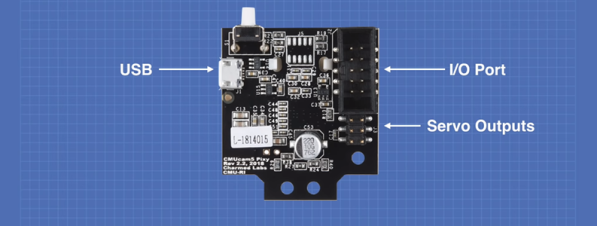
A Raspberry Pi with a camera is nothing new. But the Pixy2 camera can interface with a variety of microcontrollers and has enough smarts to detect objects, follow lines, or even read barcodes without help from the host computer. [DroneBot Workshop] has a review of the device and he’s very enthused about the camera. You can see the video below.

When you watch the video, you might wonder how much this camera will cost. Turns out it is about $60 which isn’t cheap but for the capabilities it offers it isn’t that much, either. The camera can detect lines, intersections, and barcodes plus any objects you want to train it to recognize. The camera also sports its own light source and dual servo motor drive meant for a pan and tilt mounting arrangement.

Continue reading “Pixy2 Is Super Vision For Arduino Or Raspberry Pi”

X-Ray Vision For FPGAs: Using Verifla

Last time I talked about how I took the open source Verifla logic analyzer and modified it to have some extra features. As promised, this time I want to show it in action, so you can incorporate it into your own designs. The original code didn’t actually capture your data. Instead, it created a Verilog simulation that would produce identical outputs to your FPGA. If you were trying to do some black box simulation, that probably makes sense. I just wanted to view data, so I created a simple C program that generates a VCD file you can read with common tools like gtkwave. It is all on GitHub along with the original files, even though some of those are not updated to match the new code (notably, the PDF document and the examples).

If you have enough pins, of course, you can use an external logic analyzer. If you have enough free space on the FPGA, you could put something like SUMP or SUMP2 in your design which would be very flexible. However, since these analyzers are made to be configurable from the host computer, they probably have a lot of circuitry that will compete with yours for FPGA space. You configure Verifla at compile time which is not as convenient but lets it have a smaller footprint.

Continue reading “X-Ray Vision For FPGAs: Using Verifla”

Fixing A Crazy Expensive Spectrum Analyser, With Solder

It used to be a spectrum analyzer was an exotic piece of gear. However, these days it is pretty common for a scope to have some ability to do the job — that is, plot amplitude versus frequency. However, a dedicated commercial product will usually have a lot more bandwidth and other features. [Signal Path] picked up an Anrtitsu 7.1 GHz portable spectrum analyzer. An expensive bit of kit — anywhere from around $4,000 to $8,000 on eBay — if it is working, but this one was not. It needed power, but it was also missing the internal flash card that the device uses to boot.

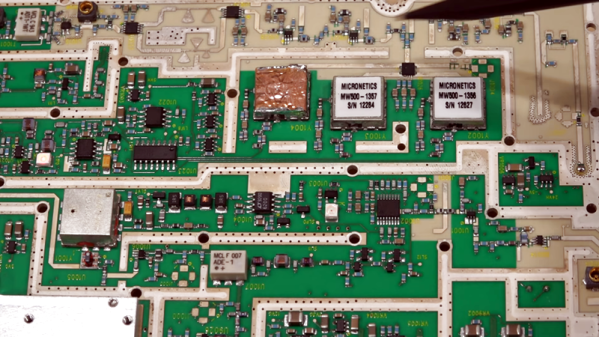
Being portable, there’s a lot of digital and RF electronics crammed into a very small space. The initial tear down didn’t look very interesting because it was mostly an RF shield. However, many tiny screws later, you can finally see the actual electronics.

Continue reading “Fixing A Crazy Expensive Spectrum Analyser, With Solder”