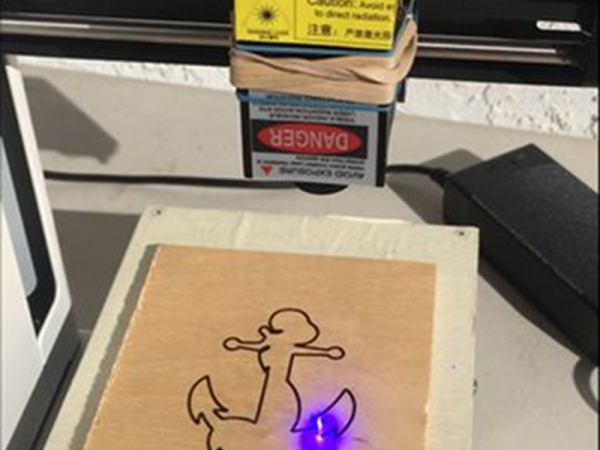
Monoprice Mini Laser Engraver Hack

There’s an old saying, that in theory there’s no difference between theory and practice, but in practice there is. That sentiment could easily be applied to refitting a 3D printer to hold a laser. There shouldn’t be much to it, rig up a laser module to turn on under computer control, mount it to your hot end carriage and off you go. In practice, though there are other considerations to account for. If you have a Monoprice Mini Select, you can start with instructions from [drodrii] for adding a laser to your printer.

Although [drodrii] mentions that you need a second 3D printer to make a bracket for the laser, we think you should be able to print it on the Mini as long as you do it before the first step of removing the hot end. However, since your laser module might not exactly match the one used in this project, you’d have to get it right the first time if you don’t have another 3D printer. Of course, you could remove the laser gear, remount the hot end, print a new bracket and start over, but that’d be a drag.
Continue reading “Monoprice Mini Laser Engraver Hack”

The WiFi Repeater You Probably Have On Your Bench

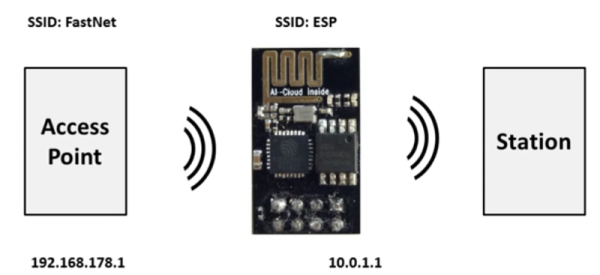
Few things are as frustrating as a WiFi signal that drops in and out. On a public network it is bad enough but at home? Even if you can live with it, your cohabitants will certainly impune your technical abilities if they don’t have solid WiFi.  One solution is a WiFi repeater. You can buy one, of course. But you can also make one out of an ESP8266 and some code from GitHub. There is also a video about the project, below.

[Martin Ger’s] code implements NAT, so it isn’t a true WiFi repeater, but more of a bridge or router. Of course, that means performance isn’t stellar, but tests show it can sustain about 5 Mbps, which isn’t bad for a little board that costs a couple of bucks. There is a limit of 8 clients, but that’s more than enough for a lot of cases. Even if you don’t want to use it as a router, it has a mesh mode that could be a basis for some interesting projects all by itself.

Continue reading “The WiFi Repeater You Probably Have On Your Bench”

Image Source: Brannon Dorsey

Art Eavesdrops On Life And Pagers

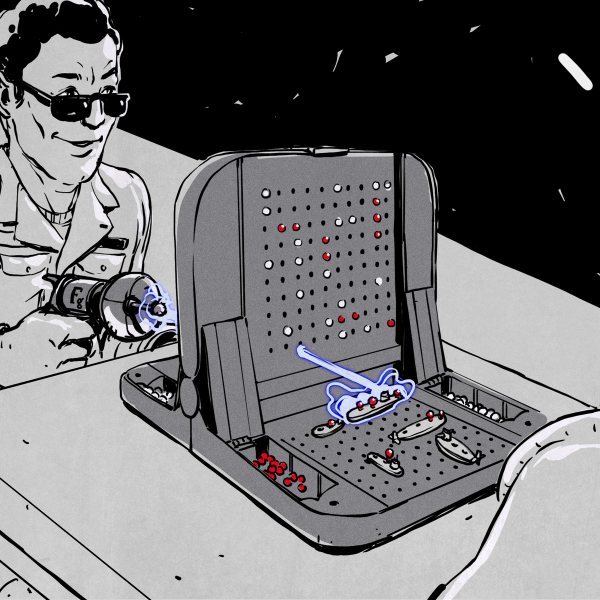
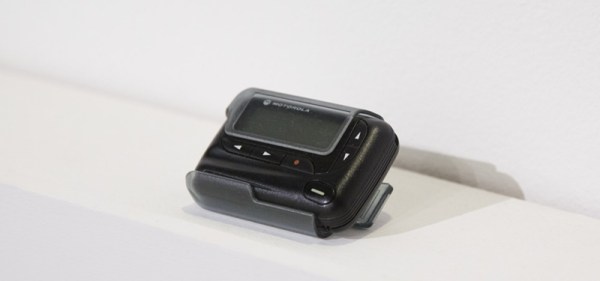
Before cell phones, pagers were the way to communicate on the go. At first, they were almost a status symbol. Eventually, they became the mark of someone who couldn’t or wouldn’t carry a cell phone. However, apparently, there are still some users that clutch their pagers with a death grip, including medical professionals. In an art project called HolyPager, [Brannon Dorsey] intercepted all the pager messages in a city and printed them on a few old-style roll printers. The results were a little surprising. You can check out the video below.

Almost all the pages were medical and many of them had sensitive information. From a technical standpoint, [Brannon’s] page doesn’t shed much light, but an article about the project says that it and other art projects that show the hidden world or radio waves are using our old friend the RTL-SDR dongle.

Pagers use a protocol — POCSAG — that predates our modern (and well-founded) obsession with privacy and security. That isn’t surprising although the idea that private medical data is flying through the air like this is. Decoding POCSAG isn’t hard. GNU Radio, for example, can easily handle the task.

We’ve looked at pager hacking in the past. You can even run your own pager network, but don’t blame us if you get fined.

Continue reading “Art Eavesdrops On Life And Pagers”

Tiny Transmitter Tracks Targets

It is a staple of spy movies. The hero — or sometimes the bad guy — sticks a device never any bigger than an Alka Seltzer to a vehicle or a person and then tracks it anywhere it goes in the world. Real world physics makes it hard to imagine a device like that for a lot of reasons. Tiny power supplies mean tiny lifetime and low power. Tiny antennas and low power probably add up to short range. However, [Tom’s] Hackaday.io project maybe as close as you can get to a James Bond-style tracker. You can see a video of the device, below.

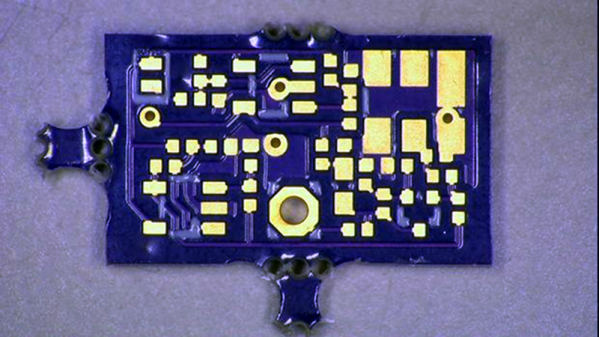
The little transmitter is smaller than a thumbnail — not counting the antenna and the battery — and draws very little current (180 uA). As you might expect, the range is not great, but [Tom] says with a Yagi and an RTL-SDR he can track the transmitter on 915 MHz for about 400 meters.

Continue reading “Tiny Transmitter Tracks Targets”

Can This Commodore 64 Be Saved?

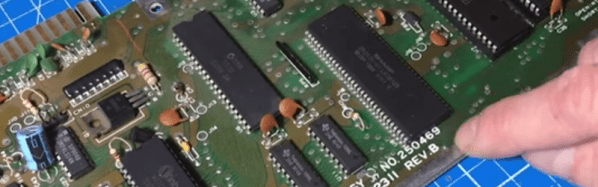
If you are a certain age, there’s a fair chance your first computer was a Commodore 64. These machines are antiques now, and [RetroManCave] received one from a friend’s loft in unknown condition. He’s made two out of three videos covering the machine, its history, and its internals. Assisting is Commodore 64 expert [Jan Beta] who apparently owned one way back when. You can see the first two videos, below.

The machine isn’t as old as you might think — it is the “newer” case style (circa 1987). [Jan] gives a great overview of the different motherboards you might encounter if you are lucky enough to come across one of these in a dumpster somewhere.

Continue reading “Can This Commodore 64 Be Saved?”

Microbalance Determines Alcohol Content

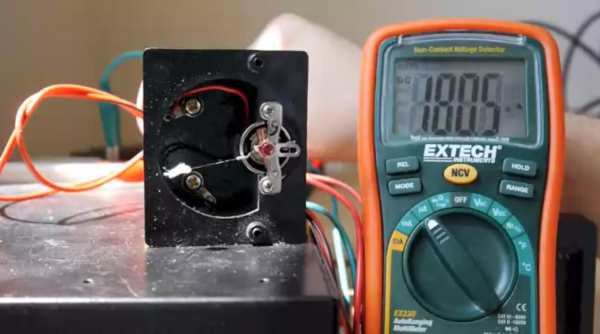
With the holiday season upon us, it is useful to be able to determine just how much (or how little) spiking the office party punch has received. [Russell Smith] shows how he tried to determine the proof level of booze using a microbalance made from an old-fashioned panel meter.

That might seem odd, but since alcohol evaporates faster than water, you can plot the change in evaporation rate if you have a good enough scale. That’s where the microbalance comes in. The idea is to weight down the needle of an old meter and measure the amount of current it takes to get to a certain deflection. His results weren’t totally satisfactory, but his methods were interesting.

Continue reading “Microbalance Determines Alcohol Content”

FCC Fines Drone FPV Maker For Using Radio Spectrum

If you listen to the radio bands in the United States, you might wonder if anyone at the FCC is paying attention, or if they are too busy selling spectrum and regulating the Internet. Apparently however, they are watching some things. The commission just levied a $180,000 fine on a company in Florida for selling audio/visual transmitters that use the ham bands as well as other frequencies.

The FCC charged that Lumenier Holdco LLC (formerly known as FPV Manuals LLC) was marketing uncertified transmitters some of which exceeded the 1-W power limit for ham transmitters used on model craft.

Continue reading “FCC Fines Drone FPV Maker For Using Radio Spectrum”