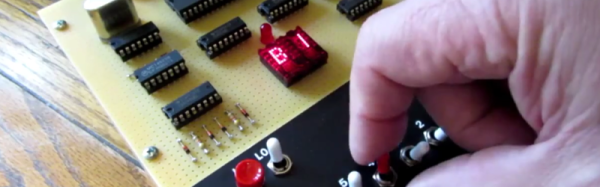
Vintage COSMAC Elf Is Pretty Close To Original

Popular Electronics was famous for the article introducing the Altair 8800 back in 1975 (well, the cover date was 1975; it really came out in late 1974). That was so popular (no pun intended), that they ran more computer construction articles, including the SWTPC 680 late in 1975. But in 1976 a very popular article ran on building a very simple computer called the COSMAC ELF. [Youtubba] had an Altair, but always wanted a “cute” COSMAC ELF. Now, forty-something years later, he finally got around to it. He made the very detailed video about his experience, below.

Surprisingly, he didn’t have to look very hard for too many of the components as most of them were available from Digikey. He had to get compatible RAM chips, the 1802 CPU and LED displays. He also couldn’t find a look-alike crystal, so he used a fake one and a hidden oscillator. The result looks awfully close to the original. He even did a nice front panel using Front Panel Express.

Continue reading “Vintage COSMAC Elf Is Pretty Close To Original”
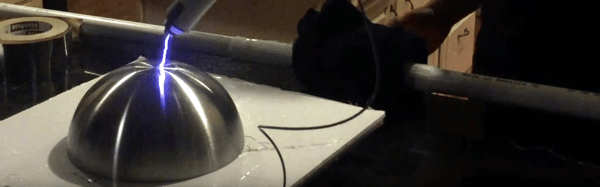
200KV Capacitor Uses Cake Pan And Bowl

[PhysicsGirl] posts videos that would be good to use in a classroom or homeschool environment. She recently showed a 200KV capacitor made from a cake pan, a bowl, and some other common items (see video, below).

One of the most interesting things about the project was how they charged the capacitor. A PVC pipe and some common hardware made a wand that they’d charge by rubbing a foam sleeve up and down against the dome formed by a metal bowl. We might have used a cat, but there’s probably some law against that.

To discharge, they used the end of the wand and were able to get a 10 cm spark. Based on the dielectric constant for air, they estimated that equated to a 200KV charge. They also discharged it through someone’s finger, which didn’t seem like a great idea.

We’ve talked about [PhysicsGirl’s] videos before. Granted, a lot of this won’t help the experienced hacker, but if you work with kids, they are a great way to make physics interesting and approachable. We wish she’d spent more time on the actual construction (you’ll need to slow it down to see all the details), though. If you really want a capacitor for your high voltage mad science, you might find these more practical. We’ve seen many homemade capacitors for high voltage.

Continue reading “200KV Capacitor Uses Cake Pan And Bowl”

Solid State Battery From The Man Who Brought Us Lithium Ion

Who is [John Goodenough]? He’s 94, so he’s been around long enough that you ought to know him. He was one of the co-inventors of the lithium-ion battery. Think about how much that battery has changed electronics. [Goodenough] along with [Maria Helena Braga] may have come up with that battery’s successor: the solid state battery. There’s a paper available that is free, but requires registration. If you don’t want to register, you can read the news release from the University of Texas with no trouble.

Keywords used to describe the new battery are low-cost, noncombustible, long cycle life, high energy density, and fast charge and discharge rates. The pair is also claiming three times the energy density of a current lithium-ion battery. They also claim that the batteries recharge in minutes instead of hours. You can see a video from [Transport Evolved] that discusses the invention, below.

Continue reading “Solid State Battery From The Man Who Brought Us Lithium Ion”

Stop Printing Air With A Filament Sensor

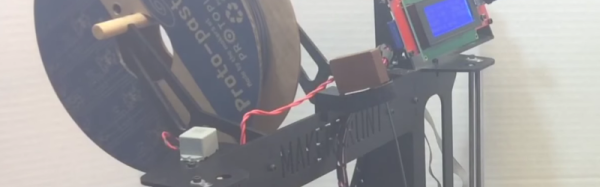
If you have had a 3D printer for awhile, you know the heartbreak of coming in to check on an 8-hour print only to find that in hour 7 you ran out of filament (or the filament broke) and your printer has been dutifully moving around for no reason. [Chuck Hellebuyck] knows and he decided to make a filament sensor he found on Thingiverse.

Finding a part on Thingiverse and printing it probably doesn’t warrant much attention. But if you watch the video, below, it is a good example of how things from Thingiverse don’t always meet your needs. The microswitch [Chuck] had was bigger than the design used. So he loaded the STL file into TinkerCAD and fixed it. He shows you exactly how he did it. That’s a useful skill because you never know when you’ll need to modify some part you’ve found on the Internet.

Continue reading “Stop Printing Air With A Filament Sensor”

Antenna Analyzer Is A Lab In A Box

There was a time when the measure of a transmitting radio antenna was having it light an incandescent bulb. A step up was a classic SWR/Power meter that showed you forward and reflected power. Over the years, a few other instruments have tried to provide a deeper look into antenna performance. However, the modern champion is the antenna analyzer which is a way of measuring vector impedance.

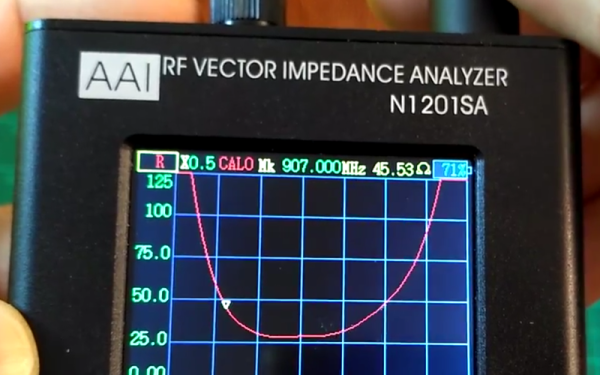
[Captain Science] did a review of an inexpensive N1201SA analyzer. This device is well under $200 from the usual Chinese sellers. The only thing a bit odd is the frequency range which is 140 MHz to 2700 MHz. For some extra money (about $80 or $100 more) you can drop the low-end frequency to just under 35 MHz.

Continue reading “Antenna Analyzer Is A Lab In A Box”

Making Laser Cutter Designs Work In A 3D Printer

The main mechanical tools in a hacker’s shop used to be a drill press and a lathe. Maybe a CNC mill, if you were lucky. Laser cutters are still a rare tool to find in a personal shop, but today’s hackers increasingly have access to 3D printers. What happens when you have a design for a laser cutter (2D parts) but only have access to a 3D printer? You punt.

[DIY3DTECH] has a two-part video on taking a 2D design (in an SVG file) and bringing it into TinkerCad. At that point, he assembles the part in software and creates a printable object. You can see the videos below.

Continue reading “Making Laser Cutter Designs Work In A 3D Printer”

Speech To Sign Language

According to the World Federation of the Deaf, there are around 70 million people worldwide whose first language is some kind of sign language. In the US, ASL (American Sign Language) speakers number from five hundred thousand to two million. If you go to Google translate, though, there’s no option for sign language.

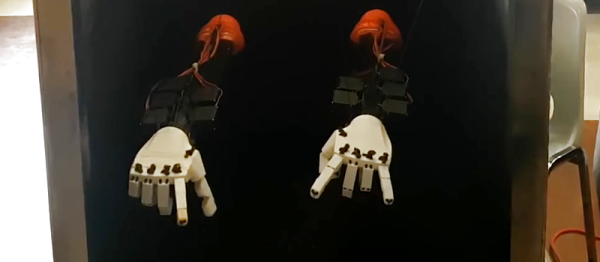
[Alex Foley] and friends decided to do something about that. They were attending McHack (a hackathon at McGill University) and decided to convert speech into sign language. They thought they were prepared, but it turns out they had to work a few things out on the fly. (Isn’t that always the case?) But in the end, they prevailed, as you can see in the video below.

Continue reading “Speech To Sign Language”