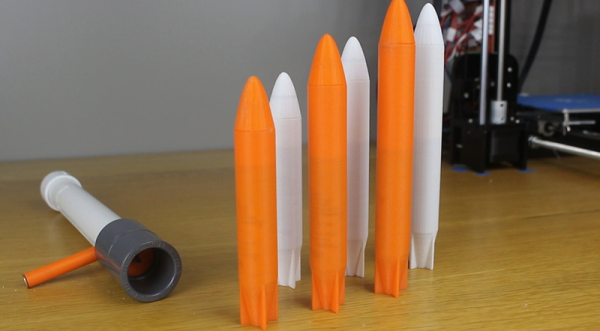
We’ve probably all made matchstick rockets as kids. And around here anything that even vaguely looks like a rocket will get some imaginary flight time. But [austiwawa] is making some really cool 3D printed rockets that use common CO2 cartridges as a propellant. You can see them in action in the video below.
You might think just sticking a CO2 cylinder in a 3D printed jacket isn’t such a big deal, but [austiwawa] really went the extra mile. He read up on how to make the rocket stable (by manipulating the center of gravity versus the center of pressure) and explains what he had to do to get the rockets flying like you’d expect.
In addition, the launch tube is pretty interesting. A 3D printed part holds a sharp point and a spring. You lock the spring and when released it punches a clean hole in the propellant casing. The actual tube is a long piece of PVC pipe. From the video, it looks like these little rockets fly pretty high.
Judging from the video, the rocket body and launcher came from TinkerCAD. The way [austiwawa] put the fins on was both simple and clever.
Of course, you could also use Coke and propane, if you like. We’ve also seen some pretty cool setups with compressed air. Check out the rockets in action after the break,
There was a time when just about every ham had a pricey VHF or UHF transceiver in their vehicle or on their belt. It was great to talk to friends while driving. You could even make phone calls from anywhere thanks to automatic phone patches. In 1980 cell phones were uncommon, so making a call from your car was sure to get attention.
Today, ham radio gear isn’t as pricey thanks to a flood of imports from companies like Baofeng, Jingtong, and Anytone. While a handheld transceiver is more of an impulse buy, you don’t hear as much chat and phone calls, thanks to the widespread adoption of cell phones. Maybe that’s why [Bastian] had bought a cheap Baofeng radio but never used it.
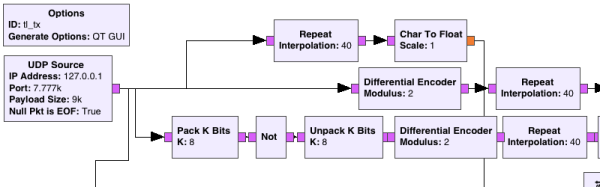
He was working on a traffic light project and wanted to send an RF signal when the light changes. He realized the Baofeng radio was cheap and cheerful solution. He only needed a way to have the PC generate an audio signal to feed the radio. His answer was to design a UDP packet to audio flow graph in GNU Radio. GNU Radio then feeds the Baofeng. The radio’s built-in VOX function handles transmit switching. You can see a video demonstration, below.
There have been a lot of smart computers on TV and movies. We often think among the smartest, though, are the ones on Star Trek. Not the big “library computer” and not the little silver portable computers. No, the smart computers on Star Trek ran the doors. If you ever watch, the doors seem to know the difference between someone walking towards it, versus someone flying towards it in the middle of a fist fight. It also seems to know when more people are en route to the door.
Granted, the reason they are so smart is that the doors really have a human operating them. For the real fan, though, you can buy a little gadget that looks like an intercom panel from the Enterprise. That would be cool enough, but this one has sound effects and can sense when someone walks into your doorway so they can hear the comforting woosh of a turbolift door.
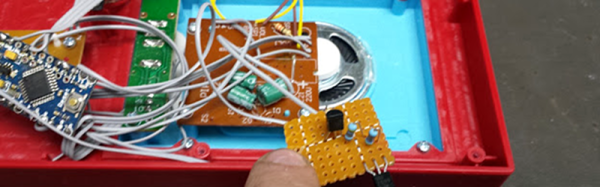
Of course, for the real hacker, that’s not good enough either. [Evan] started with this $25 gadget, but wanted to control it with an Arduino for inclusion in his hackerspace’s pneumatic door system. He did a bit of reverse engineering, a bit of coding, and he wound up in complete control of the device.
A lot of science museums and parks feature something called an acoustic mirror. The one at Houston’s Discovery Green park is called the listening vessels. [Doug Hollis] created two acoustic mirrors 70 feet apart, pointing at each other. If you stand or sit near one of the vessels, you can hear a whisper from someone near the other vessel. The limestone installations (see right) are concave and focus sound like a parabolic mirror will focus light.
Just a science curiosity, right? Maybe today, but not always. The story of these devices runs through World War II and is an object lesson in how new technology requires new ways of thinking about things.
If you lay out PC boards using software, it is a good bet you have an opinion about autorouters. Some people won’t use a package that can’t automatically route traces. Others won’t accept a machine layout when they can do their own by hand. You can, of course, combine the two, and many designers do.
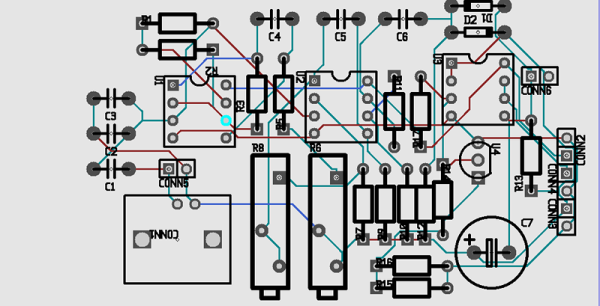
The open source gEDA PCB package (and pcb-md) have an autorouter, but it is pretty simplistic. [VK5HSE] shows how you can use a few tools to interface with the Java Freerouting application, to get a better result. For example, the original router made square corners, while the Freerouting application will create angles and arcs, if configured properly.
If you make crystal radios, you’ve probably got a few crystal earpieces. The name similarity is a bit coincidental. The crystal in a crystal radio was a rectifier (most often, these days, a germanium diode, which is, a type of crystal). The crystal in a crystal earpiece is a piezoelectric sound transducer.
Back in the 1960s, these were fairly common in cheap transistor radios and hearing aids. Their sound fidelity isn’t very good, but they are very sensitive and have a fairly high impedance, and that’s why they are good for crystal radios.
[Steve1001] had a few of these inexpensive earpieces that either didn’t work or had low sound output. He found the root cause was usually a simple problem and shares how to fix them without much trouble.
When I first got interested in computers, it was all but impossible for an individual to own a computer outright. Even a “small” machine cost a fortune not to mention requiring specialized power, cooling, and maintenance. Then there started to be some rumblings of home computers (like the Mark 8 we recently saw a replica of) and the Altair 8800 burst on the scene. By today’s standards, these are hardly computers. Even an 8-bit Arduino can outperform these old machines.
As much disparity as there is between an Altair 8800 and a modern personal computer, looking even further back is fascinating. The differences between the original computers from the 1940s and anything even remotely “modern” like an Altair or a PC are astounding. If you are interested in that kind of history, you should read a paper entitled “Electronic Computing Circuits of the ENIAC” by [Arthur W. Burks].
These mid-century designers used tubes and were blazing new ground. Part of what makes the ENIAC so different is that it had a different design principle than a modern computer. It was less a general purpose stored-program computer and more of a collection of logic circuits that could be configured to solve problems — sort of a giant vacuum tube FPGA, if you will. It used some internal representations that proved to be suboptimal which also makes it seem strange. The EDSAC — a later device — was closer to what we think of as a computer. Yet the ENIAC was a major step in the direction of a practical digital computer.
Cost and Size
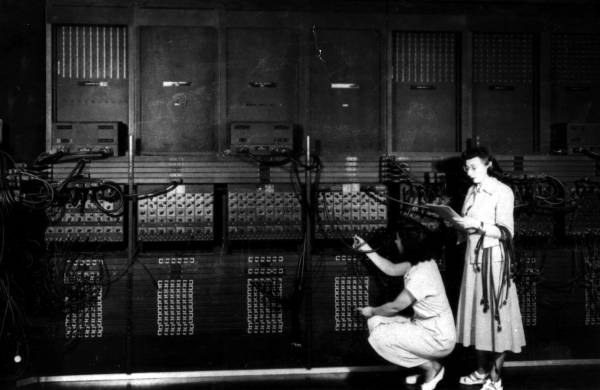
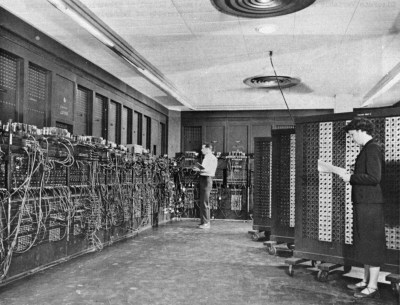
Programming the ENIAC in 1951 (±4 years) [Image Source: Public Domain]The size of ENIAC is hard to imagine. The device had about 18,000 tubes, 7,000 diodes, 70,000 resistors, 10,000 capacitors, and 6,000 switches. There were 5 million hand-soldered joints! ([Thomas Haigh] tells us that while this is widely reported, the real number was about 500,000.) Physically, it stood 10 feet tall, 3 feet deep, and 100 feet long. The tube filaments alone required 80 kW of power. Even the cooling system consumed 20 kW. In total, it took 150 kW to run the beast.
The cost of the machine was about $487,000. Almost a half-million dollars in 1946 is plenty. But that’s nearly seven million dollars in today’s money. What was worth that kind of expenditure? The military built firing tables for shell trajectories. From the [Burks] paper:
“A skilled computer with a desk machine can compute a 60-second trajectory in about twenty hours…”
Keep in mind that in 1946, a computer was a person. [Burks] goes on to say that a differential analyzer can do the same job in 15 minutes. ENIAC, on the other hand, could do it in 30 seconds and with a greater precision than the differential analyzer.


 Just a science curiosity, right? Maybe today, but not always. The story of these devices runs through World War II and is an object lesson in how new technology requires new ways of thinking about things.