The Turing Tapes

The recent movie “The Imitation Game” gave [Alan Turing] some well-deserved fame among non-computer types (although the historical accuracy of that movie is poor, at best; there have been several comparisons between the movie and reality). However, for people in the computer industry, Turing was famous for more than just helping to crack Enigma. His theoretical work on computing led to the Turing machine, which is still an important concept for reasoning about computers in a mathematical way. He also laid the foundation for the stored program computer that we take for granted today.

What’s a Turing Machine?

A Turing machine is deceptively simple and, like many mathematical models, highly impractical. Leading off the inpracticalities, the machine includes an infinite paper tape. There is a head that can read and write any symbol to the tape at some position, and the tape can move to the left or the right. Keep in mind that the head can write a symbol over another symbol, so that’s another practical difficulty, although not an insurmountable one. The other issue is that the symbol can be anything: a letter, a number, a jolly wrencher, or a bunch of dots. Again, not impossible, but difficult to do with practical hardware implementations.

Continue reading “The Turing Tapes”

Lego-Like Chemistry And Biology Erector Set

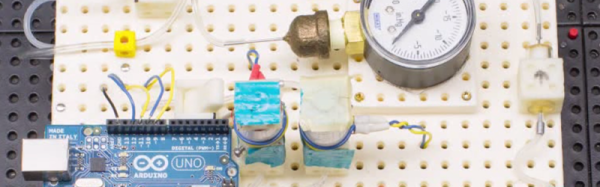
A team of researchers and students at the University of California, Riverside has created a Lego-like system of blocks that enables users to custom build chemical and biological research instruments. The system of 3D-printed blocks can create a variety of scientific tools.

The blocks, which are called Multifluidic Evolutionary Components (MECs) appeared in the journal PLOS ONE. Each block in the system performs a basic lab instrument task (pumping fluids, making measurements or interfacing with a user, for example). Since the blocks are designed to work together, users can build apparatus — like bioreactors for making alternative fuels or acid-base titration tools for high school chemistry classes — rapidly and efficiently. The blocks are especially well suited for resource-limited settings, where a library of blocks can create a variety of different research and diagnostic tools.

Continue reading “Lego-Like Chemistry And Biology Erector Set”

Retrotechtacular: Tom Carter Revolutionized Your Phone

It is hard to remember, but there was a time when you couldn’t hook much to a telephone line except a telephone. Although landlines are slowly falling out of favor, you can still get corded and wireless phones, answering machines, and even dial up modems. Alarm systems sometimes connect to the phone system along with medical monitoring devices and a host of other accessories.

All of that’s possible because of a Texan named Tom Carter. Tom Carter was the David that stood up to one of the biggest Goliath’s of his day: the phone company. The phone company had a legal monopoly on providing phone service. The reasoning was that it didn’t make sense to have multiple competing companies trying to run wires to every house and business in the country. Makes sense, right?

Continue reading “Retrotechtacular: Tom Carter Revolutionized Your Phone”

Secret Riddle Retro Radio

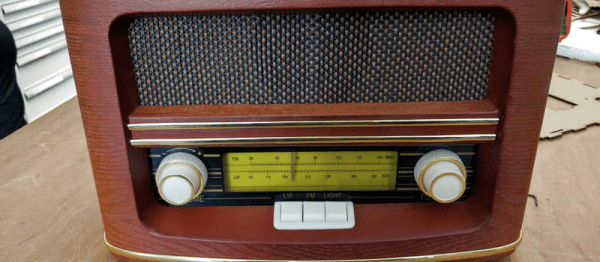
When [the-rene] was building an escape room, he decided to have a clue delivered by radio. Well, not exactly radio, but rather an old-fashioned radio that lets you tune to a faux radio station that asks a riddle. When you solve the riddle, a secret compartment opens up. [the-rene] says you could have the compartment contain a key or a clue or even a cookie.

The outer case is actually an old radio gutted for this purpose. In addition, a laser cut box and a servo motor form the secret compartment.

Continue reading “Secret Riddle Retro Radio”

Ion Trap Makes Programmable Quantum Computer

The Joint Quantum Institute published a recent paper detailing a quantum computer constructed with five qubits formed from trapped ions. The novel architecture allows the computer to accept programs for multiple algorithms.

Quantum computers make use of qubits and trapped ions–ions confined with an electromagnetic field–are one way to create them. In particular, a linear radio frequency trap and laser cooling traps five ytterbium ions with a separation of about 5 microns. To entangle the qubits, the device uses 50 to 100 laser pulses on individual or pairs of ions. The pulse shape determines the actual function performed, which is how the device is programmable. The operations depend on the sequence of laser pulses that activate it. Continue reading “Ion Trap Makes Programmable Quantum Computer”

Easy Toy Hack Makes Floating Death Star

It always seems odd to us that magnetic levitation seems to only find use in big projects (like trains) and in toys. Surely there’s a practical application that fits on our desktop. This isn’t it, but it is a cool way to turn a cheesy-looking levitating globe into a pretty cool Star Wars desk toy.

As projects go, this isn’t especially technically challenging, but it is a great example of taking something off the shelf and hacking it into something else. The globe covering came off, revealing two hemispheres. A circular hole cut out and inverted provides the main weapon. Some internal lighting and small holes provide light. Some fiber optic sanded and tinted green make the weapon fire. The rest is all in the painting.

There’s even a tiny imperial ship orbiting the killer man-made (or is that Sith-made) moon. If you want a bigger challenge, you might try bamboo. Or you can go minimalist and let your eyes and brain do most of the work.

Continue reading “Easy Toy Hack Makes Floating Death Star”

Drone Doesn’t Know Much About Art, But Knows What It Likes

There is an artistic technique known as stippling where an artist creates a picture using small dots of ink or paint. The result is almost like using a dot matrix printer at low resolution. [Paul Kry] at McGill University doesn’t directly teach art, but he did teach drones to produce pictures using the stippling technique.

As you can see in the video below, the drones carry an ink-soaked sponge. Internal sensors and a motion capture system get them to the right spot and then they move to put the ink down on the work surface. It isn’t perfect, but it does make recognizable drawings and presumably a little inconsistency makes it even more artsy.

Continue reading “Drone Doesn’t Know Much About Art, But Knows What It Likes”