Ham Radio WiFi

Many Ham Radio operators in the United States participate in Field Day. This is an annual exercise where radio operators are encouraged to set up stations in conditions that might occur after a natural disaster. Usually, this means taking over some park or camp site, bringing generators, portable equipment, and making it all work for the weekend before you tear it back down.

It isn’t much of a Field Day without electricity. That’s why most stations use a generator, solar cells, or even batteries. Today, though, you probably need an Internet-connected computer to do logging and other features. [HamRadioConcepts] has a video (see below) that shows how they grabbed Internet from a distance for their Field Day site.

Continue reading “Ham Radio WiFi”

Bridging The Air Gap; Data Transfer Via Fan Noise

When you want to protect a computer connected to the Internet against attackers, you usually put it behind a firewall. The firewall controls access to the protected computer. However, you can defeat any lock and there are ways a dedicated attacker can compromise a firewall. Really critical data is often placed on a computer that is “air gapped.” That is, the computer isn’t connected at all to an insecure network.

An air gap turns a network security problem into a physical security problem. Even if you can infect the target system and collect data, you don’t have an easy way to get the data out of the secure facility unless you are physically present and doing something obvious (like reading from the screen into a phone). Right? Maybe not.

Researchers in Isreal have been devising various ways to transmit data from air walled computers. Their latest approach? Transmit data via changing the speed of cooling fans in the target computer. Software running on a cellphone (or other computer, obviously) can decode the data and exfiltrate it. You can see a video on the process below.

Continue reading “Bridging The Air Gap; Data Transfer Via Fan Noise”

Tutorial On Signal Processing In Linux With Octave

If you’ve taken any digital signal processing classes at a college or university, you’ve probably been exposed to MATLAB. However, if you want to do your own work, you might think about Linux and one of the many scientific computing applications available for it.

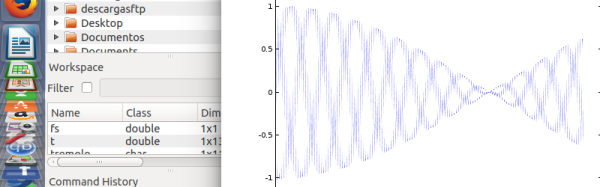
[David Duarte] recently published a three-part tutorial on using Octave to do scientific audio processing. The first part covers basic reading, writing, and playing of audio files. Part two covers synthesis of signals, plotting, and some basic transformations.  Modulation is the topic of the third part. If you prefer your tutorials on video, you can check out the video below.

We’ve talked about MATLAB before in the context of message cracking. Then again, some of the best signal processing is done by humans. If you don’t like Octave, you might try Scilab, another Linux package that is similar. There’s also Freemat, Sage, and Spyder. Of course, you can also run MATLAB under Linux.

Retrotechtacular: ASCII Art In The 19th Century

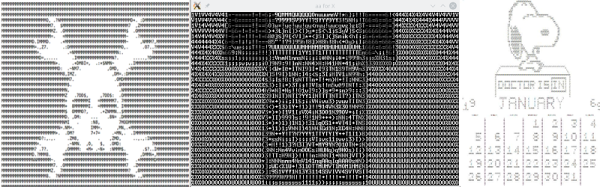
Computer graphics have come a long way. Some video games today exceed what would have passed for stunning cinema animation only a few years ago. However, it hasn’t always been like this. One of the earliest forms of computer-generated graphics used text characters to draw on printers.
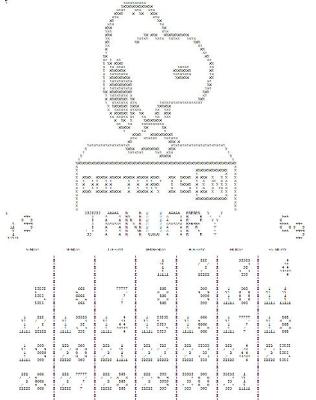
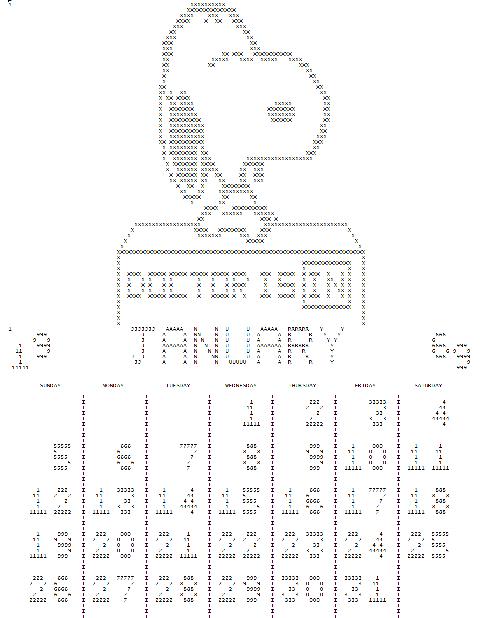
snoopy-calendarEarly computer rooms were likely to have a Snoopy character on green and white fan-fold paper. Calendars with some artwork were also popular (see left, and find out about the FORTRAN that created it, if you like). Ham radio operators who use teletypes (RTTY, in ham parlance) often had vast collections of punched tape that held artwork. Given that most hams in the 1950s and 1960s were men and the times were different, a lot of them were more or less “R” rated.
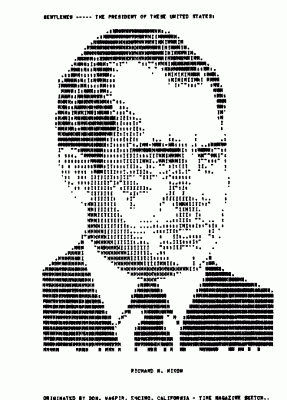
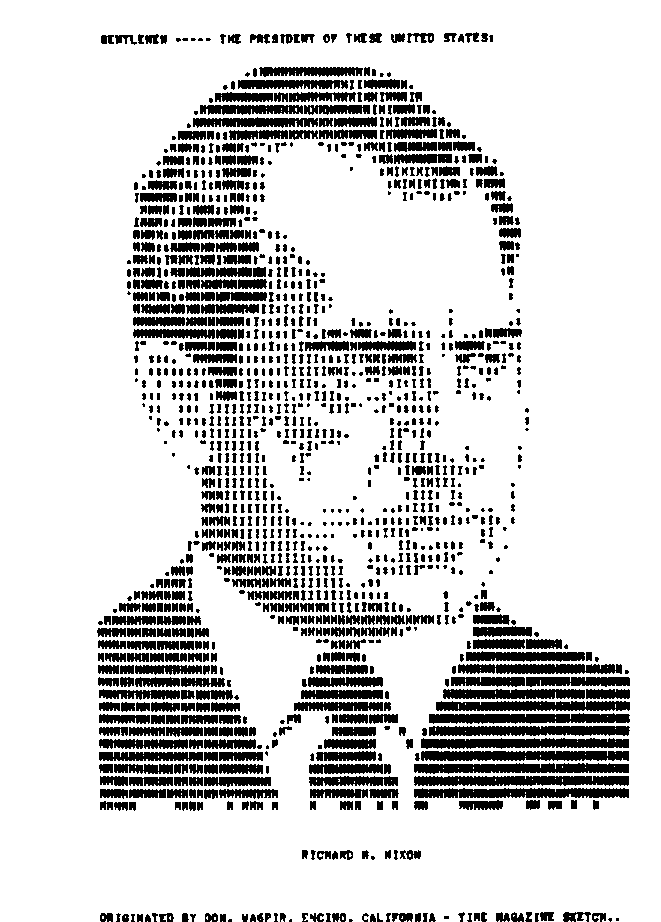
nixonNot all of them were, though. For example, Richard Nixon was decidedly “G” rated (see right). Simple pictures would use single characters, but sophisticated ones would use the backspace character to overprint multiple characters.

Ham Radio Art

You often hear this described as ASCII art, today, although hams usually use 5-bit BAUDOT code, so that’s a misnomer for those images, at least. Of course, today, people aren’t keen on storing roll after roll of paper tape (or even owning a tape reader) so there have been several projects to capture this art in a more modern format.

Although there is still some RTTY art activity, picture sending has been mostly replaced by slow scan TV (SSTV) which sends actual still images or other modes like FAX. Some of the newer digital modes even have the ability to send pictures. You can be discussing your radio for example, and then show the other ham a photo of the radio.

Continue reading “Retrotechtacular: ASCII Art In The 19th Century”

Raspberry Pi Gets Turned On

The Raspberry Pi and other similar Linux-based single board computers simplify many projects. However, one issue with Linux is that it doesn’t like being turned off abruptly. Things have gotten better, and you can certainly configure things to minimize the risk, but–in general–shutting a Linux system down while it is running will eventually lead to file system corruption.

If your project has an interface, you can always provide a shutdown option, but that doesn’t help if your application is headless. You can provide a shutdown button, but that leaves the problem of turning the device back on.

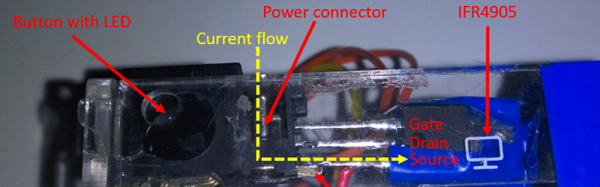
[Ivan] solved this problem with–what else–an Arduino (see the video below). Simplistically, the Arduino reads a button and uses a FET to turn off the power to the Pi. The reason for the Arduino, is that the tiny processor (which draws less than a Pi and doesn’t mind being shut down abruptly) can log into the Pi and properly shut it down. The real advantage, though, is that you could use other Arduino inputs to determine when to turn the Pi on and off.

Continue reading “Raspberry Pi Gets Turned On”

Mag Lev Without The Train (But With An FPGA)

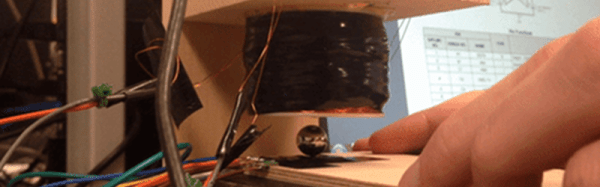
It always surprises us that magnetic levitation seems to have two main purposes: trains and toys. It is reasonably inexpensive to get floating Bluetooth speakers, globes, or just floating platforms for display. The idea is reasonably simple, especially if you only care about levitation in two dimensions. You let an electromagnet pull the levitating object (which is, of course, ferrous). A sensor detects when the object is at a certain height and shuts off the magnet. The object falls, which turns the magnet back on, repeating the process. If you do it right, the object will reach equilibrium and hover near the sensor.

Some students at Cornell University decided to implement the control loop to produce levitation using an Altera FPGA. An inductive sensor determined the position of an iron ball. The device uses a standard proportional integral derivative (PID) control loop. The control loop and PWM generation occur in the FPGA hardware. You can see a video of their result, below.

Continue reading “Mag Lev Without The Train (But With An FPGA)”

One lightbulb ON one OFF

Single Molecule Detects Light

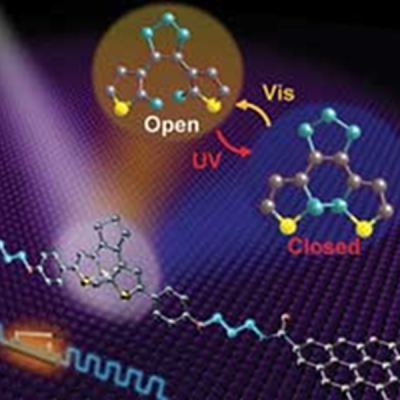
Everything is getting smaller all the time. Computers used to take rooms, then desks, and now they fit in your pocket or on your wrist. Researchers that investigate light sensors have known that individual diarylethene molecules can exist in two states: one where it conducts electricity and one where it doesn’t. A visible photon causes the molecule to be electrically open and ultraviolet causes it to close. But there’s a problem.

light600Placing electrodes on the molecule interferes with the process. Depending on the kind of electrode, the switch will get stuck in the on or off position. Researchers at Peking University in Beijing determined that placing some buffering material between the molecule and the electrodes would reduce the interference enough to maintain correct operation. What’s more the switches remain operable for a year, which is unusually long for this kind of construct.

Using chemical vapor deposition and electron beam lithography, the team produced over 40 working single molecule switches. These devices could be useful in optical computing and other applications. Future work will include developing multilevel switches comprised of multiple molecules.

If you want something more macroscopic, you might try using an LED to sense light. A switch is fine, but sometimes you want to generate a signal.