
Blue Ribbon Microphone

Edmund_Lowe_fsa_8b06653If you’ve ever seen an old movie or TV show where there was a radio announcer, you’ve probably seen a ribbon microphone. The RCA 44 (see Edmund Lowe, on right) had exceptional sound quality and are still valued today in certain applications. The name ribbon microphone is because the sound pickup is literally a thin strip of aluminum or other conductive material.

Unlike other common microphones, ribbons pick up high frequencies much better due to the high resonant frequency of the metallic ribbon. This is not only better in general, but it means the ribbon mic has a flatter frequency response even at lower frequencies. Another unique feature is that the microphone is bidirectional, hearing sounds from the front or back equally well. It is possible to build them with other directional patterns, although you rarely see that in practice.

Invention

In the early 1920s, Walter Schottky and Erwin Gerlach developed the ribbon microphone (and, coincidentally, the first ribbon loudspeaker). Harry Olson at RCA developed a ribbon mic that used coils and permanent magnets which led to the RCA Photophone Type PB-31 in 1931. Because of their superior audio response, they were instant hits and Radio City Music Hall started using the PB-31 in 1932. A newer version appeared in 1933, the 44A, which reduced reverberation.


Continue reading “Blue Ribbon Microphone”

Shor’s Algorithm In Five Atoms

If you want to factor a number, one way to do it is Shor’s algorithm. That’s a quantum algorithm and finds prime factors of integers. That’s interesting because prime factorization is a big deal of creating or breaking most modern encryption techniques.

Back in 2001, a group at IBM factored 15 (the smallest number that the algorithm can factor) using a 7 qubit system that uses nuclear magnetic resonance. Later, other groups duplicated the feat using photonic qubits. Typical implementations take 12 qubits. However, recent work at MIT and the University of Innsbruck can do the same trick with 5 atoms caught in an ion trap. The researchers believe their implementation will easily scale to larger numbers.

Each qubit is an atom and LASER pulses perform the logic operations. By removing an electron to make each atom positively charged, an electric field can exactly hold the positively charged ions in position only microns apart.

We’ve covered quantum computing before. We’ve even talked about the effect of practical quantum computing on encryption. You might also want to read more about the algorithm involved.

Photo credit: Jose-Luis Olivares/MIT

WISP Needs No Battery Or Cable

One of the problems with the Internet of Things, or any embedded device, is how to get power. Batteries are better than ever and circuits are low power. But you still have to eventually replace or recharge a battery. Not everything can plug into a wall, and fuel cells need consumables.

University of Washington researchers are turning to a harvesting approach. Their open source WISP board has a sensor and a CPU that draws power from an RFID reader. To save power during communication, the device backscatters incoming radio waves, which means it doesn’t consume a lot of its own power during transmissions.

The big  news is that TU Delft has contributed code to allow WISP to reprogram wirelessly. You can see a video about the innovation below. The source code is on GitHub. Previously, a WISP had to connect to a PC to receive a new software load.

Continue reading “WISP Needs No Battery Or Cable”

ESP8266 Or MKR1000?

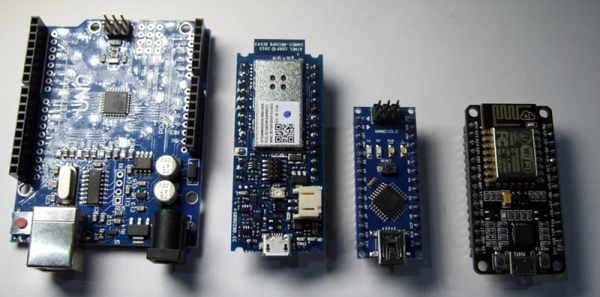
If you are a regular Hackaday reader, you’ve probably seen plenty of ESP8266 projects. After all, the inexpensive device is a workhorse for putting a project on WiFi, and it works well. There is a processor onboard, but, most often, the onboard CPU runs a stock firmware that exposes an AT command set or Lua or even BASIC. That means most projects have a separate CPU and that CPU is often–surprise–an Arduino.

It isn’t a big leap of logic to imagine an Arduino with an integrated WiFi subsystem. That’s the idea behind the MKR1000. But the real question you have to ask is: is it better to use an integrated component or just put an Arduino and ESP8266 together?

[Andreas Spiess] not only asked the question, but he answered it in a YouTube video (see below). He examines several factors on the MKR1000, the Arduino Due and Uno, and several other common boards. The examination covers performance, features, and power consumption.

Continue reading “ESP8266 Or MKR1000?”

Ping Pong Spectrum Analyzer

A spectrum analyzer is a pretty useful tool for working with signals where the size of the frequency components matter. Usually, the display is a screen. Sometimes, you see it done with LEDs. [Mag Laboratories] did it with ping pong balls.

The device uses a processor to calculate a Fourier transform, cutting an audio signal into 16 frequency bands. The processor converts each of these values to a PWM output that drives small fans. The fans blow the ping pong ball up the tube proportional to the fan speed. You can see the result in the video below.

Continue reading “Ping Pong Spectrum Analyzer”

Passwords? Just Use Your Head!

Biometrics–the technique of using something unique about your body as a security device–promises to improve safety while being more convenient than a password. Fingerprints, retinal scans, and voice identification have all found some use, although not without limitations.

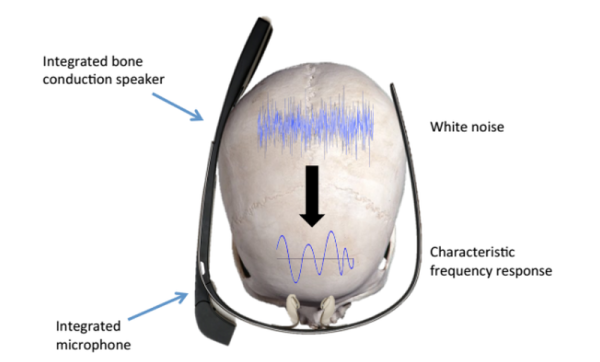
Now researchers in Germany want you to use your head, literally. SkullConduct measures vibrations of your skull in response to a sonic signal. A small prototype was successful and is particularly well suited for something you are holding up to your head anyway, like a smartphone or a headset like a Google Glass.

There are some limitations, though. For one thing, background noise can be a factor. It stands to reason, also, that more testing is necessary.

This looks straightforward enough that you could try your own version of it. After all, scanning veins in your hand has been hacked. We’ve even seen a biometric safe.

Gear Clock Uses Stepper Motor

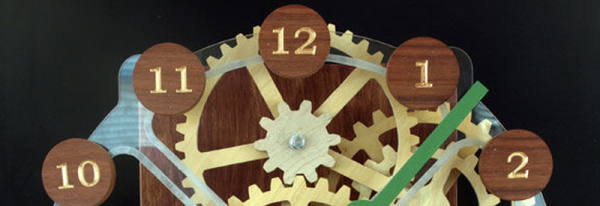
[Rjeuch] liked a wooden clock he saw on the Internet, but the gears were produced with a proprietary software tool. So he built his own version. Unlike the original, however, he chose to use a stepper motor to drive the hands.

The clock’s gears aren’t just for show, and the post does a good job explaining how the gears work, how you might customize them, and how they fit together. The clock’s electronics rely on an Arduino.

Continue reading “Gear Clock Uses Stepper Motor”