Pipe In (Robot) Hand

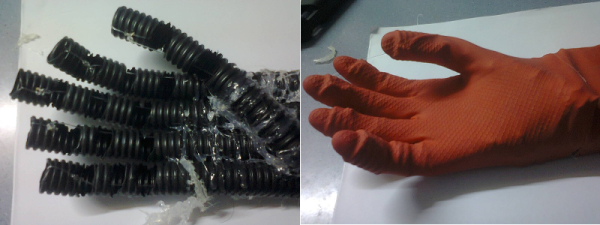
How do you make a robot hand? If you are [Robimek], you start with some plastic spiral tubing, some servo motors, and some fishing line. Oh, and you also need an old glove.

The spiral tubing (or pipe, if you prefer) is cut in a hand-like shape and fused together with adhesive. The knuckle joints are cut out to allow the tubing to flex at that point. The fishing line connects the fingertips to the servo motors.

The project uses an Arduino to drive the servos, although you could do the job with any microcontroller. Winding up the fishing line contracts the associated finger. Reeling it out lets the springy plastic pipe pull back to its original position.The glove covers the pipes and adds a realistic look to the hand.
Continue reading “Pipe In (Robot) Hand”


Crawl, Walk, Run: A Starter CPU

Last time I talked about getting started with CPU design by looking at older designs before trying to tackle a more modern architecture. In particular, I recommended Caxton Foster’s Blue, even though (or maybe because) it was in schematic form. Even though the schematics are easy to understand, Blue does use a few dated constructs and you probably ought to build your take on the design using your choice of VHDL or Verilog.

In my case, my choice was Verilog. You can find my implementation of Blue on Opencores.org. I made quite a few changes to Foster’s original design. For example, armed with semiconductor memory, I managed to get all instructions to operate in one major cycle (which is, of course, 8 minor cycles). I also modernized the clock generation and added some resources and instructions.

Continue reading “Crawl, Walk, Run: A Starter CPU”

Moldy Rechargeable Batteries

What’s worse than coming in from the workbench for a sandwich only to discover that the bread has molded? That red bread mold–Neurospora crassa–can transform manganese into a mineral composite that may improve rechargeable batteries, according to a recent paper in Current Biology.

Researchers used the carbonized fungal biomass-mineral composite in both lithium ion cells and supercapacitors. The same team earlier showed how fungi could stabilize toxic lead and uranium. Mold, of course, is a type of fungus that grows in multi-cellular filaments. Apparently, the fungal filaments that form are ideal for electrochemical use of manganese oxide. Early tests showed batteries using the new material had excellent stability and exceeded 90% capacity after 200 discharge cycles.

The team plans to continue the use of fungus in various metallurgical contexts, including recovering scarce metal elements. This is probably good news for [Kyle]. This is quite an organic contrast to the usual news about graphene batteries.

Image: Qianwei Li and Geoffrey Michael Gadd

Homebrew Multimode Digital Voice Modem

There’s an old saying that the nice thing about standards is there are so many of them. For digital voice modes, hams have choices of D-Star, DMR, System Fusion, and others. An open source project, the Multimode Digital Voice Modem (MMDVM), allows you to use multiple modes with one set of hardware.

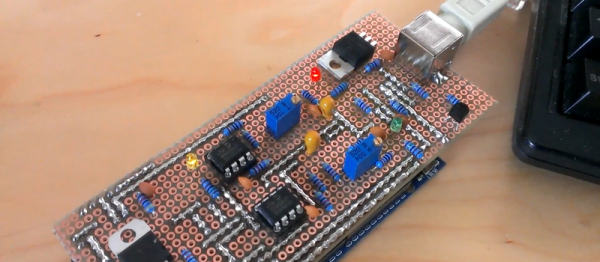
There are some kits available, but [flo_0_] couldn’t wait for his order to arrive. So he built his own version without using a PCB. Since it is a relatively complex circuit for perf board, [flo_0_] used Blackboard to plan the build before heating up a soldering iron. You can see the MMDVM in action below.

Continue reading “Homebrew Multimode Digital Voice Modem”

Unlock The Phase Locked Loop

If you want a stable oscillator, you usually think of using a crystal. The piezoelectric qualities of quartz means that it can be cut in a particular way that it will oscillate at a very precise frequency. If you present a constant load and keep the temperature stable, a crystal oscillator will maintain its frequency better than most other options.

There are downsides to crystals, though. As you might expect, because crystals are so stable it’s hard to change the frequency much when you want a different one. You can use a trimming capacitor to pull the frequency a little, but to really change frequency, you have to change crystals.

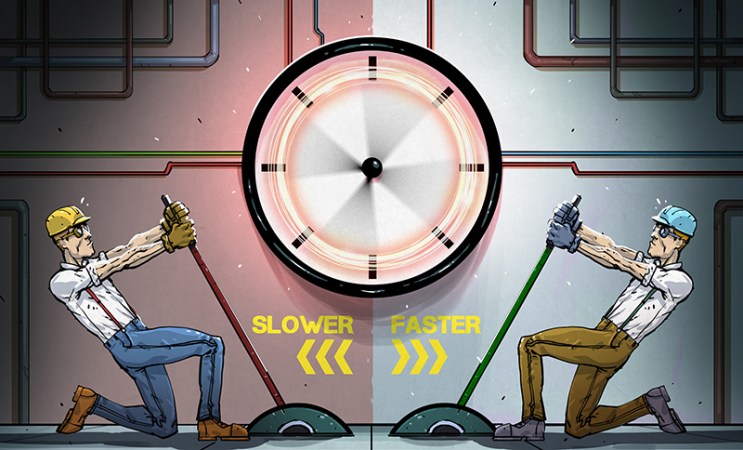
There are other kinds of oscillators that are more frequency agile. However, they aren’t usually as stable. To combine flexibility with crystal-like stability, you can use a Phase Locked Loop (PLL). Many modern systems use direct digital synthesis, but the PLL is a venerable and time-tested technique.

Continue reading “Unlock The Phase Locked Loop”

SDR Cape For BeagleBone

In the old days if you wanted to listen to shortwave you had to turn a dial. Later, you might have been able to tap in a frequency with a keypad. With modern software-defined radio (and the right hardware) you can just listen to the entire high-frequency spectrum at one time. That’s the idea behind KiwiSDR, an open source daughterboard (ok, cape) for the BeagleBone.

The front end covers 10 kHz to 30 MHz and has a 14-bit converter operating at 65 MHz. There is a Xilinx Artix-7 A35 FPGA onboard and a GPS, too. The design is open source and on GitHub.

The interface uses the OpenWebRX project for a powerful HTML 5 interface. You can see a video of its operation below or, if you can get one of the four available slots, you can listen online. From a network point of view, the demo station in Canada worked best for us. However, there are also stations in New Zealand and Sweden.

Continue reading “SDR Cape For BeagleBone”

Oscillator Design By Simulation

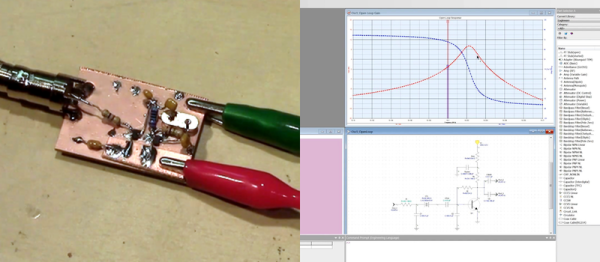
[Craig] wanted to build a 19.2 MHz crystal oscillator. He knew he wanted a Pierce oscillator, but he also knew that getting a good design is often a matter of trial and error. He used a 30-day trial of a professional simulation package, Genesys from Keysight, to look at the oscillator’s performance without having to build anything. He not only did a nice write up about his experience, but he also did a great video walkthrough (see below).

The tool generates a sample schematic, although [Craig] deleted it and put his own design into the simulator. By running simulations, he was able to look at the oscillator’s performance. His first cut showed that the circuit didn’t meet the Barkhausen criteria and shouldn’t oscillate. Unfortunately, his prototype did, in fact, oscillate.

Continue reading “Oscillator Design By Simulation”