Voice Command With No Echo

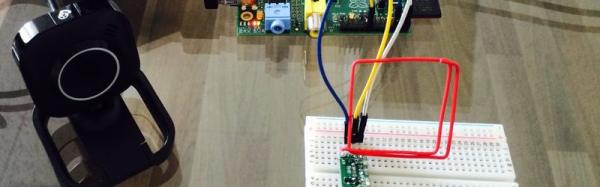
[Naran] was intrigued with the Amazon Echo’s ability to control home electronics, but decided to roll his own. By using a Raspberry Pi with the beta Prota OS, he managed to control some Phillips Hue bulbs and a homebrew smart outlet.

Prota has a speech application, which made the job simpler. He does point out though, that his project doesn’t replace the Echo’s ability to answer questions by searching the Internet. The advantage, though, is it is easily tailored to your specific application. Also, if you have a Raspberry Pi hanging around, you can’t beat the price. Continue reading “Voice Command With No Echo”
Wii MotionPlus Gyro To Microchip PIC

Sometimes the most mundane products have surprisingly sophisticated internals. What’s in a game controller? If it is a Wii remote, you’ll find a lot inside–an IR sensor, Bluetooth, an accelerometer, and EEPROM. It also has a six pin expansion port that allows I2C peripherals connect to the controller.

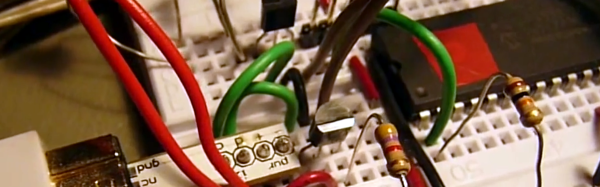
[DotMusclera] wanted to experiment with a gyroscope and decided to hook up to the Wii MotionPlus to a Microchip PIC. Using information from the WiiBrew wiki, [DotMusclera] connected a PIC18F4550, an LCD, and a handful of components (mostly to do 3.3V level conversion), he set up the hardware on a breadboard. The only odd part you might have to work around is a Wii breakout board that converts from the breadboard to the Wii interface.

The software is easy to follow since it is written in Hi-TECH C and well-commented. The hardware lacks a schematic, but from the parts list and the video, you can probably figure it out. The setup works well and shows roll, pitch, and yaw on the LCD screen.

The project log is very detailed, with a lot of information about gyroscopes and the communication format the gyro uses. The video demo is worth watching as well.

Continue reading “Wii MotionPlus Gyro To Microchip PIC”

Basically, It’s An ESP8266

Before the Arduino, there was the Parallax Basic Stamp. It was an easy-to-use PIC chip on a PCB that you programmed in BASIC — a story of those humble beginnings was published earlier this week. Before that, even, legions of small computers from TRS-80s to Commodore 64s and even Altairs were commanded primarily by the BASIC language. BASIC was easy to run on a small machine and very simple to learn. Old fashioned BASICs are difficult to use to write huge systems, but a lot of small computers aren’t going to run very large programs anyway.

The ESP8266 is more than a just a WiFi peripheral for a microcontroller. It is its own little computer in its own right. While it is common to run the “AT” firmware, Lua, or program the device yourself, you can now load the beast with a version of BASIC.

Continue reading “Basically, It’s An ESP8266”

Reverse Engineering A Different Kind Of Bus

Radio enthusiasts have a long history of eavesdropping on non-broadcast stations–police, fire, and public transportation frequencies, for example. These days, though, a lot of interesting communications are digital. When [bastibl] wanted to read data displayed on bus stop signs, he turned to software defined radio. He used gr-fosphor to monitor the radio spectrum as buses drove by and discovered a strong signal near 151 MHz (see photo below).

That, however, was just the start. Using a variety of tools, he figured out the modulation scheme, how the data framing worked, and even the error correction scheme. Armed with all the information, he built a GNU Radio receiver to pick up the data. A little number crunching and programming and [bastibl] was able to recover data about  individual buses including their position and schedule.

Continue reading “Reverse Engineering A Different Kind Of Bus”

Learning Verilog For FPGAs: Hardware At Last!

Getting into FPGA design isn’t a monolithic experience. You have to figure out a toolchain, learn how to think in hardware during the design, and translate that into working Verliog. The end goal is getting your work onto an actual piece of hardware, and that’s what this post is all about.

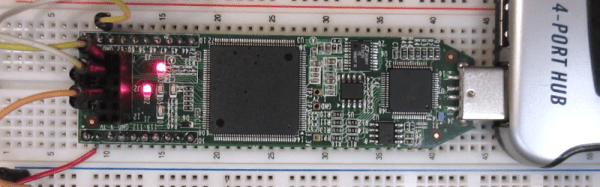
In the previous pair of installments in this series, you built a simple Verilog demonstration consisting of an adder and a few flip flop-based circuits. The simulations work, so now it is time to put the design into a real FPGA and see if it works in the real world. The FPGA board we’ll use is the Lattice iCEstick, an inexpensive ($22) board that fits into a USB socket.

Like most vendors, Lattice lets you download free tools that will work with the iCEstick. I had planned to use them. I didn’t. If you don’t want to hear me rant about the tools, feel free to skip down to the next heading.

Continue reading “Learning Verilog For FPGAs: Hardware At Last!”

Ubuntu Core Supports Raspberry Pi 2 I/O

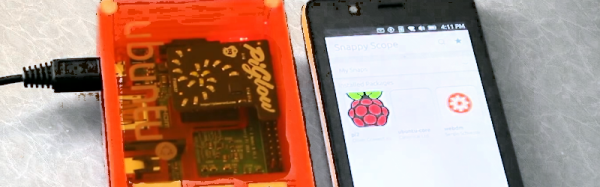
Although it isn’t official, Ubuntu Core–the tiny Internet of Things version of Ubuntu–now runs on the Raspberry Pi 2. There are prebuilt binaries as well as instructions for how to roll your own, if you prefer. You can even access GPIO

Ubuntu Core abandons the old-style Debian packages, in favor of Snap, a new version of the Ubuntu phone’s Click package manager. Snap offers transactional updates. The idea is that all of these “things” on the IoT need to be updated to patch security holes or fix other issues.

Continue reading “Ubuntu Core Supports Raspberry Pi 2 I/O”

Data Logging In The Picoampere Range

You probably know that to transfer the most energy between a source and a load their impedance needs to match. That’s why a ham radio transmitter needs a 50 ohm antenna (at least, usually). The transmitter is 50 ohms and you want a match. Some test equipment matches impedance, but for multimeters, oscilloscopes and a lot of other gear, the instrument just presents a very large impedance. As long as it is much larger than the measured circuit’s impedance, the effect will be small.

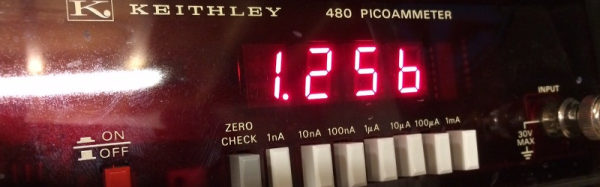
With today’s MOSFET instrumentation amplifiers, it isn’t uncommon to see very high input impedances.  However, you sometimes run into something that has a low input Z and that can cause issues if you don’t account for them. On the other hand, where some people see issues, others see opportunities.

Continue reading “Data Logging In The Picoampere Range”