A Tidy Clamshell Keyboard For The Pinephone

Something a lot of people don’t realise about modern smartphones is that many of them have fully-featured USB interfaces. Perhaps the best of all is the Pinephone, which is a fully open-source smartphone that gives end users total control over their phone experience. [silver] has such a phone, and set about building himself a neat keyboard setup for the platform.

The build is based around an RCA RKT773P tablet keyboard case, which uses USB to interface with a tablet via pogo pins. [silver] modified this by soldering on a USB cable to the pins, paired with a USB-C host adapter on the Pinephone. Paired with a few 3D printed parts to hold everything in place, it almost turns the assembly into a cute little Pinephone laptop.

It’s a neat build that would likely save a lot of frustration when hacking away at a terminal window on the Pinephone. Parts are available on Thingiverse for those interested in replicating the hack. Those eager to dive into the Pinephone platform may relish the new Pro model that has just dropped, too. Video after the break.

Continue reading “A Tidy Clamshell Keyboard For The Pinephone”

Building A Water Rocket That Lands Via Parachute

Water rockets are plenty of fun, but they can be even more fun if you go wild with the engineering. [The Q] is one such experimenter, who built a dual-thrust water rocket that even has a parachute for landing!

The testing took place in an area strangely reminiscent of a certain operating system.

The dual-thrust concept is an interesting one, and is well explained by fellow YouTube channel [Air Command Rockets]. The basic idea is to use several chambers on the water rocket, one which provides an initial short “boost” phase of high acceleration, followed by a longer “sustain” level of acceleration from a secondary chamber.

It’s a great way to send a water rocket ever higher, but [The Q] didn’t stop there. The build was also fitted with a wind-up module from a little walking toy, colloquially referred to as a “Tomy timer” in the water rocket scene. A rubber band is wound around the timer’s output shaft, holding a door shut containing a parachute. At launch, the windup mechanism is released, and its output shaft turns, eventually releasing the parachute. The trick is setting up the timer to release the chute just after the rocket is done with its thrust phase.

It’s a neat build, and one that would serve as a great guide to those eager to start their own journey down the rabbit hole of advanced water rockets. We’ve seen similar work before, too. Video after break.

Continue reading “Building A Water Rocket That Lands Via Parachute”

The Longest Ever Flight Was Over 64 Days In A Cessna 172

Often, when we think of long-endurance flights, our first thoughts jump to military operations. Big planes with highly-trained crew will fly for long periods, using air-to-air refuelling to stay aloft for extended periods.

However, many of the longest duration flights have been undertaken as entirely civilian operations. The longest of all happened to be undertaken by that most humble of aircraft, the Cessna 172. From December 1958 to February 1959, Bob Timm and John Cook set out to make history. The duo remained aloft for a full 64 days, 22 hours and 19 minutes, setting a record that stands to this day.

A Test of Endurance

One might expect that such an effort was undertaken to push the envelope or to strike new ground in the world of aerospace engineering. However, the real truth is that Bob Timm was a slot machine mechanic and former bomber pilot who worked at the Hacienda casino in Las Vegas. Proprietor Doc Bailey was always on the hunt for promotional ideas, and Timm pitched his boss that a record attempt in a plane bearing the casino’s branding would be a good way to go. Bailey agreed, and committed $100,000 to the effort. 

Modifications to prepare the aircraft for the stunt took the best part of a year. The pint-sized Cessna was fitted with a 95-gallon belly tank, paired with a electric pump that could transfer fuel to the main wing tanks as needed. Special plumbing was also added that would allow the engine oil and filters to be changed while the engine was still running.

Continue reading “The Longest Ever Flight Was Over 64 Days In A Cessna 172”

Automating Pool Monitoring And Chemical Dosing

Anyone who has had a backyard pool will know that it only takes a little lapsed attention to turn the whole thing green. For those sick of having to stay on top of things, the idea of automating pool care may be attractive. This project from [Discreet Mayor] hopes to do just that.

Data is graphed for easy analysis using Grafana.

The project uses a TI SimpleLink wireless-enabled microcontroller to run the show, which allows data to be offloaded to a base station for graphing with Grafana. The system can monitor pH levels as well as ORP (oxidation/reduction potential) levels using probes attached via BNC connectors. Based on these readings, the device can dose chlorine into the pool as needed using a peristaltic pump driven by a TI DRV8426 stepper motor driver.

We’d want to keep a close eye on the system for some time, making sure it wasn’t over or underdosing the pool with chemicals. However, that’s easy enough to do when all the data is logged neatly in a web-accessible graph.

We’ve seen other hackers implement similar controls to their own pools, too. If you’ve been working on your own home automation projects, be sure to drop us a line.

You Can Build A Lego Rubik’s Cube

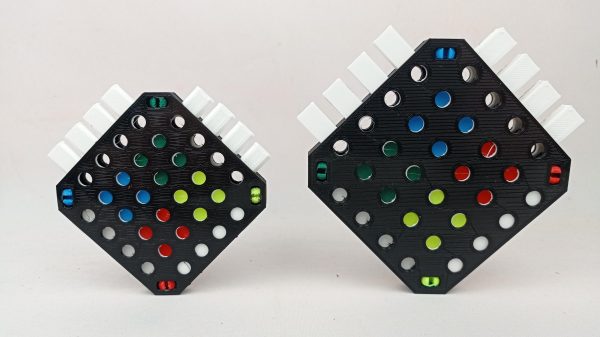
Rubik’s cubes are a popular puzzle — one found exciting or infuriating depending on your personal bent. [PuzzLEGO] has designed a LEGO Rubik’s cube, with the latest revision improving on flimsy earlier designs.

The first step was to design a core that would allow the cube to rotate freely without being too loose. This involved a lot of trial and error until [PuzzLEGO] found just the right combination of parts to do the job. From there, it was a matter of introducing the edge pieces and corner pieces without jamming everything up.

It took some experimenting to get everything moving together smoothly, but the end result is pretty impressive. It’s certainly not a build you’d use for speedcubing; the fragility meant that it took 20 minutes to solve just one face. [PuzzLEGO] hopes to make further improvements to increase playability.

If you want to replicate the feat, you’ll need plenty of little Lego bits and pieces, but it’s definitely a replicable build. Alternatively, consider using Lego to build a Rubik’s Solver, instead. Video after the break.

Continue reading “You Can Build A Lego Rubik’s Cube”

Testing 3D Printed Cutting Blades Is Scary Work

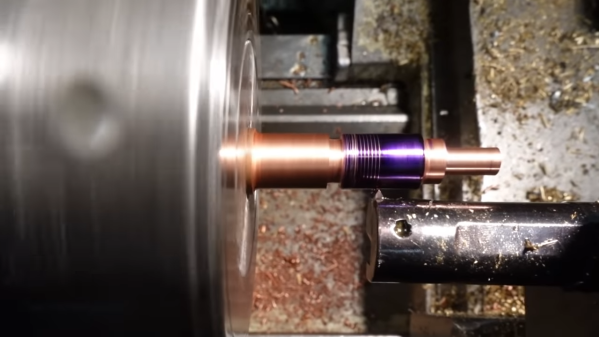
[Ivan Miranda] comes from a land where the shops close on Sundays. Thus, when he found himself in need of a cutting blade, he realised he would have to build his own, or simply wait. He elected to do the former, and we get to enjoy the journey. (Video, embedded below.)

His first attempt was to cut a wooden plank with a 3D-printed cutting blade fitted to a mitre saw. After setting up the mitre saw to cut while he was at a safe distance, [Ivan] elected to test the blade. Alas, it simply melted, and the wood was barely scratched, so [Ivan] went back to the drawing board.

His second attempt was to CNC mill an aluminium blade, which was a full 6 mm thick. The saw needed some modifications to the saw to fit properly, but it was able to cut wood without major drama!

Returning to the 3D-printed concept, [Ivan] suspected reducing the surface speed of the cutting disc could reduce friction-induced heating. This would allow the 3D-printed blade to cut wood without melting, in theory. To achieve this, he built his own basic drop saw using a steel frame and a brushless motor. With a little water spray, and careful control of speed and pressure, the blade was able to slowly chew through a plank of wood. Afterwards, the teeth were almost completely worn down.

The fact is, 3D-printed blades are usually going to be too soft to do any real useful work. However, it’s fun to watch, and that’s good enough for us. If you want something more useful though, consider building your own knives.

Continue reading “Testing 3D Printed Cutting Blades Is Scary Work”

Building A Devil’s Toothpaste Rocket Motor

When it comes to weird and wacky homebrew rocket experiments, [Integza] keeps himself fairly busy. He’s now attempted a design repurposing Devil’s Toothpaste for propulsion.

Devil’s Toothpaste is really the same as the famous Elephant Toothpaste experiment, just executed with higher concentration hydrogen peroxide. In this case, [Integza] is using 50% hydrogen peroxide combined with potassium permanganate as a catalyst. When the two are combined, the hydrogen peroxide breaks down into oxygen and water, which [Integza] uses here to propel a skateboard.

The potassium permanganate catalyst is impregnated into 3D printed porous ceramic parts. The peroxide is then  injected into this matrix via a compressed air mechanism, where it decomposes, creating a jet of water and oxygen that then blasts out of a 3D printed rocket nozzle to generate thrust.

It works surprisingly well, even if it’s a messy and unconventional way to build a rocket. It’s also a lot less fiery than most of [Integza]’s previous projects. Video after the break.

Continue reading “Building A Devil’s Toothpaste Rocket Motor”