Roku TV Hacked To Run Philips Ambilight Setup

Roku TVs are interesting beasts, which use automatic content recognition on whatever you happen to be watching in order to market online streaming services direct to your loungeroom. [Ammar Askar] realised that this technology could instead be used to feed data to a computer to run a Philips Ambilight setup natively from whatever the TV displays. 

The core of the hack came about because [Ammar’s] TV doesn’t work natively with Philips Ambilight technology. Most off-the-shelf solutions involve feeding sources, like Chromecasts or game consoles, to a HDMI splitter and then to a PC running the Ambilight software, but it gets messy real quick. Instead, [Ammar] realised that the Roku-enabled TV should be more than capable of working with the Ambilight system, given the capability of its inbuilt hardware.

The hack consists of a custom app running on the Roku hardware, which uses the in-built Roku libraries to capture frames of whatever is being displayed on the TV. It then breaks up the screen into sections and averages the color in each area. This data is then passed to a laptop, which displays the relevant colors on its own screen, where the standard Philips Hue Sync app handles the Ambilight duties.

It’s a great hack and [Ammar] doesn’t skimp on the granular fine details of what it took to get this custom code running on the Roku TV. We’d love to see more hacks of this calibre done on smart TVs; after all, there’s plenty of horsepower under the hood in many cases. Alternatively, you could always follow the CIA’s example and turn your Samsung TV into a covert listening device. Video after the break.

Continue reading “Roku TV Hacked To Run Philips Ambilight Setup” →
3D Printing Omni-Balls For Robot Locomotion

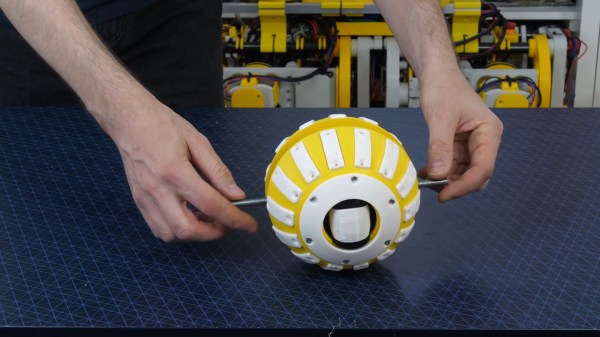
Wheels are all well and good for getting around, but they only tend to rotate about a single axis. Omni-wheels exist, but they’re still a little too pedestrian for [James Bruton]. His latest project involved 3D printing custom omni-balls which roll in all directions. (Video, embedded below.)

The omniball concept comes from earlier work by Osaka University, which also produced a treaded tank-like vehicle by the name OmniCrawler as well. The spherical design, fitted with an axle and casters as well, allows rotation in multiple directions, allowing for a platform fitted with such omni-balls to easily rotate and translate in all directions.

[James] set about creating his own version of the design, which relies on grippy TPU filament for grip pads to give the 3D printed hemispheres some much needed grip. There’s also bearings inside to allow for the relative rotation between the hemispheres and the internal castor, necessary to allow the wheels to move smoothly when sitting on either pole of the hemispheres. Skate bearings were then used to assemble three of the omni-balls onto a single platform, which demonstrated the ability of the balls to roll smoothly in all directions.

While it’s just a demonstration of the basic idea for now, we can imagine these balls being used to great effect for a robot platform that needs to navigate in tight spaces on smooth surfaces with ease. The mechanical complexity of the omni-balls probably negates their effective use in dirtier offroad contexts, however.

We’ve seen [James]’s work before too – such as his compliant leg design for walking robots, and his active gyroscope balancer last week. When does [James] sleep?

Continue reading “3D Printing Omni-Balls For Robot Locomotion” →

What NES Development Looks Like On The Apple II

These days, if you want to code a game for the original Nintendo Entertainment System, it’s about as easy as downloading an assembler, firing up Notepad, and running the ROMs you cook up in any one of a variety of emulators. In the 1980s none of those things existed, and the process was a little more complicated – as demonstrated by [Tyler Barnes] in the video embedded below.

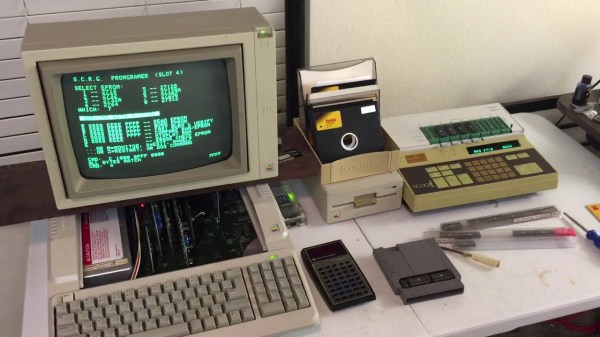
[Tyler] has put together a 40-minute guide on what it takes to get to “Hello World” – or more accurately, a simple pink screen – on the NES, using period-correct hardware. He starts the process by formatting some floppy disks and whipping up some basic assembly code on an Apple IIe, which gets run through the Merlin assembler for the 6502. It’s particularly convenient as the Apple II line and the NES both run the same CPU. From there it’s a case of using a standalone EPROM programmer to verify some appropriately-datecoded chips are empty, before programming them in a special add-on card for the Apple II. From there, the EPROMs are loaded into a cart custom modified with chip sockets, where it can be inserted into a NES for testing.

It’s a tedious process, with just the programming side of things taking on the order of ten to twenty minutes with a few fiddly steps along the way. While there are likely some efficiency gains to be had that were used by studios back in the day, it remains clear that development in this era was a much slower process.

Of course, if you prefer your Nintendo homebrew a couple generations hence, consider getting stuck in on the Nintendo 64. Video after the break.

Continue reading “What NES Development Looks Like On The Apple II” →

River Cleanup Aims To Expand In Earnest To Tackle Plastic Pollution

The Great Pacific Garbage Patch is just one of a number of pollution disasters affecting the world’s oceans. All over the globe, huge amounts of plastic enter waterways every day, causing havoc in delicate ecosystems.

Heading up the charge to deal with the problem, The Ocean Cleanup have been working on a variety of projects to help clean up plastic pollution. Chief among these is their river cleanup efforts, aiming to stop plastic pollution from reaching the ocean in the first place. The non-profit group intends to rapidly scale up its efforts, partnering with Finnish industrial manufacturer Konecranes in order to put its latest river cleaning design into series production.

We last reported on the group’s efforts in 2020, with their Interceptor craft operating in rivers in Malaysia, Indonesia, and the Dominican Republic. They’ve since refined the design for better functionality and easier deployment. Let’s jump in and see what they’ve learned and how their hunt for plastic pollution is shaping up.

Continue reading “River Cleanup Aims To Expand In Earnest To Tackle Plastic Pollution” →

3D Printed Tank Takes On The Elements

Commercially available radio control tanks are fun and all, but sometimes you’ve just got to build your own. [Let’s Print] did just that, whipping up a tank on his 3D printer before taking it out in the snow.

The tank is a fairly straightforward build, relying on a pair of brushed motors for propulsion, controlled by twin speed controllers hooked up to standard radio control hardware. Everything else is bespoke, however, from the 3D printed gearboxes, to the chassis and the rather aggressive-looking tracks. The pointed teeth of the latter leave deep indentations when the tank cruises around on mud, though weren’t quite enough to stop the little tank from getting high-centered in deep snow.

The build isn’t for the impatient, however. [Let’s Print] notes that the tracks alone took over 80 hours to run off in PETG, let alone the rest of the frame and gearboxes. However, we’re sure it was a great learning experience, and great fun to drive outside. Now the next step is surely to go bigger. Video after the break.

Continue reading “3D Printed Tank Takes On The Elements” →

Robotic Bartender Built With Industrial-Grade Hardware

Robotic bartenders are a popular project around these parts. If there’s one thing hackers love, after all, it’s automating tasks – as much for the challenge as for the actual time saved. This build from a group of [Teknic Servo] engineers is an impressive example of what can be done with some industrial-grade hardware.

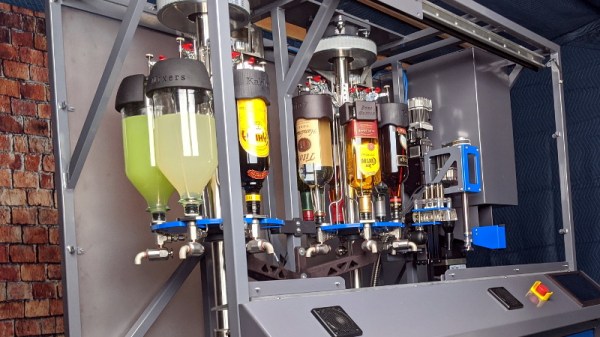
The bartender is built as a demo project for the ClearCore controller, [Teknic’s] industrial-grade device capable of interfacing with a whole bunch of servomotors and sensors to get the job done. The controller is hooked up to a bunch of ClearPath servomotors that handle spinning the bottle carousel, muddling or stirring the beverage, or transporting the drinking glass through the machine. There’s also several interlocks to avoid the patron coming into contact with the bartender’s moving parts while it’s working, and a standard bar-style mixer dispenser actuated with solenoids to keep things simple. Drink selection and control is via a touch screen, with sliders for selecting preferences such as alcohol content and sweetness.

The bartender is certainly capable of producing a neat drink (pun intended), and serves as a great example of how easily a project can be put together with industrial-grade hardware. If you’ve got the budget, you might find using an industrial plug-and-play components quicker than assembling development boards, motor controller shields and other accessories on breakout boards. There’s always more than one way to get the job done, after all.

We’ve seen some great barbots over the years, from builds relying on robotic arms to those focused on ultimate speed. Video after the break.

Continue reading “Robotic Bartender Built With Industrial-Grade Hardware” →

Putting 3D Printed Chain Through Its Paces

One of the more frustrating things facing makers in decades past was the problem of power transmission. Finding things like belts, pulleys, sprockets, and chain for your projects could be difficult, particularly if you lived far from the shipping radius of suppliers like McMaster-Carr. These days, there’s no need to fuss, because you can simply 3D print whatever you need,  as [Let’s Print] demonstrates by whipping up some chains.

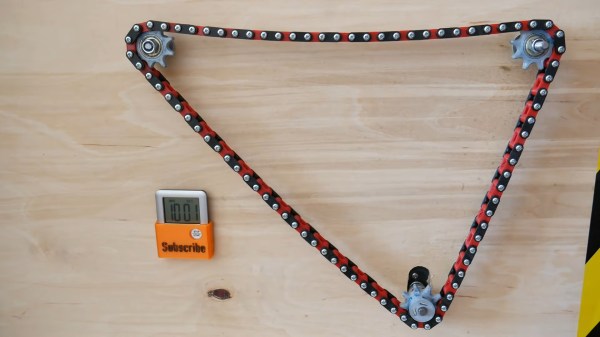
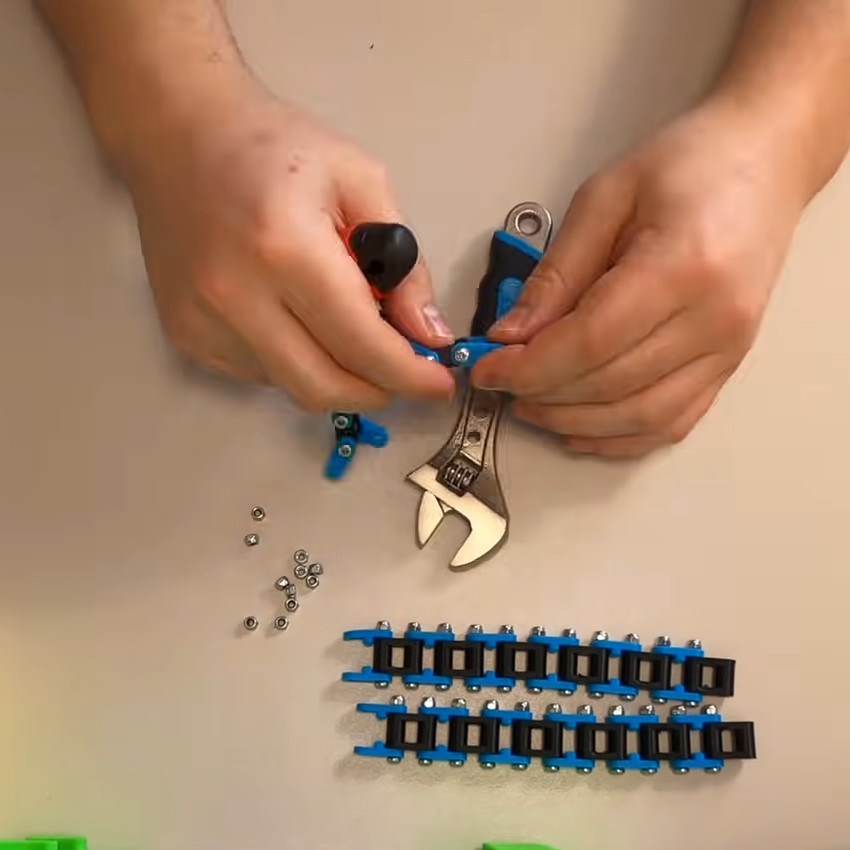
The chains are a mixed design, combining plastic inner and outer links with bolts and nuts to fasten them together. [Let’s Print] tries out several combinations of ABS, PLA, and PETG, running them on 3D printed sprockets and determining that they are all functional, albeit at minimum load. The chains are also put through tensile testing by attaching a heavy brake disc to a length of chain and dropping the weight to see at which point the chains snap.

We’d love to see more 3D-printed chains; all-plastic snap-together designs, or even those that print pre-assembled are particularly tantalizing ideas. We’d also enjoy more testing done with the chain under some proper torque loads, rather than just spinning freely.

We’ve seen work from [Let’s Print] before, too – in the case of this awesome water pump. Video after the break.

Continue reading “Putting 3D Printed Chain Through Its Paces” →