Notification Wearable Helps Get Child’s Attention

Getting a child’s attention can be difficult at the best of times. Add deafness into the picture, and it’s harder again. [Jake]’s daughter recently had to go without her cochlear implants, raising this issue. Naturally, he whipped up some hardware to solve the problem.

[Jake]’s solution was to devise a vibrating wristband that could be used to get his daughter’s attention. An Adafruit Trinket M0 is used to vibrate a pager motor, using a DRV2605 motor driver. This is paired with a Tile Bluetooth device, allowing the unit to interface with Google Assistant. This allows [Jake] to get his daughter’s attention with a simple voice command to a smartphone, tablet or smart speaker.

While [Jake]’s daughter will regain her cochlear implants soon, they do have limitations as far as hearing distant sounds and working in high-noise environments. It’s likely that this little gadget will prove useful well into the future, and could serve others well, too. Wearable notification devices are growing more popular; this OLED ring is a particularly good example. Video after the break.

Continue reading “Notification Wearable Helps Get Child’s Attention” →
A Beginner’s Guide To Lithium Rechargeable Batteries

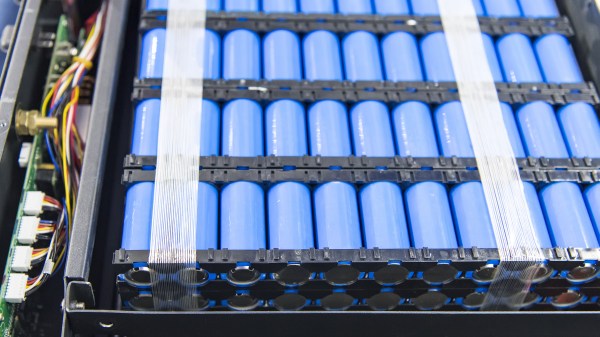
Batteries were once heavy, awkward things, delivering only a limp amount of current for their size and weight. Thankfully, over time, technology has improved, and in 2020, we’re blessed with capable, high-power lithium polymer batteries that can provide all the power your mobile project could possibly need. There are some considerations one must make in their use however, so read on for a primer on how to properly use LiPos in your project!

So Many Types!

With the first commercial lithium-ion battery entering the market in 1991, the (nearly) 30 years since have seen rapid development. This has led to a proliferation of different technologies and types of battery, depending on construction and materials used. In order to treat your batteries properly, it’s important to know what you’ve got, so paying attention to this is critical. Continue reading “A Beginner’s Guide To Lithium Rechargeable Batteries” →

Wireless Tin Can Telephone

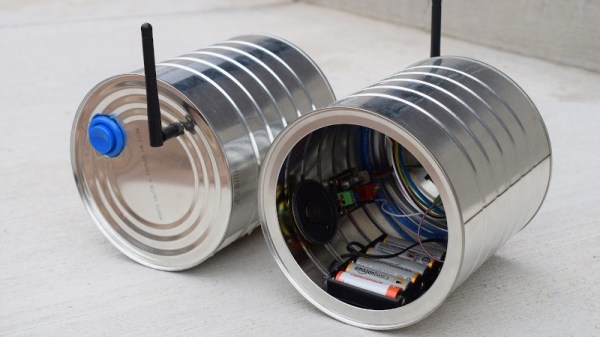
For many kids, the tin-can telephone is a fun science experiment that doesn’t last much longer than it takes to tangle the string around a nearby tree. [Geoff] decided to go a different however, building a tin-can telephone that’s completely wireless.

The build starts with a hacker favorite, the Arduino Uno. It’s hooked up to an microphone input board which uses the Arduino’s analog input to pick up audio. The Arduino then sends this data out over an NRF24L01+ wireless transceiver, to be picked up by the corresponding tin can receiver at the other end. An LM386 is given amplifier duties, hooked up to a small speaker so the user can hear the incoming audio.

The Arduino Uno is in no way a high-fidelity digital audio platform, but the project does deliver some legible, if scratchy, voice transmission. It also serves as a great way to learn about radio communications and working with digital audio signals. The NRF24L01+ is a great way to add wireless communication to a project, and if you’re looking for more range, we’ve got that covered, too. Video after the break.

Continue reading “Wireless Tin Can Telephone” →

Contactless Doorbell Built To Avoid Coronavirus

It’s often said that necessity breeds creativity, and during a global pandemic such words have proved truer than ever. Realising the common doorbell could be a potential surface transmission point for coronavirus, [CasperHuang] whipped up a quick build.

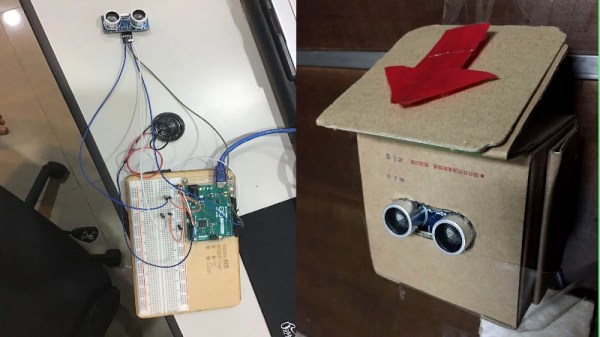
The build eschews the typical pushbutton we’re all familiar with. Instead, it relies on an ultrasonic distance sensor to detect a hand (or foot) waved in front of the door. An Arduino Leonardo runs the show, sounding a buzzer when the ultrasonic sensor is triggered. In order to avoid modifying the apartment door, the build is housed in a pair of cardboard boxes, taped to the base of the door, with wires passing underneath.

It’s a tidy way to handle contactless deliveries. We imagine little touches like this may become far more common in future design, as the world learns lessons from the COVID-19 pandemic. Every little bit helps, after all. Video after the break.

Continue reading “Contactless Doorbell Built To Avoid Coronavirus” →

Netbooks: The Form Factor Time Forgot

Long ago, before smartphones were ubiquitous and children in restaurants were quieted with awful games on iPads, there was a beautiful moment. A moment in which the end user could purchase, at a bargain price, an x86 computer in a compact, portable shell. In 2007, the netbook was born, and took the world by storm – only to suddenly vanish a few years later. What exactly was it that made netbooks so great, and where did they go?

A Beautiful Combination

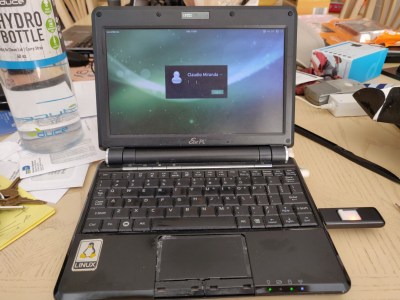
An Asus EEE PC shown here running Linux. You could run anything on them! Because they were real, full-fat computers. No locked down chipsets or BIOS. Just good, clean, x86 fun.

The first machine to kick off the craze was the Asus EEE PC 701, inspired by the One Laptop Per Child project. Packing a 700Mhz Celeron processor, a small 7″ LCD screen, and a 4 GB SSD, it was available with Linux or Windows XP installed from the factory. With this model, Asus seemed to find a market that Toshiba never quite hit with their Libretto machines a decade earlier. The advent of the wireless network and an ever-more exciting Internet suddenly made a tiny, toteable laptop attractive, whereas previously it would have just been a painful machine to do work on. The name “netbook” was no accident, highlighting the popular use case — a lightweight, portable machine that’s perfect for web browsing and casual tasks.

But the netbook was more than the sum of its parts. Battery life was in excess of 3 hours, and the CPU was a full-fat x86 processor. This wasn’t a machine that required users to run special cut-down software or compromise on usage. Anything you could run on an average, low-spec PC, you could run on this, too. USB and VGA out were available, along with WiFi, so presentations were easy and getting files on and off was a cinch. It bears remembering, too, that back in the Windows XP days, it was easy to share files across a network without clicking through 7 different permissions tabs and typing in your password 19 times.

Continue reading “Netbooks: The Form Factor Time Forgot” →

Arduino Car HUD Does The Job

Many cars these days come with a basic Heads Up Display, or HUD. Typically, these display speed, though some also throw in a tachometer or navigational graphics too. Of course, if your car doesn’t have one of these stock, hacking in your own is always an option.

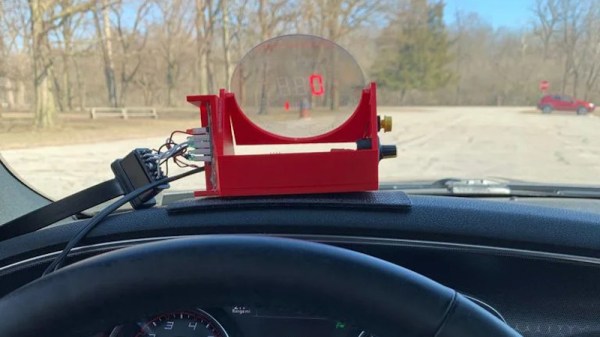
[PowerBroker2] developed this HUD in a somewhat circuitous way, but it’s effective nonetheless. An ELM327 Bluetooth OBD-II reader is hooked up to the car, collecting data on speed and RPM. This data is passed to an ESP-32 and Teensy 3.5. From reading the code, it appears the Teensy is responsible for logging data from the CAN bus on an SD card, and running a small OLED display. The ESP32 is then charged with running the LED display that actually forms the HUD. It’s then combined with a 3D-printed housing, some plexiglass, and reflective windshield film to complete the effect.

It’s a build that probably packs in more hardware than is strictly needed to get the job done, but it does indeed get the job done. Other builds we’ve seen use LED strips as a quick and tidy way to get the job done. Video after the break. Continue reading “Arduino Car HUD Does The Job” →

Ford’s Powershift Debacle

In the automotive world, change is a constant, and if you’re not keeping up, you’re falling behind. New technologies and methodologies are key to gaining an edge in the market, and companies invest billions each year trying to find the next big thing, or even the next minor incremental improvement.

In just such a quest, Ford Motor Company decided to explore an alternative to the traditional automatic gearbox, aiming for greater fuel efficiency in their small cars. On paper, there were gains to be had. Unfortunately, not everything went according to plan. Continue reading “Ford’s Powershift Debacle” →