Concrete USB Hub Isn’t Going Anywhere

When starting a new project, the choice of material can have a big effect on the character of the finished product. Wood is stylish and has a certain elegance to it, while polished or brushed aluminium is great for a more futuristic feel. Sometimes though, you just want big, cheap and heavy – in which case, concrete is your friend!

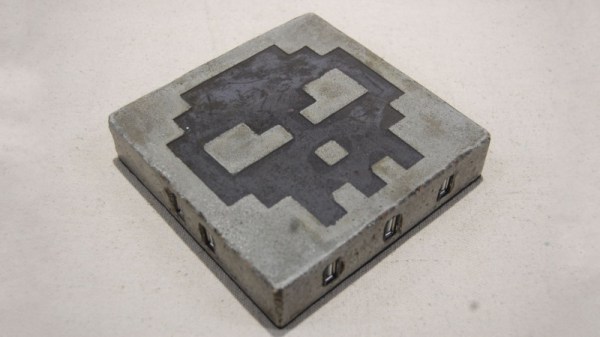
[BALES] was short on USB ports, and needed a hub with plenty of connectivity. Concrete had the benefits of being solid and heavy, and also impervious to beverages. Thus, a melamine form was produced, chosen as its surface doesn’t give the concrete anything to grab on to. A foam skull was cut out and added to create an inlay for decoration, and the 7-port octopus-style hub was placed inside.

With careful attention paid to the mixture consistency, the concrete was poured into the mold and allowed to set. Care was taken to avoid air bubbles and to ensure the mixture flowed completely into the mold, without leaving air pockets behind the inserted components. After allowing it to set for a few days, the part was demolded, with care taken to minimise edge crumbling. The foam skull was removed, and infilled with black epoxy, with a little more used to coat the top and sides of the hub. As a finishing touch, a foam pad was fitted to the base to allow it to sit on a desk without scratching everything up.

In the end, [BALES] has ended up with a hefty hub that won’t skitter around when plugging and unplugging devices. It should also serve admirably as a sturdy drink coaster on those cold winter nights. If you’re trying a similar project yourself, note that sometimes concrete can be surprisingly conductive. Video after the break.

Continue reading “Concrete USB Hub Isn’t Going Anywhere” →

Analysing National Budgets With File System Tools

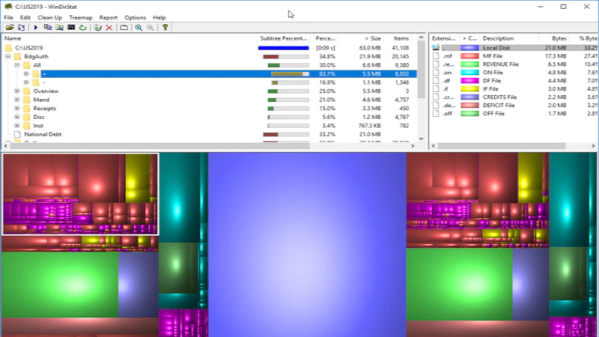
Understanding a national budget can be difficult, with political interests and distorted talking points obscuring the truth. There’s no substitute for diving into the hard data yourself, but it can be difficult to know where to start. [D. Scott Williamson] wanted to do just that, and took an unconventional path – using file system tools to analyse the 2019 US budget.

The basic idea is simple. A file is created for every line item on the budget, and this file is filled with a $ for every million dollars that item costs. These files are sorted into folders for the relevant bureaus and agencies responsible, creating a Fiscal File System representation of the entire budget. The file system can then be analysed with standard tools to get a look at the overall make up of the budget – in this case, WinDirStat does a particularly good job.

It’s a novel way to go about budget analysis, and fills a gap in the market now that Time Plots aren’t producing their Death and Taxes infographics anymore. Pre-cooked file systems covering budgets back to 1977 are available for your perusal, should you need to investigate how things have changed over time.

Unsurprisingly, we haven’t covered the national budget before, but we’re always down to talk file systems.

Undertale Pinball Machine Is A Work Of Art

Undertale came out in 2015 and took the world by storm. With a heartwrenching story, compelling characters and a soulful soundtrack, it won legions of fans and became an indie gaming legend. Years later,  [Gornkleschnitzer] decided to begin a pinball machine build, and it became a tribute of epic proportions.

No expense was spared on getting the artwork professionally printed, and the results speak for themselves.

Yes, we’re talking about a living, clacking, and breathing Undertale pinball build. [Gornkleschnitzer] demonstrates not only a deep knowledge of the source content, but also a mastery of pinball construction. The build began with a design in Virtual Pinball, which allowed the basic design to be dialled in. This allows things like trick shots and other features to be tested before cutting real parts. With the design roughed out, the real work starts. Full sets of cabinet and playfield decals were professionally printed, flashers installed, and subway tunnels lasercut in steel. All manner of flippers, slingshots and ball troughs were installed, tested, and tweaked in the pursuit of perfection.

The attention to detail is where this machine really shines. The artwork is stunning, and the game is complete with the original soundtrack, including the death theme. There’s even hidden gems like the Tem Shop and bonuses galore to be had.

It’s a stunning pinball machine, and one we’re dying to play for ourselves. If you’re keen to get your feet wet, why not consider starting with a cardboard build? Video after the break. Continue reading “Undertale Pinball Machine Is A Work Of Art” →

Building Your Own Guitar Pickup From Scrap

Pickups are a key part of an electric guitar’s sound. You can spend a king’s ransom on tracking down just the right Vintage American Original 1950s Whatevers (TM) to put in your Spudocaster, but it’s not the only way. [Keith Decent] decided to make a pickup from scratch, using only materials found lying around the workshop. (Youtube, embedded below).

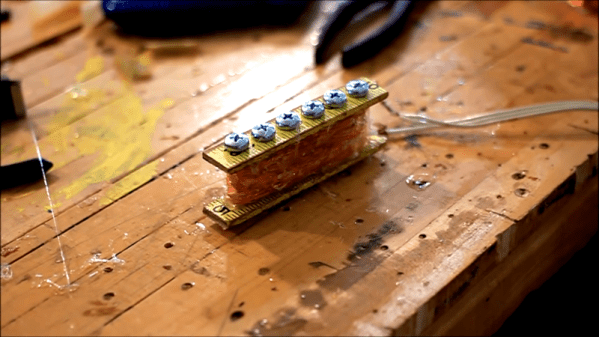
To build a pickup, you’ll want some magnet wire. In this case, [Keith] harvests this from an old transformer. A pickup body is then constructed from an old wooden ruler and some machine screws. A drill is used to spin the pickup body while the wire is roughly wound on, and everything is then held together with lashings of hot glue.

It’s a grungy build with a very Mad Max vibe – with the perfect aesthetic to suit [Keith]’s junkbox guitar build. The sound is good, but difficult to rate accurately when used on a guitar with slightly imperfect intonation. We’d love to hear it installed on a well-tuned body to get a better comparison.

It goes to show you don’t need to spend money on new parts and tools to get a build started. Sometimes you can make something perfectly functional with stuff you have lying around at home. Video after the break.

Continue reading “Building Your Own Guitar Pickup From Scrap” →

This Bot Might Be The Way To Save Recycling

Recycling is on paper at least, a wonderful thing. Taking waste and converting it into new usable material is generally more efficient than digging up more raw materials. Unfortunately though, sorting this waste material is a labor-intensive process. With China implementing bans on waste imports, suddenly the world is finding it difficult to find anywhere to accept its waste for reprocessing. In an attempt to help solve this problem, MIT’s CSAIL group have developed a recycling robot.

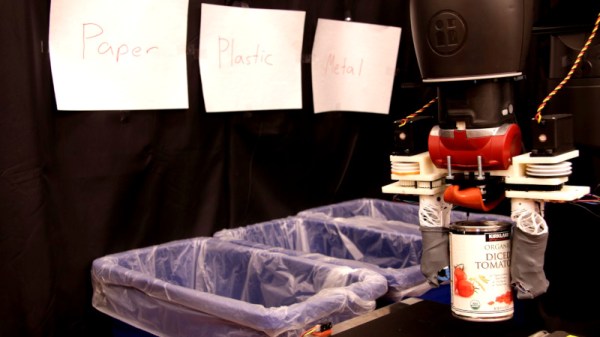
The robot aims to reduce the reliance on human sorters and thus improve the viability of recycling operations. This is achieved through a novel approach of using special actuators that sort by material stiffness and conductivity. The actuators are known as handed shearing auxetics – a type of actuator that expands in width when stretched. By having two of these oppose each other, they can grip a variety of objects without having to worry about orientation or grip strength like conventional rigid grippers. With pressure sensors to determine how much a material squishes, and a capacitive sensor to determine conductivity, it’s possible to sort materials into paper, plastic, and metal bins.

The research paper outlines the development of the gripper in detail. Care was taken to build something that is robust enough to deal with the recycling environment, as well as capable of handling the sorting tasks. There’s a long way to go to take this proof of concept to the commercially viable stage, but it’s a promising start to a difficult resource problem.

MIT’s CSAIL is a hotbed of interesting projects, developing everything from visual microphones to camoflauge for image recognition systems. Video after the break.

Continue reading “This Bot Might Be The Way To Save Recycling” →

Simon Game Is A Story Of Rushed Deadlines And Holiday Cheer

Sometimes the Christmas season can feel like a holiday all about spending money to demonstrate your love for others. Many a maker has attempted to subvert these commercialistic overtones by giving handmade presents to friends and loved ones. [APA] is no exception, and has shared their story of producing a simple Simon game during the holidays.

The circuit is nothing wild – an ATtiny85 microcontroller interfaces a handful of buttons and LEDs to handle the basic Simon gameplay. The real value is in [APA]’s retelling of the development process. It’s an accurate recounting that makes us relive some of our own follies of early projects. There’s the confusion between SMD and through hole versions of the same part, forgotten pull up resistors, as well as hours lost trying to figure out why a chip won’t write, only to learn the bootloader hasn’t been burned yet.

In the end, [APA] was able to push through a rush order and deliver the gifts on time, despite the many pitfalls along the way. The final game provided some laughs around the dinner table at Christmas, so we’d say the mission was definitely accomplished.

We’ve seen similar work before, too – like this tiny Simon game on an ATtiny13.

Pick And Place For Toys

Toys are great for keeping the kids amused at play time, but oftentimes its difficult to get them to understand the importance of tidying up after themselves. It would naturally be ideal to have some manner of robot to help in this regard, and [Paco Garcia] might just be leading the charge in this area.

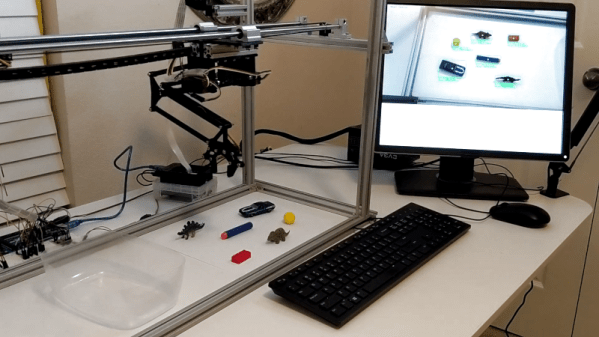
[Paco]’s project involves combining a robotic arm with computer vision tools in order to allow it to pick and place small objects – in this example, toys. The robot arm is of a gantry type, built on an aluminium frame with 3D printed components. The computer vision side of things is handled by a Raspberry Pi, fitted with the standard camera and running OpenCV software for object recognition. This then passes commands to an Arduino which runs the stepper motors controlling the arm.

[Paco] notes that the hardest part of the build was learning how to generate real-world coordinates from a single camera feed in OpenCV. With that mastered, the rest of the dominoes began to fall. With trigonometry and kinematics knowledge in hand, the robot has grown capable of reliably picking and placing small objects across its range of motion. Future work aims to improve the robot’s abilities to rotate and otherwise manipulate its end effector for more versatility.

Naturally, we typically see pick and place machines used for PCB production – and this build is no exception. Video after the break.

Continue reading “Pick And Place For Toys” →