Cocktail Barbot Takes Things Up A Level

Mixing a cocktail is considered as much an art as a science. The practice is studied dilligently by bartenders the world over. Of course, for any given human task, there’s always another human building a robot to automate it. [CamdenS5] is one such human, with a cocktail mixing barbot with a few tricks up its sleeve.

As you’d expect, there’s a smattering of the usual alcoholic liquids and mixers, along with a battery of pumps for fluid delivery. The fun doesn’t end there, though. There’s a linear actuator capable of putting out 500 N for slicing limes, and a mint and sugar dispenser as well. If that wasn’t enough, there’s even a muddling station to help bring out the flavours just right.

This is a machine that takes a broader look at the process behind making a good cocktail. It’s not just about lumping ingredients into a glass – it takes finesse and care to get the best results. It’s not the first barbot we’ve seen – this one is built in a grandfather clock.

Pocket Watch Becomes Pinhole Camera

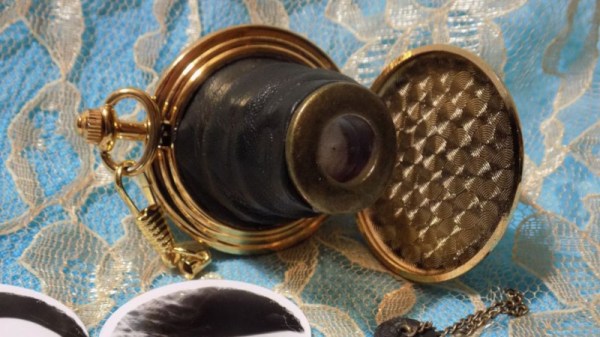
A pinhole camera is essentially the combination of the camera obscura with photographic film. The pinhole acts as the lens, focusing the scene onto the film, and after exposure, the film can then be developed and you’ve got your picture. They’re a fun way to learn about photography, and easy to make, too. [Brooklyntonia] decided to undertake just such a build, secreted away inside a pocket watch.

The build starts with with the disassembly of the watch, which acts as the main cavity of the camera. A bellows is then constructed from leather and a toilet paper roll to allow the camera to still fold up inside the original watch case. A pinhole is then installed at the end of the bellows, and a plug is used as a shutter to allow the bellows to be properly unfolded prior to exposure.

It’s a fun build, and one that comes complete with instructions for the proper processing of film in your own darkroom – or bathroom. Pinhole cameras can be useful tools, too – particularly for things such as capturing an eclipse.

FabGL Has Everything You Need To Write Games For The ESP32

Typically, when one considers writing a video game, the platform is among the first decisions to be made. The PC can be an easy one to start with, and mobile development is fairly accessible too. Of course, you could always develop for a microcontroller platform instead. [Fabrizio Di Vittorio] has built the perfect set of tools to do just that with the ESP32, by the name of FabGL.

The library contains a laundry list of features that are perfect for developing games. There’s VGA output with up to 64 colors, PS/2 mouse and keyboard inputs, as well as a capable graphics library and game engine. It can even act as an ANSI/VT terminal if necessary.

[Fabrizio] has put the hardware through its paces, with a variety of benchmarks displaying impressive performance with simple balls, polygons and sprites. You could easily produce a 2D game in an early 90s style without running into any hardware limitations — though given the ESP32 clocks in at up to 240MHz, that’s somewhat to be expected.

It’s an impressive project (video after the break), and we’d love to see more games developed on the platform. Once you have a VGA connector wired in you should try out some ESP32 VGA hacks. And for those ESP8266 die hards there’s a game engine for that chip too!

Continue reading “FabGL Has Everything You Need To Write Games For The ESP32” →

A Mostly 3D Printed Speaker

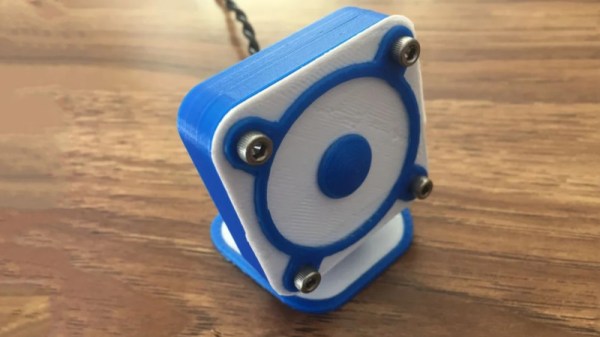
The common magnetic loudspeaker is, fundamentally, a fairly simple machine. A static magnetic field is generated by a permanent magnet, and a membrane is mechanically connected to a coil. When a varying electrical current is passed through the coil, this causes the coil to move due to the magnetic field, vibrating the membrane and producing sound. [Mattosx] put this theory into practice with a simple 3D-printed speaker.

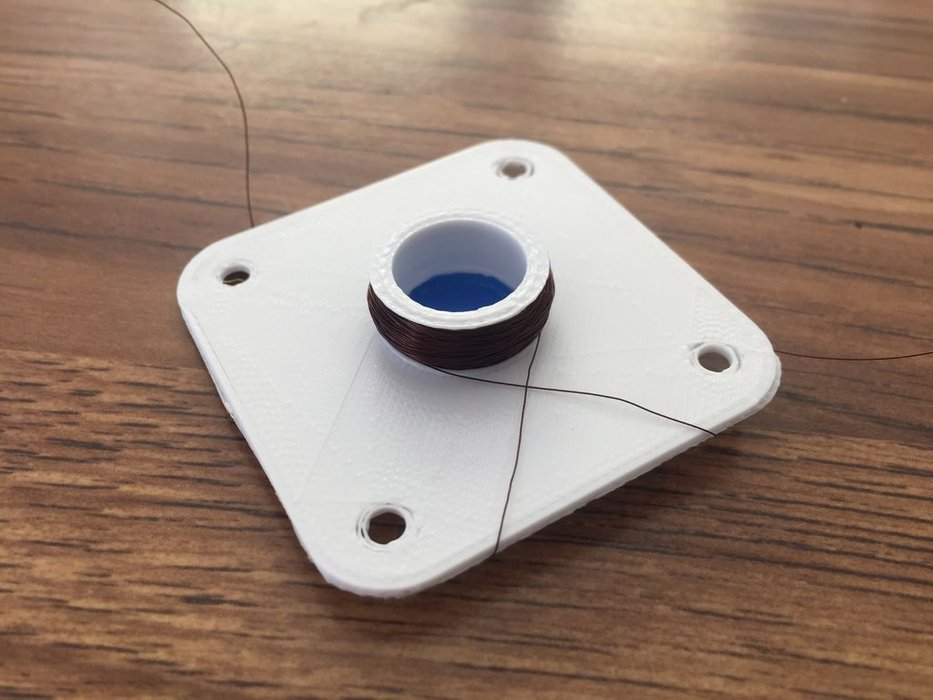
It’s not the first 3D-printed speaker we’ve ever seen, but it’s one of the cutest. The main body of the speaker is rectangular, and has a cavity in which three neodymium magnets are placed. The vibrating membrane is then printed separately, including an integrated spindle upon which the coil is wound. The assembly is held together with some socket-head cap screws which complement the pleasantly modern look.

The device does a good job delivering the bleeps when hooked up to an Arduino, and we could see this basic design serving well in all manner of charming 3D-printed builds. Video after the break.

Continue reading “A Mostly 3D Printed Speaker” →

Making Crampons Out Of Scrap

If you’re living somewhere that gets icy in the wintertime, you know the sidewalk can be perilous. Slipping on ice hurts like hell if you’re lucky, and can cause serious injuries if you’re not. Naturally, if you’re trying to get down to the hackerspace when it’s cold out, you’ll look for solutions. [masterbuilder] wanted to be surefooted in the coming season, and decided to build a set of crampons.

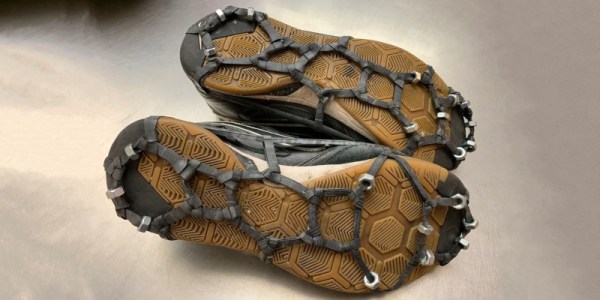
Scrap inner tubes are the key here, providing a source of hardy rubber for the build. The tubes are cut into a series of bands which are woven together in a hexagonal pattern. Steel nuts are included at various points to help grip the ice in inclement conditions. A larger strip of rubber is then used to form a band which secures the entire assembly to the wearer’s shoes.

It’s a design that’s intended for ease of use over outright performance. The crampons can be quickly attached and removed, and using nuts instead of spikes reduces the chance of damaging the floor if you forget to take them off immediately when returning home. If you’ve got any handy winter hacks of your own, you know where to send ’em.

This Air Compressor Sucks

Vacuum is something most people learn about as children, when they’re first tasked with chores around the home. The humble vacuum cleaner is a useful home appliance and a great way to lose an eye as an inquisitive child. When it comes to common workshop tasks though, they can be a bit of a let down. When you need to pull some serious vacuum, you might wanna turn to something a little more serious – like this converted air compressor.

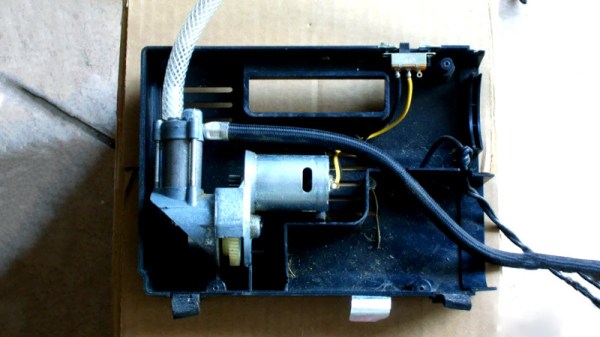
The build starts with a cheap off-the-shelf tyre inflator. These can be had for under $20 from the right places. They’re prone to overheating if used at too high a duty cycle, but with care they can last just long enough to be useful. The hack consists of fitting a hose barb connection over the intake of the pump, to allow air to be sucked out of whatever you’re trying to pull vacuum on. This is achieved with some hardware store parts and a healthy dose of JB-Weld. It’s then a simple matter of removing the valve adapter on the tyre inflator’s outlet so it can flow freely.

You might also consider adding a check valve, but overall this remains a cheap and easy way to get an electric vacuum pump for your workshop up and running. If that’s not quite your jam, you can always go down the handpump route instead.

Casting CNC Parts In Aluminium

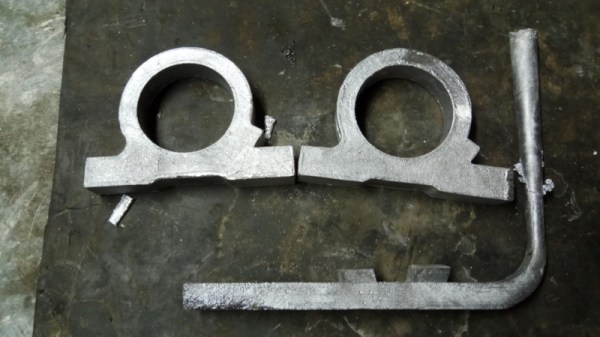
When it comes to machining, particularly in metal, rigidity is everything. [Tailortech] had a homebuilt CNC machine with a spindle held in place by a plastic bracket. This just wasn’t up to the job, so the decision was made to cast a replacement.

[Tailortech] decided to use the lost PLA process – a popular choice amongst the maker crowd. The spindle holder was first sketched out, then modeled in Fusion 3D 360. This was then printed in PLA slightly oversized to account for shrinkage in the casting process.

The PLA part was then used to make a plaster mold. [Tailortech] explains the process, and how to avoid common pitfalls that can lead to problems. It’s important to properly heat the mold once the plaster has set to remove moisture, but care must be taken to avoid cracking or wall calcination. It’s then necessary to slowly heat the mold to even higher temperatures to melt out the PLA prior to casting. With the mold completed, it can be filled with molten aluminium to produce the final part. When it’s cooled off, it’s then machined to final tolerances and installed on the machine.

Lost PLA casting is a versatile process, and goes to show that not everything has to be CNC machined out of billet to do the job. It’s also readily accessible to any maker with a furnace and a 3D printer. If you’ve got a casting project of your own, be sure to let us know. Video after the break.

Continue reading “Casting CNC Parts In Aluminium” →