Giant Xbox Series X Works Like A Real One

Like most home consoles, the Xbox Series X was specifically designed to fit neatly in the average home theater unit. [Michael Pick] thought that wasn’t quite big enough, and set out to build the world’s largest working Xbox Series X himself.

The build was in part inspired by a Microsoft creation: a large fridge in the shape of an Xbox Series X. However, [Michael] wanted to go further, maintaining the gaming functionality and more faithfully recreating details like the divot on the top of the console.

Carefully positioned servos press the Xbox’s buttons

The first step was to build a big wooden frame, with wooden panels screwed on to create the basic form of the console. Creating the lovely curved and perforated top was done by 3D printing a series of pieces that were all glued together to emulate the feature on the real console itself. The back was also given fake giant ports that look just like the real thing.

The real hack is inside, though. The Xbox hardware itself just sits inside the frame on a little shelf. There’s a handful of servo motors set up to press the real console’s buttons when the corresponding buttons are pressed on the giant Xbox itself. It goes a long way to making the build feel “real” to the user.

The final build measures over 2 meters (6.5 feet) tall and 1 meter wide, weighing in at a total of 113 kg (250 lbs). It was good enough to win [Michael] a Guinness World Record for his trouble. The build was later donated to a local youth center in Georgia.

We’ve seen [Michael]’s giant builds before, too; his 300%-sized Nerf Gun was a particular highlight. Video after the break.

Continue reading “Giant Xbox Series X Works Like A Real One”

Hacker Diary: Embedded World 2022

Yesterday I went up to the Embedded World trade fair in Nuremburg, Germany. As a lone hacker, you often feel more than a little out of place when you buy chips in single unit quantities and the people you’re talking to are used to minimum order quantities of a million. But what’s heartening is how, once you ask an interesting question, even some of the suit-wearing types flip into full-on kids who like to explain the fun tech. I struck up conversations with more than a couple VPs of global chip behemoths, and they were cool.

But my heart is still with the smaller players, and the hackers. That’s where the innovation is. I met up with Colin O’Flynn, of Chip Whisperer fame — his company is selling fancier chip-glitching tools, but he still had a refined version of the open source, quick-and-dirty zapper circuit from his Remoticon talk last year. There was a small local company producing virtual buttons that were essentially Pepper’s Ghost illusions floating in mid-air, and the button press was detected by reflective IR. Cool tech, but I forgot the company’s name — sorry!

Less forgettable was Dracula Technologies, a French company making inkjet-printable organic solar cells. While they wouldn’t go into deep details about the actual chemistry of what they’re doing, I could tell that it pained them to not tell me when I asked. Anyway, it’s a cool low-power solar tech that would be awesome if it were more widespread. I think they’re just one of many firms in this area; keep your eyes on organic solar.

When talking with a smaller German FPGA manufacturer, Cologne Chip, about their business, I finally asked about the synthesis flow and was happily surprised to hear that they were dedicated to the fully open-source Yosys toolchain. As far as I know, they’re one of the only firms who have voluntarily submitted their chips’ specs to the effort. Very cool! (And a sign of things to come? You can always hope.)

I met a more than a few Hackaday readers just by randomly stumbling around, which also shows that the hacker spirit is alive in companies big and small. All of the companies have to make demos to attract our attention, but from talking to the people who make them, they have just as much fun building them as you or I would.

And last but not least, I ran into Hackaday regular Chris Gammell and my old boss and good friend Mike Szczys who were there representing the IoT startup Golioth, and trying to fool me into using an RTOS on microcontrollers. (Never say never.) We had an awesome walkaround and a great dinner.

If you ever get the chance to go to a trade show like this, even if you feel like you might be out of your league, I encourage you to attend anyway. You’d be surprised how many cool geeks are hiding in the least likely of places.

[Banner image: Embedded World]

NASA Called, They Want Their Cockroaches Back

News hit earlier this month that the infamous “cockroach moon dust” was up for auction? Turns out, NASA is trying to block the sale as they assert that they own all the lunar material brought back from the Apollo missions. What? You didn’t know about cockroach moon dust? Well, it is a long and — frankly — weird story.

It may sound silly now, but there was real concern in 1969 that Apollo 11 might bring back something harmful. So much so that NASA tricked out an RV and kept the astronauts and a volunteer in it for about three weeks after they came home. During that time they were tested and some experiments were done to see if they’d been exposed to anything nasty.

One of those experiments was to feed lunar dust to cockroaches (by the way, the table of contents has a mistake in it — check out page 8). Seriously. But that isn’t even the really weird part. A scientist who worked on the project by the name of Marion Brooks decided she wanted a memento, so she extracted the lunar dust from the dead cockroaches and saved it in a vial. At least we learned a new word: chyme.

RR Auction — the RR stands for Remarkable Rarities — was starting the bidding for some dead cockroaches and a vial of chyme at about 12 grand but it was sure to go higher than that, perhaps up to $400,000 USD. That was before they got a cease and desist from NASA.

It appears the collection has been sold at least once before. NASA has cracked down on anyone selling lunar material as even those given to people are considered on loan from the agency. However, many of the rocks given to different countries and state governments are now unaccounted for.

Back in 2002, interns Thad Roberts and Tiffany Fowler worked in the building where NASA stores most of the moon rocks it has. They took a 600-pound safe containing about 100 grams of moon samples and some other materials. With some help, Roberts tried to fence them to an amateur rock collector who helped the FBI set up a sting. Roberts got over 8 years in federal prison for his efforts, just a little more than an accomplice, Gordon McWhorter, who claimed to have been duped by Roberts. There have been a few other cases of theft, most of which remain unsolved.

This is one of those tricky things. From NASA’s point of view, they own all the moon rocks (with a few exceptions, mostly of material that didn’t come from Apollo). If you steal them, they want them back and if you are given them on loan they don’t appreciate you giving them away, selling them, or losing them. On the other hand, outside of outright theft like the Roberts case, it is hard to imagine that you want to control old roach chyme.

There’s two things we do wonder. First, who saves roach chyme even if it did start as lunar dust? Second, if three little pebbles brought back by the Soviet Luna 16 probe sold for over $850,000 and this dust might have gone for $400,000, why aren’t more of these “New Space” startups scrambling to bring some fresh samples back? Seems like it might pay for itself.

Getting Serial Data Out Of An Old Spectrophotometer

[Jure Spiler] came into possession of an old spectrophotometer, which measures the absorbance and transmittance of light in a sample. Getting data out of the device was difficult, particularly as the model in question was an educational version missing some functionality. However, perseverance got the old machine talking happily to a PC.

After an earlier experiment with sniffing the signals being sent to the LCD, [Jure] did some more research. It turned out that a special expensive cable could hook up to the device’s parallel port and deliver serial data, for the low price of € 356 Euros. Now knowing a serial output was present, [Jure] was able to find the data stream desired.

Hooking up a logic analyzer to the “parallel port” on the machine revealed that the device would actually send serial data out over certain pins on the port. The trick that made it harder was that it was in Inverted RS232 form. Thus, all it took was a simple TTL inverter hooked up to a USB-TTL adapter to get the device talking to a modern PC.

With that achieved, [Jure] was able to whip up a simple VB6 program to collect data from the spectrometer and put it in a CSV file for further analysis. There’s even a program to graph the data right off the bat, making the scientific instrument easier and quicker to use than ever!

Oftentimes, old scientific hardware like this isn’t especially difficult to hack. It’s usually just hard enough to make busy scientists stump up the cash for the fancy adapters and cable, while being no match for the dedicated hacker!

Mysterious Adder From 1960s Bendix G-20

[David Lovett] aka Usagi Electric is taking a dive into yet another old computer design, this one from the early 1960s. He recently obtained eight mystery circuit boards on-loan for the purpose of reverse engineering them. It turns out these came from an old mainframe called the Bendix G-20, a successor to the 1965 G-15 vacuum tube model. The cards are:

  • Full Adder
  • AND Gate
  • OR Gate
  • Emitter Follower
  • Flip Flop
  • Quad Inverting Amplifier
  • DLO Amplifier
  • Gated CPA

Most of these are pretty straightforward to figure out, but he ran into some troubles trying to understand the full adder board. The first issue is there is some uncertainty surrounding the logic level voltages. This system uses negative voltages, with -3.5 V representing a logic 1 … or is it a logic 0? And even taking into account this ambiguity, [David] is having a hard time deciphering how the adder works. It uses a bunch of diodes to implement a logic lookup table of an adder — except he is not able to make it match any known addition scheme. [David] has called out to the community for help on this one, and if you have any ideas how this adder works, visit his wiki linked above for more information and give him shout.

We don’t know how [David] squeezes in the time for these side projects, when he is so busy on the Centurion mini-computer restoration and the monstrous single-bit vacuum tube computer he is building.

Continue reading “Mysterious Adder From 1960s Bendix G-20”

A Water Leak Detector That Listens Carefully

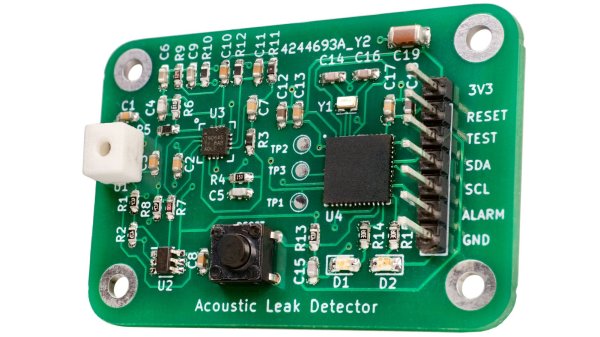
Water leaks can be pernicious things. Even just a few drips per minute happening undetected inside a wall can cause major damage if left unrepaired for long enough. AquaPing is a new device that hopes to detect difficult-to-find water leaks with the aid of acoustic methods. 

The AquaPing is a so-called “stand-off” sensor that is intended to detect leaks at a distance, even if they are inside a wall. No contact is needed with the plumbing itself. Instead, the device detects the broadband high-frequency noise created when water leaks from a pipe under pressure.

It’s a method that’s best suited to leaks from cracks or loose fittings. These generate a characteristic hiss that can be picked up with signal analysis even if the noise itself is obscured to human perception by other noises in the area. However, leaks like a hole in a gutter or a dripping rusted-out water tank are best found by other methods, as they don’t create this same signature noise.

The device will soon be launched on CrowdSupply as a purchasable product, however the project is fully open source for those eager to dive in themselves. We’ve featured some other really creative leak detectors before, too! Video after the break.

Continue reading “A Water Leak Detector That Listens Carefully”

An In-Depth Look At The Haptic Smart Knob

At Hackaday, we love those times when we get a chance to follow up on a project that we’ve already featured. Generally, it’s because the project has advanced in some significant way, which is always great to see. Sometimes, though, new details on the original project are available, and that’s where we find ourselves with [Scott Bez] and his haptic smart knob project.

Alert readers may recall [Scott]’s announcement of this project back in March. It made quite a splash, with favorable comments and a general “Why didn’t I think of that?” vibe. And with good reason; the build quality is excellent, and the idea is simple yet powerful. By attaching a knob to the shaft of a brushless DC motor and mounting a small circular LCD screen in the middle, [Scott] came up with an input device that could be reprogrammed on the fly. The BLDC can provide virtual detents at any interval while generating haptic feedback for button pushes, and the LCD screen can provide user feedback.

But how is such a thing built? That’s the subject of the current video, which has a ton of neat design details and build insights. The big challenge for [Scott] was supporting the LCD screen in the middle of the knob while still allowing the knob — and the motor — to rotate. Part of the solution was, sadly, a hollow-shaft motor that was out of stock soon after he released this project; hopefully a suitable replacement will be available soon. Another neat feature is the way [Scott] built tiny strain gauges into the PCB itself, which pick up the knob presses that act as an input button. We also found the way button press haptics are provided by a quick jerk of the motor shaft very clever.

This is one of those projects that seems like a solution waiting for a problem, and something that you’d build just for the coolness factor. Hats off to [Scott] for following up a sweet build with equally juicy details.

Continue reading “An In-Depth Look At The Haptic Smart Knob”