Old IPad Keyboard Makes For A Modern Netbook

Netbooks were a class of tiny laptops which hit their peak over a decade ago, with the idea being that you could use the Internet and do your computing on the move with ease. Unfortunately manufacturers were scared of them eating their profits from bigger computers, and they were invariably built to a very disappointing spec. That doesn’t lessen the appeal of small form factor laptops though, and [bob-foss] is here with a simple hack to make one.

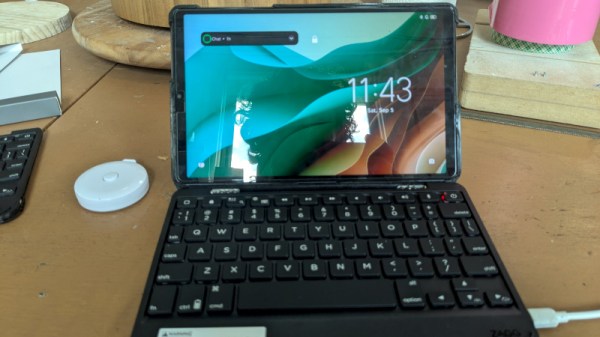
He’s taken a hinged keyboard case made for one of the previous generations of iPad Mini, and paired it with a high-end Lenovo gaming tablet by way of a 3D printed replacement for the original Apple-grabber. We said it was a simple hack and it is, but it’s no less elegant for that as the detail is what matters. This isn’t a mess-of-wires cyberdeck, instead it’s a machine you could pull out on a train and get some work done.

Meanwhile, if you’d like to take a wallow in what that netbook thing was all about, we took a look at the phenomenon back in 2020.

How Bats Prevent Doppler Acoustic Interference

https://commons.wikimedia.org/wiki/File:Bat(20070605).jpg
Lesser horseshoe bat. (Credit: Lylambda, Wikimedia)

As great as echolocation is, things can get rather messy once it’s not just you chirping away, but also hundreds of your buddies in roughly the same area. This is the scenario that the typical colonies of bats have to deal with. In a recent study by [Haruhito Matsumoto] et al. in Journal of Comparative Physiology they investigated how colonies of greater Japanese horseshoe bats deal with this issue.

Echolocation in animals can use a variety of methods, including frequency modulation (FM, varying the pitch) or constant frequency (CF), with both having their uses during hunting as well as obstacle avoidance. One big advantage of CF is that it can be used for Doppler shift, giving very precise information about location and velocity of objects in the environment, but if used in a busy colony the acoustic interference would effectively render them blind.

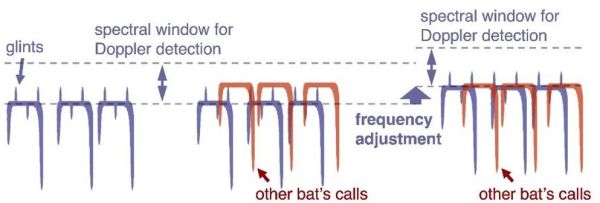
What researchers have found is that the CF component frequencies differ per bat colonies, with the mixing of wild-caught and resident horseshoe bats in this experiment showing them adjusting the dominant second harmonic (CF2) to match, with bats using a lower frequency CF2 adjusting it upwards. In this way frequency convergence is used as a strategy to avoid acoustic interference using a so-called ‘silent spectral window’.

As this spectral window for effective Doppler tracking is found above the CF2 frequency, it therefore makes sense that the bats at a lower CF2 harmonic would adjust their CF upwards to match that of their neighbors. Although more research is required to fully confirm these findings, it sheds some more light on the use of echolocation by these amazing flying mammals.

Kelvin–Helmholtz Instabilities Found To Drive Plasma Mixing On The Sun

As easy as the Sun is to observe, it’s simultaneously very hard to study due to how extreme the conditions are, even on the surface of a rather unassuming star. One of these study topics is the interaction between the Sun’s plasma and magnetic field, as this drives much of the dynamism of the Sun’s surface layer (i.e., the photosphere). Recent observations by the 4-meter solar telescope in Hawaii have now led to interesting new findings, as detailed in a paper in Nature by [David Kuridze] et al.

Despite popular portrayal, this photosphere is not a boiling liquid, but rather pockets of plasma at various temperatures. The plasma moves within the magnetic field and convective movements that create the ‘boiling’ pattern, which gives the illusion of a boiling liquid surface.

Within this photosphere, [Kuridze] et al. were able to observe Kelvin-Helmholtz instabilities, which are fluid instabilities caused by velocity shearing in either a continuous fluid or due to a velocity difference between two fluids. This is also observed in clouds in Earth’s atmosphere, where they cause the billowing effect, somewhat similar to watching a boiling liquid.

In a MURaM simulation (see heading image), these findings were confirmed, showing how these instabilities drive the transport of plasma in the Sun’s photosphere.

ESP32-P4 Powers Video Alarm Clock

Once upon a time, you had the option of waking up to a bell, a harsh buzzer, or whatever happened to be on the radio that morning. Now that it’s the 21st century, we’ve gotten used to being able to set our alarms to whatever sound or song we want, but what if you don’t just want to wake up to sound? Enter [Impossible_Agent1436] a.k.a. [brunokeymolen]’s Video Alarm Clock that will wake you up to whatever clip you want, as long as it fits on the 720 pixel square display.

That display is a pre-built Waveshare module powered by an ESP32-P4, which looks like a handy bit of kit aside from being out of stock at the moment. The dev board makes this almost entirely a software project– the only hardware [bruno] had to come up with was the 3D-printed stand to hold it on his bedside. That’s not a slight to [bruno]; it was a good choice in the spirit of “work smarter, not harder”. Sometimes you want to reinvent the wheel, and sometimes you just want an alarm clock.

The module’s RTC means it keeps good time, and the built-in SD card reader means you can load up a whole library of clips to wake up to. The only caveat is that those files have to be AVI containers holding 720×720 MJPEG video with PCM stereo audio at 44.1 kHz, and you’re limited to old FAT filename rules: eight characters, and none of them special.

This is an easier project and a better idea than the exploding capacitor alarm clock, but there’s no arguing which would get us out of bed faster. If you miss the old days of clock radios, you can always bring them back with the right microcontroller.

Story via reddit.


A Vacuum Tube Computer For The Home

The earliest all-electronic computers used vacuum tubes, and most of us will know about machines such as ENIAC or Colossus. Vast machines that required the budget of a country at war to build, andfill very large rooms. It’s very pleasing then to see that a useful vacuum tube computer can be made which has neither of these requirements, as with this example from [Mike] that uses former eastern bloc double-triodes.

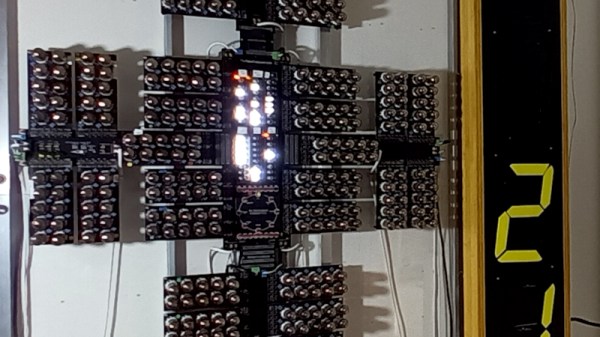
It’s an 8-bit design following a von Neumann architecture with 16 instructions, whose operational block diagram would be instantly recognisable to anyone used to working with a 1970s-era 8-bit microcomputer. It follows a NOR-based design in the same manner as the famous NASA machines from the Apollo programme, and as we understand from the description it uses more modern parts for its I/O circuitry. Physically it’s a surprisingly compact wall-mounted unit, and it has an accompanying ex-British Rail flip-digit display as well as a control panel for a simple airship simulator game. There’s a website with full details, if you are interested.

We like this machine, a lot. It may not be the largest computer we’ve seen and it certainly isn’t the first one with vacuum tubes, but it’s a very impressive achievement to have created it. If tubes in computing interest you meanwhile, we took a trip to see the daddy of them all.

Should [Mike] enter this into the Retrocomputing Challenge? We think so.

The Helicopter With Radioactive Blades

Sometimes you find gold in unexpected places. In this case, it’s from a video about the CH-53 helicopter. The CH-53 Sea Stallion first entered service in 1966. It’s a huge helicopter, capable of lifting immense amounts of weight. All that weight hangs from 6 (or 7 on some models) rotor blades.  The problem was detecting problems with the blades before they grew into a catastrophic failure.

Continue reading “The Helicopter With Radioactive Blades”

How To Talk To A Machine Without Anthropomorphising It

LLMs remain a divisive topic in these times. Perhaps we all know someone who’s become over-infatuated with their new robotic friend, or who believes it has made them a genius. [Emily M. Bender] and [Nanna Inie] have written about how people anthropomorphise the LLMs they interact with, and suggested some language tips to avoid that. It’s a couple of months old, but we think Hackaday readers will find it interesting.

Their analysis is interesting, because it looks at the way people talk about LLMs and highlights the unconscious anthropomorphism. The LLM is a piece of software not a person, so why does it “recognise” when it does “speech recognition”, for example. They suggest “automatic transcription” instead. Even “hallucination” implies cognisance that evidently isn’t there. They admit that their suggestion of “undesirable output” isn’t entirely appropriate. They’re on safer ground with “input” and “output” instead of “prompt” and “response”.

Whatever your views on them, it’s evident that LLM usage will be a feature of the world for the forseeable future. The language surrounding them is however capable of evolving, and maybe some of the suggestions here are worth taking note of.

Grappling with our new electronic overlords? Have a look at our AI for Skeptics series.