Surprisingly Stomp-able Soft Switches

Competition sure brings out the brute in people, doesn’t it? So what do you do when you need a bunch of switches you can let people fist-pound or stomp on repeatedly without them taking damage? You could look to the guitar pedal industry and their tough latching switches, or you could simply build your own smash-resistant buttons as [wannabemadsci] has done.

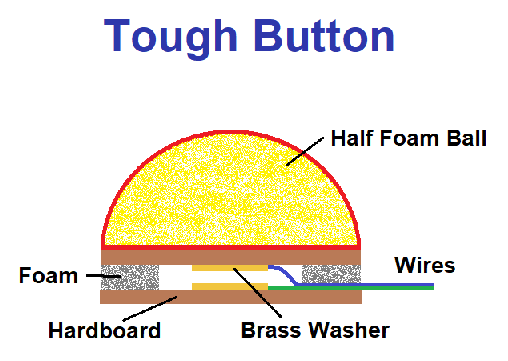
The main thing about these switches is that they aren’t easily destroyed by shoes or angry fists. That’s because the shiny red push-me part of the button is made by cutting a foam ball in half.


Not easily crush-able Styrofoam, mind you — squishy, coated foam like an indoor football. This is mounted to the top of a sandwich made of hardboard and a couple pieces of easily-compressible foam from craft paintbrushes.

A brass washer is mounted to the middle of both pieces of hardboard, and these have wires soldered to them to read button presses. Then it’s just a matter of hooking it to a microcontroller like any other momentary.

There are all kinds of things you could cut in half for the top, like maybe tennis balls. Or, do what [Sprite_TM] did and use inverted plastic bowls.

The Great Euro Sat Hack Should Be A Warning To Us All

Military officials and civilian security researchers have been warning us for years: cyberattacks are becoming a very real part of modern warfare. Far from being limited to military targets, cyberattacks can take out everything from vital public infrastructure to commercial and industrial operations, too.

In the early hours of February 24, as the Russian invasion force began raining missiles on Ukrainian cities, another attack was in progress in the digital realm. Suddenly, satellite terminals across Europe were going offline, with many suffering permanent damage from the attack.

Details remain hazy, but researchers and military analysts have pieced together a picture of what happened that night. The Great Euro Sat Hack prove to be the latest example of how vulnerable our digital infrastructure can be in wartime.

Continue reading “The Great Euro Sat Hack Should Be A Warning To Us All”

Life-Sized Colonial Viper Touches Down In Australia

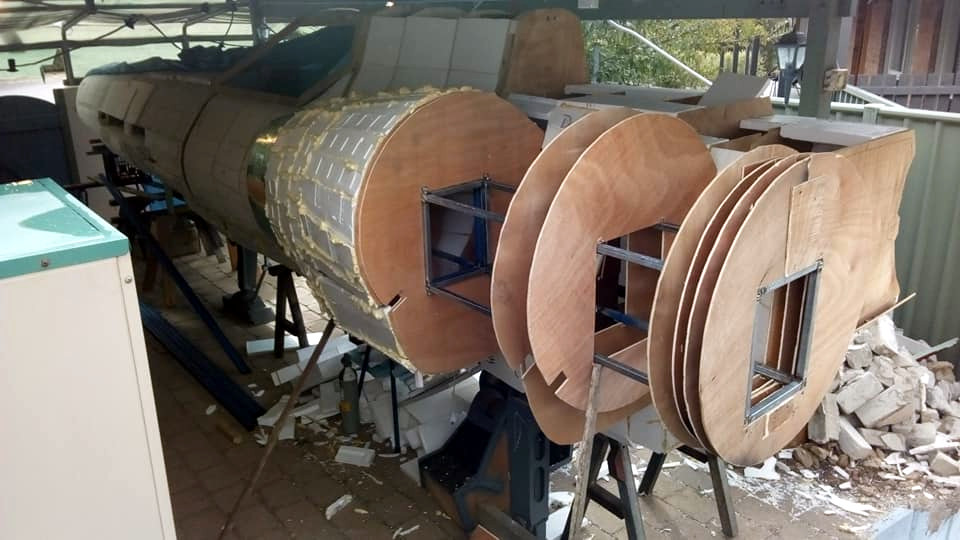
Don’t worry, this 8.4 meter (27 foot) Australian Viper won’t bite, but it’s likely to do a number on any Cylon Raiders that wander too close to Canberra. As recently reported by Riotact, creator [Baz Am] has been painstakingly piecing together this 1:1 scale replica of a Colonial Viper Mark II from the reimagined Battlestar Galactica series in his shed for several years now, and at this point things are really starting to come together.

On his personal site, [Baz] has been maintaining a build log for the fictional spacecraft since 2017 that covers everything from the electronics that power the cockpit displays to the surprisingly intricate woodworking that went into the lathe-turned 30 mm cannons. He’s even documented interviews he conducted with members of the show’s special effects team in his quest to get his version of the Viper to be as screen-accurate as possible.

Plywood bulkheads are mounted to an internal metal frame.

No matter how you look at this build, it’s impressive. But one thing we especially appreciated was the skill with which [Baz] manages to repurpose what would otherwise be junk. For example, the main cockpit display is actually an in-dash navigation system pulled from a car, and the engine’s turbine blades are cut out of aluminum road signs. He’s even managed to outfit the Viper with an array of real aircraft instruments by collecting broken or uncalibrated units from local pilots.

While the Viper might look like it’s ready to leap into action at a moment’s notice, there’s still quite a bit of work to be done. The craft’s fuselage, made of metal, wood, and foam, needs to be coated with fiberglass, sanded, and then painted to match its televised counterpart. [Baz] says that process will take at least another year, but also mentions off-hand that he’s thinking of adding a functional reaction-control system with cold gas thrusters — so we’re going to go out on a limb and say this is probably one of those projects that’s never quite finished. Not that we’re complaining, mind you. Especially when you consider the shaky track record the Battlestar Galactica franchise has when it comes to neatly wrapping things up in the finale. Continue reading “Life-Sized Colonial Viper Touches Down In Australia”

Have You Heard Of MCGA?

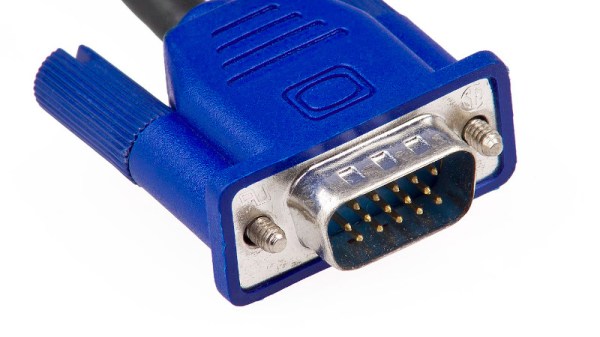
In the world of PC graphics, the early standards followed the various video cards of the day. There was MDA, familiar through the original text-based DOS prompt, CGA, then EGA, and the non-IBM Hercules along the way. Finally in 1987 IBM produced the VGA, or Video Graphics Array standard for their PS/2 line of computers, which became the bedrock on which all subsequent PC graphics cards, even those with digital outputs, have been built. It’s interesting then to read an account from [Dave Farquhar] of the other now-forgotten video standard that made its debut with the PS/2, MCGA, or Multicolor Graphics Array. This was intended as an entry-level graphics system to compete with the more multimedia-oriented home computers of the day such as the Commodore Amiga and Atari ST.

Offering 320×200 graphics at 256 colors but only two colors at 640×480 it’s difficult to see how it could have been a viable competitor to the Amiga’s 4096-color HAM mode, but it did offer the ability to drive an RGB monitor through its VGA-like socket. The story goes that IBM intended it to provide an upgrade incentive for PS/2 customers to buy a more powerful model with VGA, but in the event a host of third-party VGA-compatible cards emerged and allowed more traditional ISA computers from third parties to retain a competitive edge and eventually sideline the PS/2 line entirely.

We called time on VGA back in 2016, and it’s fair to say that it’s disappeared from PC hardware since then even if much of its technologies still lurk within. It’s pleasing to see though that it remains a stalwart of hacked-together display interfaces, with efforts such as this 7400-based VGA card continuing to impress us.

Dissecting A T1 Line

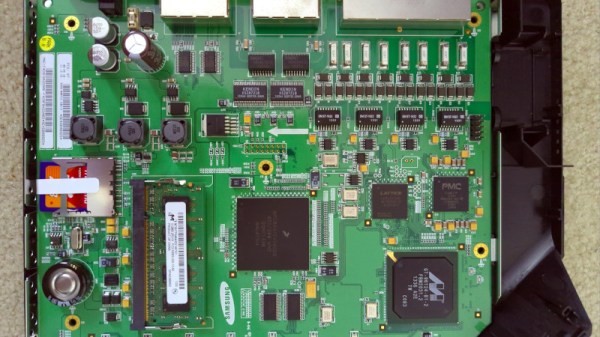
When it comes to internet connections, here in 2022 so many of us have it easy. Our ISP provides us with a fibre, cable, or DSL line, and we just plug in and go. It’s become ubiquitous to the extent that many customers no longer use the analogue phone line that’s so often part of the package. But before there was easy access to DSL there were leased lines, and it’s one of these that [Old VCR] is dissecting. The line in question is a T1 connection good for 1.536 Mbit/s and installed at great cost in the days before his cable provider offered reliable service, but over a decade later is now surplus to requirements. The ISP didn’t ask for their router back, so what else to do but give it the hacking treatment?

In a lengthy blog post, he takes us through the details of what a T1 line is and how it’s installed using two copper lines, before diving into the router itself. It’s an obsolete Samsung device, and as he examined the chips he found not the MIPS or ARM processors we’d expect from domestic gear of the period, but a PowerPC SoC from Freescale. Connecting to the serial port reveals it as running SNOS, or Samsung Network Operating System from an SD card, and some experimentation finds a default password reset procedure through the bootloader commands. The rest of the piece is dedicated to exploring this OS.

There was a time before the advent of the Raspberry Pi and similar cheap Linux-capable boards, that hacking a router was the way to get a cheap embedded Linux system, but now it’s much more done to liberate a router from the clutches of manufacturer and telco. Still, it’s very much still part of the common fare here at Hackaday.

Building Faster Rsync From Scratch In Go

For a quick file transfer between two computers, SCP is a fine program to use. For more complex, large, or regular backups, however, the go-to tool is rsync. It’s faster, more efficient, and usable in a wider range of circumstances. For all its perks, [Michael Stapelberg] felt that it had one major weakness: it is a tool written in C. [Michael] is philosophically opposed to programs written in C, so he set out to implement rsync from scratch in Go instead.

[Michael]’s path to deciding to tackle this project is a complicated one. His ISP upgraded his internet connection to 25 Gbit/s recently, which means that his custom router was the bottleneck in his network. To solve that problem he migrated his router to a PC with several 25 Gbit/s network cards. To take full advantage of the speed now theoretically available, he began using a tool called gokrazy, which turns applications written in Go into their own appliance. That means that instead of installing a full Linux distribution to handle specific tasks (like a router, for example), the only thing loaded on the computer is essentially the Linux kernel, the Go compiler and libraries, and then the Go application itself.

With a new router with hardware capable of supporting these fast speeds and only running software written in Go, the last step was finally to build rsync to support his tasks on his network. This meant that rsync itself needed to be built from scratch in Go. Once [Michael] completed this final task, he found that his implementation of rsync is actually much faster than the version built in C, thanks to the modernization found in the Go language and the fact that his router isn’t running all of the cruft associated with a standard Linux distribution.

For a software project of this scope, we find [Michael]’s step-by-step process worth taking note of for any problem any of us attempt to tackle. Not only that, refactoring a foundational tool like rsync is an involved task on its own, let alone its creation simply to increase network speeds beyond what most of us would already consider blazingly fast. We’re leaving out a ton of details on this build so we definitely recommend checking out his talk in the video below.

Thanks to [sarinkhan] for the tip!

Continue reading “Building Faster Rsync From Scratch In Go”

It’s TikTok, On Your Wrist!

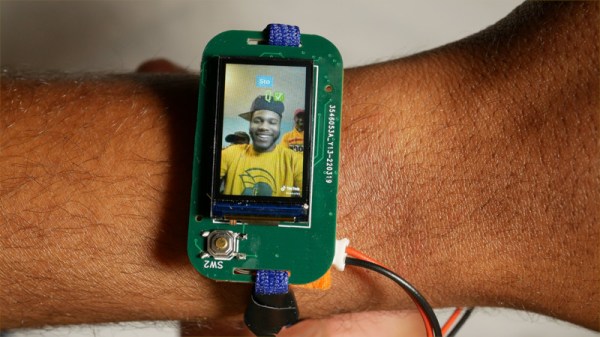
One of the ultimate objects of desire in the early 1980s was the Seiko TV wristwatch. It didn’t matter that it required a bulky external box in your pocket for its electronics, it was a TV on your wrist, and the future was here! Of course, now we have the technology to make wrist-mounted video a practical reality, but it’s sad to see we’ve opted to use our phones for video and never really followed up on the promise of a wrist-mounted television. There’s always hope though, and here it is in the form of [Dave Bennett]’s ESP32-powered TikTok wristwatch.

On the wrist is the ESP32 itself with an audio DAC and amplifier, LCD screen, and battery, but sadly this combo doesn’t have quite the power to talk to TikTok directly. Instead that’s done using Python on a companion PC with the resulting videos uploaded to the device over WiFi. It’s not the bulky electronics of the Seiko TV, so we’ll take it. All the info can be found on GitHub, and there’s a YouTube video below the break.

So the viral videos of a generation can now be taken on the move without resorting to a slightly less portable mobile phone. It may not be the most unobtrusive of timepieces, but it’ll certainly get you noticed.

Continue reading “It’s TikTok, On Your Wrist!”