The Heinz Nixdorf Museumsforum building in Paderborn

Visit The World’s Largest Computer Museum: The Heinz Nixdorf

Most stories in the history of computing took place in one of a small number of places. The wartime code-breaking effort in Bletchley Park led to Colossus, the first programmable electronic computer. Various university campuses in Britain and the US were home to first-generation computers like ENIAC, EDVAC and the Manchester Baby in the late 1940s. Silicon Valley then stole the limelight with the home computer revolution in the 1970s. Naturally, all of these places have their museums celebrating their local achievements, but the world’s largest computer museum is not found in Silicon Valley or on the campus of a famous university. Instead, you have to travel to a small German town called Paderborn, which houses the Heinz Nixdorf Museumsforum, or HNF.

Heinz Nixdorf might not be a household name in America like Jack Tramiel or Steve Jobs, but he was one of Europe’s great computer pioneers. Starting with vacuum tube based machines in 1952, Nixdorf gradually expanded his company into one of the largest computer manufacturers of the 1970s. His products were especially popular among large businesses in the financial sector, such as banks and insurance companies. By the late 1980s however, sales went downhill and the company was eventually acquired by Siemens. Today, the Nixdorf name lives on as part of Diebold-Nixdorf, a major producer of ATMs and checkout machines, reflecting the original company’s focus on the financial industry.

The museum’s roots lie in Heinz Nixdorf’s personal collection of typewriters and other office equipment. Although he already envisioned starting a museum dedicated to computing, his sudden death in 1986 put a stop to that. A few of his employees kept the plan alive however, and in 1996 the HNF was opened in Paderborn. Today the museum is run by a non-profit foundation that aims to provide education in information and communication technology to a wide audience.

The collection is housed in the former worldwide headquarters of Nixdorf Computer AG, a rather imposing 1970s office building covered in gold-tinted windows. Inside,]] you’re reminded of its former life as an office building through its compact layout and low ceilings. It does give the museum a bit of a cosy feel, unlike, say, the cavernous halls of London’s Science Museum, but don’t let this fool you: at 6,000 m2, the main exhibition area is about twice as large as that of Silicon Valley’s Computer History Museum. Continue reading “Visit The World’s Largest Computer Museum: The Heinz Nixdorf”


Fancy Wire Loop Game Is A Beauty In Brass

The simple wire-loop game is often built as a fun project to teach students about electronics. [W&M Levsha] built their own version, showing off their fine crafting and machining skills and branding it as a sobriety test with the playful name “Breathalyzer.”

The mechanics of the game are quite simple. The player must guide a metal ring around the puzzle without touching it. A buzzer and light is used to indicate to the player when they’ve failed, with the project powered from a small lithium-polymer pouch cell charged via a USB port.

Where this build really shines is in the presentation, with [W&M Levsha] showing they really have what it takes to do great work in brass. Rather than a simple bent wire, we’re instead treated to a delicately-formed beam of rectangular cross-section hewn out of a single piece of metal. It’s paired with a nicely-crafted wand with a knurled handle.

We’ve seen similar displays of their exquisite craft before, too – such as with a bespoke toothbrush and a powder-powered lighter. Video after the break.

Continue reading “Fancy Wire Loop Game Is A Beauty In Brass”

Replaceable Batteries Are Coming Back To Phones If The EU Gets Its Way

Back in the day, just about everything that used a battery had a hatch or a hutch that you could open to pull it out and replace it if need be. Whether it was a radio, a cordless phone, or a cellphone, it was a cinch to swap out a battery.

These days, many devices hide their batteries, deep beneath tamper-proof stickers and warnings that state there are “no user serviceable components inside.” The EU wants to change all that, though, and has voted to mandate that everything from cellphones to e-bikes must have easily replaceable batteries, with the legislation coming into effect as soon as 2024.

Continue reading “Replaceable Batteries Are Coming Back To Phones If The EU Gets Its Way”

Wind-Up Tape Measure Transformed Into Portable Ham Antenna

If there’s one thing that amateur radio operators are good at, it’s turning just about anything into an antenna. And hams have a long history of portable operations, too, where they drag a (sometimes) minimalist setup of gear into the woods and set up shop to bag some contacts. Getting the two together, as with this field-portable antenna made from a tape measure, is a double win in any ham’s book.

For [Paul (OM0ET)], this build seems motivated mainly by the portability aspect, and less by the “will it antenna?” challenge. In keeping with that, he chose a 50-meter steel tape measure as the basis of the build. This isn’t one of those retractable tape measures, mind you — just a long strip of flexible metal on a wind-up spool in a plastic case. His idea was to use the tape as the radiator for an end-fed halfwave, or EFHW, antenna, a multiband design that’s a popular option for hams operating from the 80-m band down to the 10-m band. EFHW antennas require an impedance-matching transformer, a miniature version of which [Paul] built and tucked within the tape measure case, along with a BNC connector to connect to the radio and a flying lead to connect to the tape.

Since a half-wave antenna is half the length of the target wavelength, [Paul] cut off the last ten meters of the tape to save a little weight. He also scratched off the coating on the tape at about the 40-meter mark, to make good contact with the alligator clip on the flying lead. The first video below details the build, while the second video shows the antenna under test in the field, where it met all of the initial criteria of portability and ease of deployment.

Continue reading “Wind-Up Tape Measure Transformed Into Portable Ham Antenna”

Building 7-Segment Displays With LEGO

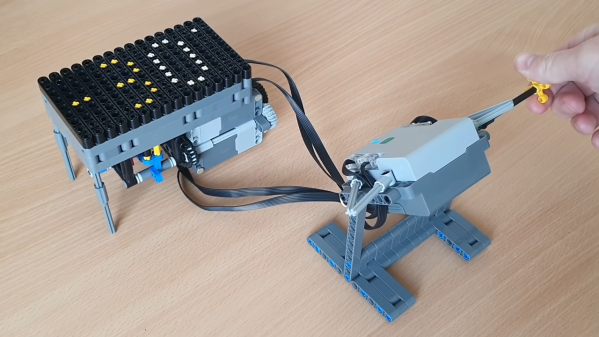
Utter the words “7-segment display” amongst hackers and you’ll typically get people envisaging the usual LED and LCD versions that we all come across in our daily lives. However, mechanical versions do exist, and [ord] has assembled a couple of designs of their very own.

The first uses what appears to be two LEGO motors to drive individual segments of the display. Each segment consists of a pair of yellow axles thrust up through a black grid to represent parts of the number, as well as a minus sign as needed. [ord] demonstrates it by using it to display angle data from a tilt sensor inside a LEGO Powered Up controller brick. Further photos on Flickr show the drive system from underneath.

The second design relies upon a drum-like mechanism that seems to only be capable of displaying numbers sequentially. It works in a manner not dissimilar to that of a player piano. The required movements to display each number are programmed into sequences with Technic pins sticking out of beams in a drum assembly driven by either a hand crank or motor. It’s again demonstrated by [ord] using it to display angular data.

While it’s unlikely we’ll see LEGO displays used as angle of attack meters in light aircraft, you could do so if you wanted a cheap and unreliable device that is likely to fall to pieces if unduly jostled. In any case, it’s not the first time we’ve seen LEGO 7-segment displays, but it’s always great to see a new creative take on an existing concept. We’d love to see such a design implemented into a fancy clock, or perhaps even a news ticker running on a 16-segment version. Video after the break.

Continue reading “Building 7-Segment Displays With LEGO”

Building A DIY Flight Yoke For Flight Simulator

Flight yokes are key to getting an authentic experience when playing a flight simulator, but [Michel Rechtin] didn’t want to pay big money for a commercially-available solution. He ended up building a design using a lot of parts he had laying around, which saved money and worked out great.

The build is based around an Arduino Micro, which reads a series of potentiometers from the yoke and pedals to control pitch, roll, and yaw, A series of buttons are then added to control ancillary functions for the plane and simulator software.

Much of the build uses old 3D printer components, including linear bearings and rods for the pitch axis for smooth operation. There’s even a throttle setup and some more buttons and switches for a more complete flying experience.

Files are available on Thingiverse from anyone looking to replicate [Michael]’s build. We love to see a yoke built from scratch, though we’ve also seen creative builds repurpose PlayStation controllers for the same purpose. Video after the break.

Continue reading “Building A DIY Flight Yoke For Flight Simulator”

Fifty Motored Paraglider Partly Flies, Partly Glides

If there’s one thing you can count on [Peter Sripol] for, it’s for defining the the aviation category of “Don’t Try This At Home.” In the video below the break, [Peter] displays his latest terror of the skies: A powered paraglider backpack that has fifty electric motors. Does it fly? Yes. Was it a success? Eh… mostly.

As [Peter] even says in the video: Don’t try this at home. [Peter] has taken a paraglider, which is essentially a non-rigid fabric wing that to the untrained eye resembles a parachute, and powered it with fifty drone motors taken from other projects. Two motors each are mounted in a push/pull configuration inside a 5×5 array of 3d printed ducts.

While the experiment was essentially a success, it was also a failure due to not having enough power, too little battery life, and overall just not being that great. Does every experiment need to end in absolute success in order to have fun and learn lessons that can be applied to the next iteration? Definitely not! We applaud [Peter] for being willing to fail- although, we have to admit, failing is a lot easier when you’ve already got a parachute of sorts deployed!

Looking for some more don’t-try-this-at-home projects to gawk at? Look no further than [Colin Furze] who like [Peter],  has managed to gain his own Hackaday tag.

Continue reading “Fifty Motored Paraglider Partly Flies, Partly Glides”