Workshop Organization With Panels

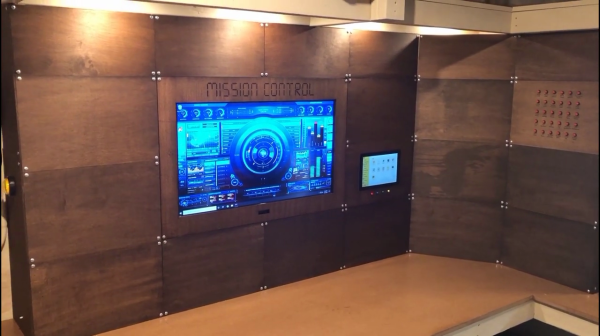
Tired of all your completed (or half-completed) projects cluttering up your workspace? Or you toss them in a box and later forget which box? Well [Another Maker] aka [Develop With Dan] came up with a solution which he dubs Mission Control — panelize your projects and store them in one of many cubbyholes which are provided by a false wall.
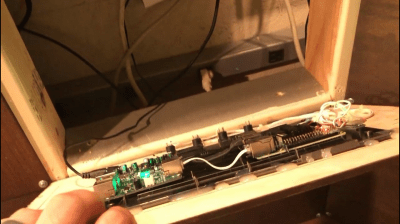
Back view of an example project panel

Each project gets a panel and is neatly stored away when not in use. For some project, this could be simply for storage. For other projects, this might serve as a showcase. Occupying the center of Mission Control is a large monitor, presumably a permanent installation. It looks like there are two different sizes of panels, but we wonder whether more and smaller panels might be more useful. As he’s putting this together, we particularly like one piece of advice that [Dan] offers regarding his custom tool, the Cornerator 3000:

Never hesitate to make a jig when you want to repeat something.

[Dan] will be posting this workspace on his GitHub repository along with code and documentation for various projects he posts on YouTube. He’s also proud to have built this system out of 100% recycled material, or as he says, he went dumpster diving. Do you have a good system for storing / displaying projects in your lab? Let us know in the comments below.

Continue reading “Workshop Organization With Panels”

China MagLev Train Aspirations Boosted By New 600 Km/h Design

Maglev trains have long been touted as the new dawn for train technology. Despite keen and eager interest in the mid-20th century, development has been slow, and only limited commercial operations have ever seen service. One of the most well-known examples is the Shanghai Maglev Train which connects the airport to the greater city area. The system was purchased as a turnkey installation from Germany, operates over a distance of just 30.5 km, and according to Civil Engineering magazine cost $1.2 billion to build in 2001. Ever since, it’s served as a shining example of maglev technology — and a reminder of difficult and expensive maglev can be.

However, China has fallen in love with high-speed rail transport in the last few decades and has invested heavily. With an aggressive regime of pursuing technology transfers from foreign firms while building out the world’s largest high-speed rail network, the country has made great progress. Now, Chinese rail transit manufacturer, CRRC Corporation, have demonstrated their newest maglev train, which hopes to be the fastest in the world.

Continue reading “China MagLev Train Aspirations Boosted By New 600 Km/h Design”

Tamagotchis Everywhere

Tamagotchi’s relatively simple technical complexity pales in comparison to its huge cultural impact, with over 76 million sold. It has spawned comics, stories, numerous toys, and offshoots such as an anime and two films. [JC] was looking through some of his old stuff and came across a Tamagotchi P1 (the original Tamagotchi) and decided to create a portable emulator for it. The ROM for the P1 has long been dumped and can be run within a MAME emulator. After all, it’s just an E0C6S46 Epson MCU, 32×16 LCD with 8 additional icons, three buttons, and a piezo. The manual for the MCU is even available on Epson’s website. Here at Hackaday, we’ve seen Tamagotchis many times before, such as the infinite matrix of the Tamagotchi Singularity and a ROM dump of the latest generation of Tamagotchi based on a 6502 core.

So what’s different about what [JC] is trying to accomplish? For starters, the tooling. It is divided into two parts: TamaLIB and TamaTool. The first is a hardware-agnostic P1 emulation library that relies on a HAL layer to communicate with the hardware. The second is a frontend for the first, allowing debugging, RAM editing, and modifications to the ROM. In particular, it supports easy modification of images within the ROM and allows for custom eggs and Tamagotchis. The homage to the Jolly Wrencher is nice.

Given that the emulation is platform-agnostic and access to a low-resolution timer is not guaranteed, cycle counts become tricky. The rather clever solution [JC] stumbled upon was synchronizing against input polling, screen updates, and sound output. TamaLIb keeps track of how many CPU cycles have passed and regularly checks if the emulation is going too fast or too slow. Slowing down or speeding up the simulation allows it to seem to run in real-time.

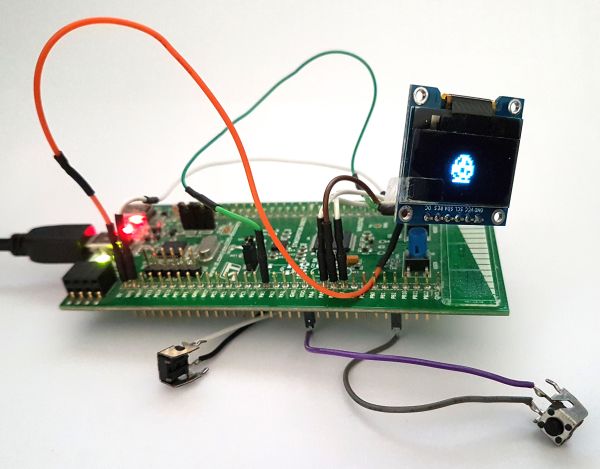
The last goal [JC] had was to run it on embedded hardware. Using an STM32F072 board and a cheap OLED screen had a portable emulated Tamagotchi known as MCUGotchi. The code is available on GitHub and should work on most STM32 MCUs with a few small tweaks. Now that someone has gone through the effort to make it easy to run a Tamagotchi literally anywhere, it might not be long until we see a coffee maker or a smart light acting as a Tamagotchi. Perhaps the new joke will be, can it run Tamagotchi?

Video after the break.

Continue reading “Tamagotchis Everywhere”

Hiding Links In Plain Sight With Bookmark Knocking

Have you ever been looking for a screwdriver, USB stick, or your keys, only to find them right where you left them in plain sight? We have. As many prolific geocachers know, hiding things out in the open is a great way to make sure that people overlook them. 

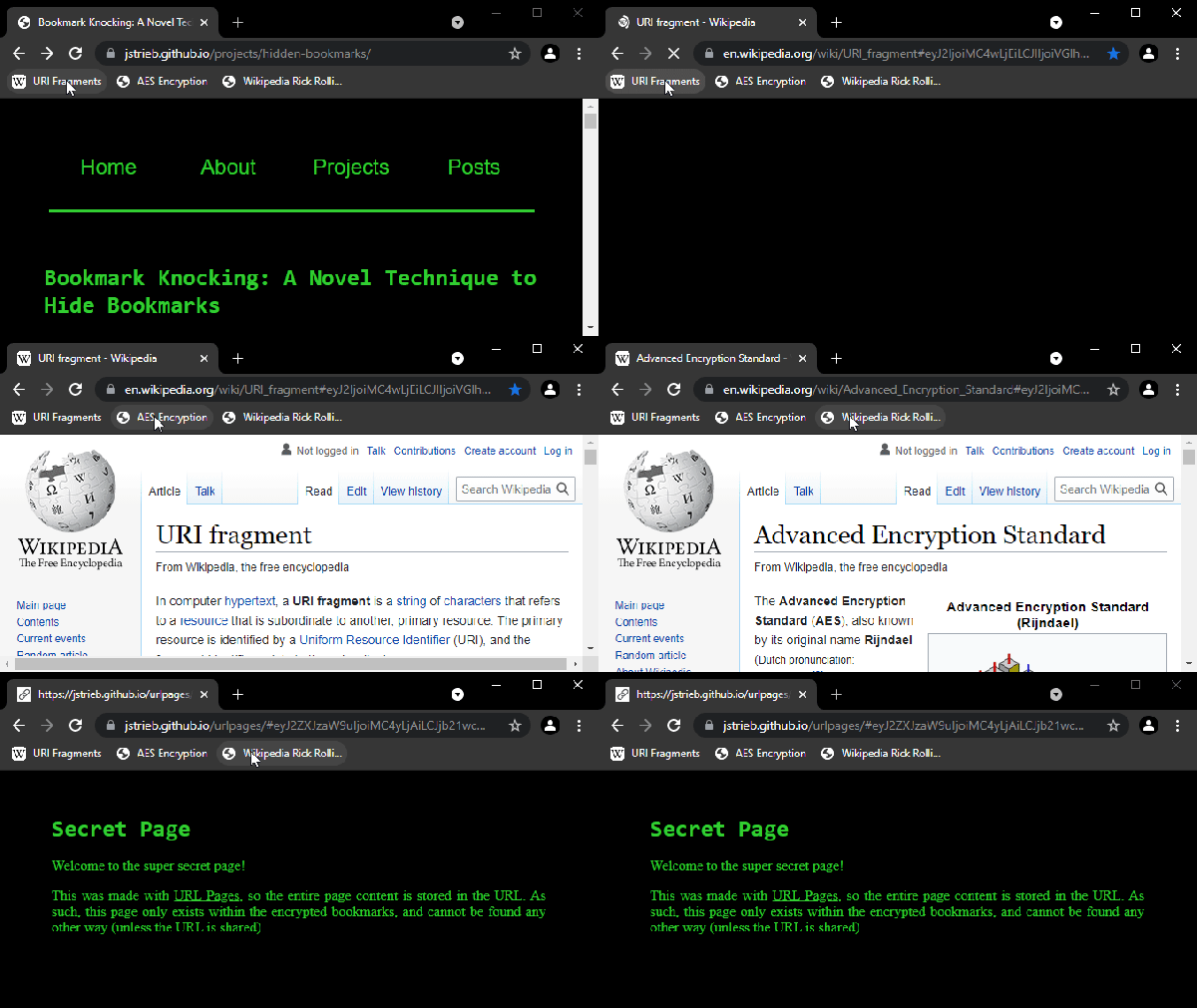
[Jacob Strieb] has been researching various ways to password protect and hide browser bookmarks in plain sight. He calls his latest technique “Bookmark Knocking” and he’s made a demonstration available on his Github account.

Why hide bookmarks to begin with? A browser’s bookmark collection can give away the habits, interests, and needs of the person who put them there. Bookmarks to gifts, domestic abuse support websites, and other private destinations might be best kept away from prying eyes.

Inspired by port knocking — opening connections to specific network ports in sequence to gain access through a firewall — bookmark knocking requires clicking bookmarks in a specific order to open a link. When the bookmarks are accessed in the proper order, the third bookmark reveals a hidden site. It’s not only a novel approach to hiding things in plain sight, it’s very cool to use! 

We especially appreciate [Jacob]’s motivation: Helping those who are vulnerable to protect themselves in any way possible. It’s a solid reminder that technology can be elevated to a higher stature when put to a noble use. Be sure to check out the demonstration so you can try it for yourself!

If camouflaging data flips your bits, you may want to look at a neat way to embed data right into bash scripts, or conceal a WiFi enabled microcontroller in a USB cable. Do you have your own favorite “hidden in plain sight” hack? Be sure to let us know through the Tip Line.


Taking A Walk Down [Computer] Memory Lane

There’s nothing quite like going to a museum and being given a tour by a docent who really knows their way around the exhibits. When that docent has first hand experience in the subject matter, the experience is enhanced even further. So you can imagine our excitement when hacker, maker, and former DEC mainframe memory engineer [Ned Utzig] published a tour of what he calls “Memories of Weird Memories of Computers Past.” [Ned] expertly guides us through each technology, adding flavor and nuance to an already fascinating subject.

The tour begins with early storage media such as IBM punch cards, and then walks us through time to the paper tape, vacuum tubes, and even complex vats of mercury — all used for the sake of storing data either permanently or temporarily.

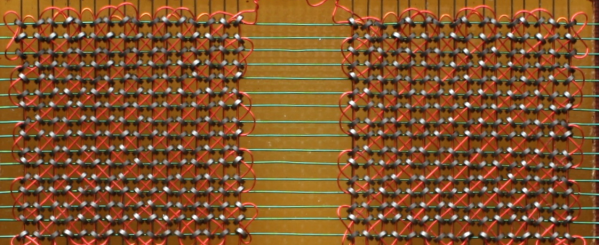
Next in the exhibit is an impressive CRT hack that isn’t unlike modern DRAM. The tour continues on to ferrite core memory such as that used on mainframes, minicomputers, and even the Apollo Guidance Computer. Each type is examined for its strengths and weaknesses and its place in computing history.

We really appreciated the imaginative question posed toward the end of the article. We won’t give it away here- it’s worth it to go give The Mad Ned Memo a read.

Is obsolete technology your cup of tea? Perhaps an Arduino based experiment with core memory will scratch the itch, or maybe storing data in thin air will bring back memories of computers gone by.

Animation In Education, 1950’s Style

Back before the days of computers, animation was drawn by hand. We typically think of cartoons and animated feature films, but there were other genres as well. For example, animation was also used in educational and training films. [Javier Anderson] has tracked down a series of antenna and RF training videos from the Royal Canadian Air Force in the 1950s and 60s and posted them on his YouTube channel.

He has found three of these gems, all on the topic of antenna fundamentals: propagation, directivity, and bandwidth (the film on propagation is linked below the break). Casually searching for the names listed in the film’s credits will lead you down an endless and fascinating rabbit hole about the history of Canadian animation and the formation of the Canadian National Film Board and its Studio A group of pioneering young artists (one can easily lose a couple of hours doing said searches, so be forewarned). For these films that [Javier] located, the animator is [Kaj Pindal]. [Kaj] (1927-2019) was a Dane who learned his craft as a teenager, drawing underground anti-Hitler comics in Copenhagen until fleeing for his life. He later emigrated to Canada, where he had a successful career as an artist and educator.

Animator [Kaj Pindal] at his desk, c.2012
Anyone who has tried to really grasp the physical connection between currents flowing in an antenna wire and the resultant radiated signal described by the second-order partial differential electromagnetic wave equation, all while using only a textbook, will certainly agree — unarguably this is a topic whose teaching can be significantly improved by animations such as [Kaj]’s. And if you’d like to sprinkle more phrases like “… in time-phase and space-quadrature …” into your conversations, then this film series is definitely for you.

Have you encountered any particularly helpful or well-made animated educational videos in your education and/or career? Are there any examples of similar but modern films made using computer generated images? Thanks to reader [Michael Murillo] for tipping us off to these old films.

Continue reading “Animation In Education, 1950’s Style”

Relay Logic Nixie Tube Clock Checks All The Boxes

There are a few words in the electrical engineering lexicon that will perk any hardware hacker’s ears. The first of course is “Nixie tubes” with their warm cold war era ambiance and nostalgia inducing aura. A close second is “relay logic”. Between their place in computing and telecom history and the way a symphony of click and clatter can make a geek’s heart go pitter patter, most of us just love a good relay hack. And then there’s the classic hacker project: A unique timepiece to adorn our lair and remind us when we’ve been working on our project just a little too long, if such a thing even exists.

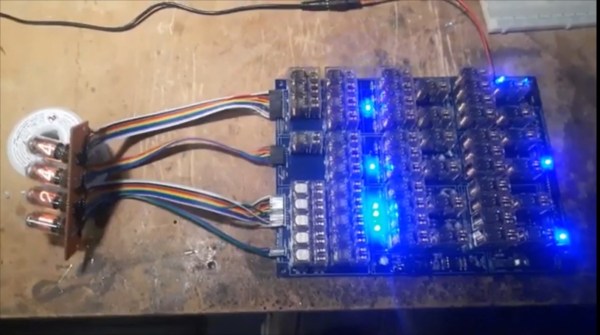
With those things in mind, you can forgive us if we swooned ever so slightly when [Jon Stanley]’s Relay Logic Nixie Tube Clock came to us via the Tip LineAdorned with its plethora of clicking relays and set aglow by four Nixie tubes, the Relay Logic Nixie Tube Clock checks all our boxes. 

[Jon] started the build with relay modules that mimic CD4000 series CMOS logic chips. When the prototype stage was complete, the circuit was recreated on a new board that mounts all 55 Omron relays on the same PCB. The result? A glorious Nixie tube clock that will strike envy into even the purest hacker’s heart. Make sure to watch the video after the break!

[Jon] has graciously documented the entire build and even makes various relay logic boards available for purchase if you’d like to embark on your own relay logic exploits . His site overflows with unique clock projects as well, so you can be sure we’ll be checking those out. 

If you feel inspired to build your own relay logic project, make sure you source genuine Omron relays, especially if your Relay Computer Masterpiece takes six years to build.

Thanks to [Daniel] for sending this our way. Got a cool project you’d like to share? Be sure to send it in via the Tip Line

Continue reading “Relay Logic Nixie Tube Clock Checks All The Boxes”