Microfluidics For Biohacking Hack Chat

Join us on Wednesday, July 7 at noon Pacific for the Microfluidics for Biohacking Hack Chat with Krishna Sanka!

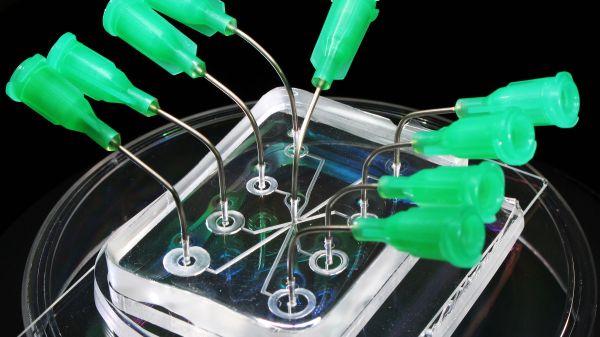
“Microfluidics” sounds like a weird and wonderful field, but one that doesn’t touch regular life too much. But consider that each time you fire up an ink-jet printer, you’re putting microfluidics to work, as nanoliter-sized droplets of ink are spewed across space to impact your paper at exactly the right spot.

Ink-jets may be mundane, but the principles behind them are anything but. Microfluidic mechanisms have found their way into all sorts of products and processes, with perhaps the most interesting uses being leveraged to explore and exploit the microscopic realms of life. Microfluidics can be used to recreate some of the nanoscale biochemical reactions that go on in cells, and offer not only new ways to observe the biological world, but often to manipulate it. Microfluidics devices range from “DNA chips” that can rapidly screen drug candidates against thousands of targets, to devices that can rapidly screen clinical samples for exposure to toxins or pathogens.

There are a host of applications of microfluidics in biohacking, and Krishna Sanka is actively working to integrate the two fields. As an engineering graduate student, his focus is open-source, DIY microfluidics that can help biohackers up their game, and he’ll stop by the Hack Chat to run us through the basics. Come with your questions about how — and why — to build your own microfluidics devices, and find out how modern biohackers are learning to “go with the flow.”

join-hack-chatOur Hack Chats are live community events in the Hackaday.io Hack Chat group messaging. This week we’ll be sitting down on Wednesday, July 7 at 12:00 PM Pacific time. If time zones have you tied up, we have a handy time zone converter.

[Featured image: Cooksey/NIST]

A New Spin On Empty Filament Spools For Part Storage

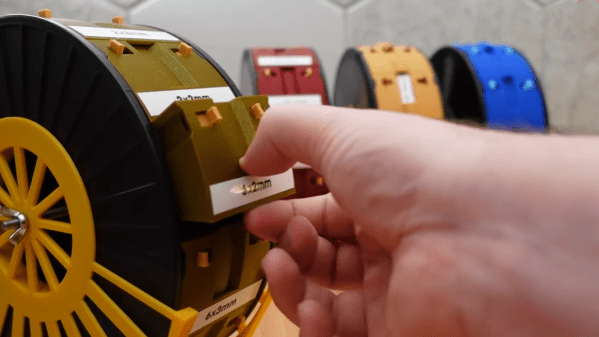
Empty spools from 3D printer filament are the kind of thing that begs to be repurposed, and one option is [3d-printy]’s vertical filament spool parts drawer design. The way this solution works is by using the spool to hold twelve vaguely pie-shaped drawers that can be individually unlocked and removed entirely, which makes accessing their contents (or dumping them out) much easier. This method requires the spools to be oriented vertically, so it ends up handling a bit like a Rolodex.

One downside of the design is that it requires two inserts to be installed on the inside of the spool walls, which act as guide rails and lock points for the drawers. Another is that managing a vertical spool can be a bit awkward, given its lack of flat surfaces. Happily, there is an option for a matching stand that not only provides a flat base, but keeps any accidentally-unlocked drawers from falling out and spilling their contents.

The project files are OpenSCAD files, which allows easy customization for different spool manufacturers and dimensions, and [3d-printy] provides measurements for some common ones. Another nice element of this design is that no single part uses more than 30 grams of filament, which makes printing them an attractive way to use up the last bits of filament rolls.

We’ve seen drawer-style storage for filament spools before, but haven’t seen a design quite like this one before. Watch an overview of the drawer design as well as the spool holders in the videos, embedded below.

Continue reading “A New Spin On Empty Filament Spools For Part Storage”

Messaging On Signal Via The ESP32

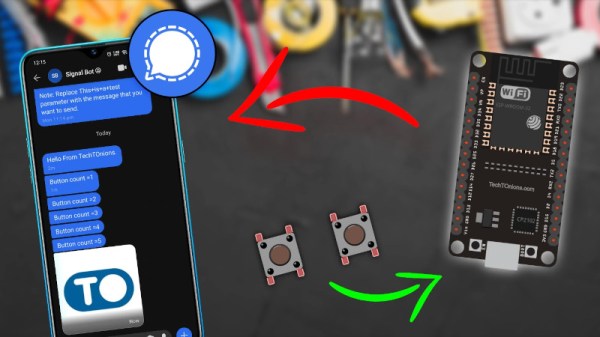
Signal is a popular encrypted messaging app, typically used on smartphones. The cross-platform service can now be used via the ESP32, however, thanks to the work of [Dharmik] and [Tirth].

The demonstration is simple, using an ESP32 microcontroller fitted with two push buttons. When one button is pushed, it increments a counter and sends a Signal message noting the current count. The other button sends an image as a Signal message.

The project relies on a Signal bot to deliver an API key that enables the project to work. Messages are sent by making HTTP requests with this key to the CallMeBot.com server. With the API key as authentication, users can only send messages to their own number, keeping the system safe from spammers.

While the demonstration is basic, it merely serves to illustrate how the project works. The aim was to allow home automation and other Internet of Things systems to send Signal messages, and through this method, it’s now possible. The highly security conscious likely won’t want to rely on a random third party server, but for those tinkering around, it may not be such a big deal.

The Internet of Things has a long history with self-messaging projects; we featured the Twittering Toaster back in 2008! Video after the break.

Continue reading “Messaging On Signal Via The ESP32”

Litter Buggies Haul Trash Off The Beach

There is a depressing amount of trash in our oceans, and a lot of it is washes up on beaches. [Glenn Morris] has turned collecting all this trash into a favourite pastime, using a series of custom radio-controlled Litter Buggies to haul the load.

The most basic versions of these buggies are off the shelf RC rock crawlers, usually a Traxxas TRX-4, with a basket mounted in place of the body. However, [Glenn] has developed the buggies far beyond that, making extensive use of 3D printing to create purpose-built trash haulers. He has created several frame systems to hold removable baskets, buckets, lights and tools. Most of the buggies use lithium power tool batteries to allow quick swapping, and the electric motors, ESCs and gearing is selected for low speed and high torque. Since the buggies spend a lot of time exposed to salt water, almost all the steel hardware on the chassis are replaced with stainless steel. To allow for one handed control, [Glenn] attached 3D printed levers to the steering knobs of the standard RC controllers, allowing steering to be done with his thumb.

We really like what [Glenn] has been doing with these buggies, and think they might be a good platforms for adding some autonomous capabilities. Add a smartphone for target following or obstacle avoidance, or some solar panels and a GPS autopilot system.

Continue reading “Litter Buggies Haul Trash Off The Beach”

Convert Your Mouse Into A Paddle Controller

Early game consoles had a wide and interesting variety of controllers, many of which fell by the wayside as consoles evolved. One of these is the Atari 2600 paddle controller, which was the preferred interface for playing games like Kaboom!, Tempest, and Pong.  While it is possible to play these games with a mouse, [Retro Gaming I Guess] wanted to do it the historically correct way, so he created a simple hack to convert an optical mouse into a paddle controller.

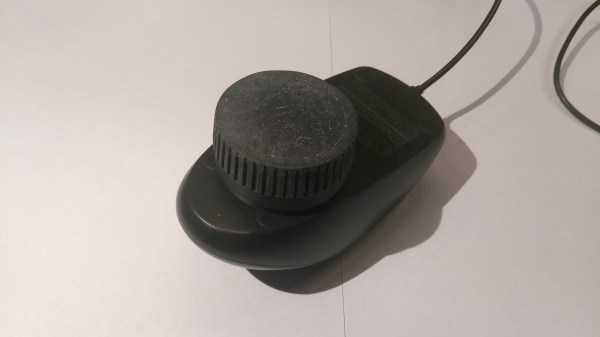
The main idea Is to attach a rotary knob to the bottom of the mouse, with the optical sensor located just inside the edge of the knob. To the optical sensor, it appears that the bottom surface of the knob is moving in a straight line, so the mouse pointer will move in a straight line as the knob rotates. The 3D printed knob (or bottle cap) is magnetically attached to the bottom of the mouse, by gluing one magnet into the center of the knob, and the other on the inside of the mouse under the PCB. This allows for quick conversion back to a normal mouse. You could off course sacrifice an old mouse to the cause to create a dedicated paddle controller, and make it closer to the original by adding end stops and a spring return.

We really like the simplicity of this hack, and we’re sure our readers can come up with a few other use cases for it in the comments below. You can also approach old Atari games from the opposite end, like adding a machine vision powered laser blaster. While many may think the Atari 2600 was the first gaming console, that honor actually goes to the Magnavox Odyssey, which was the start the of the multi-billion dollar home gaming industry we know today.

Iron Becomes SMD Hot Plate

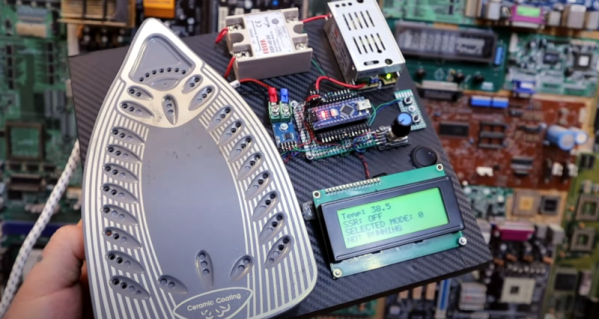
Few things have changed our workshops more than surface mount components. In 1980 it would have been strange to see a hobby bench with a microscope, hot air equipment, tweezers, and all the other accouterments that are a necessity today. [Electronoobs] wanted a reflow hot plate and decided that he could repurpose a consumer laundry iron for the job. You can see the results in the video below.

Opening the iron revealed surprisingly simple circuitry, so the build has some additional parts along with a controller and an LCD, of course. The power requirement for the heating element is significant — 13 amps — so the plate uses a solid state relay to turn things on and off.

Continue reading “Iron Becomes SMD Hot Plate”

Hackaday Links Column Banner

Hackaday Links: July 4, 2021

With rescue and recovery efforts at the horrific condo collapse in Florida this week still underway, we noted with interest some of the technology being employed on the site. Chief among these was a contribution of the Israeli Defense Force (IDF), whose secretive Unit 9900 unveiled a 3D imaging system to help locate victims trapped in the rubble. The pictures look very much like the 3D “extrusions” that show up on Google Maps when you zoom into a satellite view and change the angle, but they were obviously built up from very recent aerial or satellite photos that show the damage to the building. The idea is to map where parts of the building — and unfortunately, the building’s occupants — ended up in the rubble pile, allowing responders to concentrate their efforts on the areas most likely to hold victims. The technology, which was developed for precision targeting of military targets, has apparently already located several voids in the debris that weren’t obvious to rescue teams. Here’s hoping that the system pays off, and that we get to learn a little about how it works.

Radio enthusiasts, take note: your hobby may just run you afoul of authorities if you’re not careful. That seems to be the case for one Stanislav Stetsenko, a resident of Crimea who was arrested on suspicion of treason this week. Video of the arrest was posted which shows the equipment Stetsenko allegedly used to track Russian military aircraft on behalf of Ukraine: several SDR dongles, a very dusty laptop running Airspy SDR#, an ICOM IC-R6 portable communications receiver, and various maps and charts. In short, it pretty much looks like what I can see on my own desk right now. We know little of the politics around this, but it does give one pause to consider how non-technical people view those with technical hobbies.

If you could choose a superpower to suddenly have, it really would take some careful consideration. Sure, it would be handy to shoot spider webs or burst into flames, but the whole idea of some kind of goo shooting out of your wrists seems gross, and what a nuisance to have to keep buying new clothes after every burn. Maybe just teaching yourself a new sense, like echolocation, would be a better place to start. And as it turns out, it’s not only possible for humans to echolocate, but it’s actually not that hard to learn. Researchers used a group of blind and sighted people for the test, ranging in age from 21 to 79 years, and put them through a 10-week training program to learn click-based echolocation. After getting the basics of making the clicks and listening for the returns in an anechoic chamber, participants ran through a series of tasks, like size and orientation discrimination of objects, and virtual navigation. The newly minted echolocators were also allowed out into the real world to test their skills. Three months after the study, the blind participants had mostly retained their new skill, and most of them were still using it and reported that it had improved their quality of life.

As with everything else he’s involved with, Elon Musk has drawn a lot of criticism for his Starlink satellite-based internet service. The growing constellation of satellites bothers astronomers, terrestrial ISPs are worried the service will kill their business model, and the beta version of the Starlink dish has been shown to be flakey in the summer heat. But it’s on equipment cost where Musk has taken the most flak, which seems unfair as the teardowns we’ve seen clearly show that the phased-array antenna in the Starlink dish is being sold for less than it costs to build. But still, Musk is assuring the world that Starlink home terminals will get down in the $250 to $300 range soon, and that the system could have 500,000 users within a year. There were a couple of other interesting insights, such as where Musk sees Starlink relative to 5G, and how he’s positioning Starlink to provide backhaul services to cellular companies.

Well, this is embarrassing. Last week, we mentioned that certain unlucky users of an obsolete but still popular NAS device found that their data had disappeared, apparently due to malefactors accessing the device over the internet and forcing a factory reset. Since this seems like something that should require entering a password, someone took a look at the PHP script for the factory restore function and found that a developer had commented out the very lines that would have performed the authentication:

    function get($urlPath, $queryParams=null, $ouputFormat='xml'){
//        if(!authenticateAsOwner($queryParams))
//        {
//            header("HTTP/1.0 401 Unauthorized");
//            return;
//        }

It’s not clear when the PHP script was updated, but support for MyBook Live was dropped in 2015, so this could have been a really old change. Still, it was all the hacker needed to get in and wreak havoc; interestingly, the latest attack may be a reaction to a three-year-old exploit that turned many of these devices into a botnet. Could this be a case of hacker vs. hacker?