Comparing Bare Silicon On Two Game Boy Audio Chips

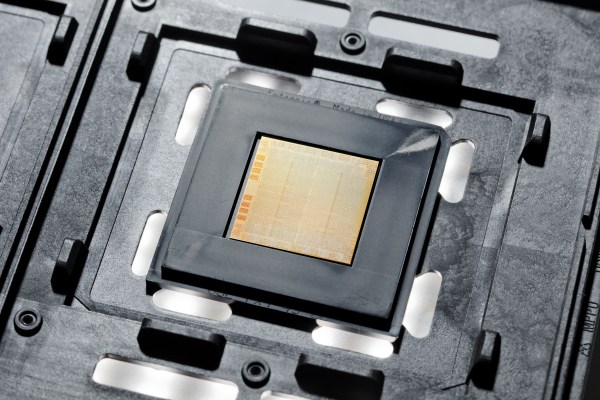
We always look forward to a new blog post by [Ken Shirriff] and this latest one didn’t cure us of that. His topic this time? Comparing two Game Boy audio chips. People have noticed before that the Game Boy Color sounds very different than a classic Game Boy, and he wanted to find out why. If you know his work, you won’t be surprised to find out the comparison included stripping the die out of the IC packaging.

[Ken’s] explanation of how transistors, resistors, and capacitors appear on the die are helpfully illustrated with photomicrographs. He points out how resistors are notoriously hard to build accurately on a production IC. Many differences can affect the absolute value, so designs try not to count on exact values or, if they do, resort to things like laser trimming or other tricks.

Capacitors, however, are different. The exact value of a capacitor may be hard to guess beforehand, but the ratio of two or more capacitor values on the same chip will be very precise. This is because the dielectric — the oxide layer of the chip — will be very uniform and the photographic process controls the planar area of the capacitor plates with great precision.

We’ve decapsulated chips before, and we have to say that if you are just starting to look at chips at the die level, these big chips with bipolar transistors are much easier to deal with than the fine and dense geometries you’d find even in something like a CPU from the 1980s.

We always enjoy checking in with [Ken]. Sometime’s he’s taking apart nuclear missiles. Sometimes he is repairing an old computer. But it is always interesting.

Variable Mirror Changes Shape Under Pressure

Unless you’re in a carnival funhouse, mirrors are generally dead flat and kind of boring. Throw in some curves and things get interesting, especially when you can control the curve with a touch of your finger, as with this variable surface convex mirror.

The video below starts off with a long but useful review of conic constants and how planes transecting a cone can create circles, parabolas, or ellipses depending on the plane’s angle. As [Huygens Optics] explains, mirrors ground to each of these shapes have different properties, which makes it hard to build telescopes that work at astronomical and terrestrial distances. To make a mirror that works over a wide range of distances, [Huygens Optics] built a mirror from two pieces of glass bonded together to form a space between the front and rear surface. The front surface, ground to a spherical profile, can be deformed slightly by evacuating the plenum between the two surfaces with a syringe. Atmospheric pressure bends the thinner front surface slightly, changing the shape of the mirror.

[Huygens Optics] also built an interferometer to compare the variable mirror to a known spherical reference. The data from the interferometer was fed to a visualization package that produced maps of the surface shape, which you can easily see changing as the pressure inside the mirror changes. Alas, a deeper dive into the data showed the mirror to be less than perfect, but it’s fascinating to think that a mirror can flex enough to change from elliptical to almost parabolic with nothing more than a puff of air.

We’ve seen a couple of interesting efforts from [Huygens Optics] before, including this next-level spirit level. He’s not all about grinding glass, though — witness this investigation into discriminating metal detectors.

Continue reading “Variable Mirror Changes Shape Under Pressure”

What Does The Bat Say? Tune In With This Heterodyne Detector

Bats are fascinating animals, and despite all the myth and creepiness surrounding them, they really remind one more of a drunk bird lost in the night sky than the blood-sucking creature they’re often made out to be. Of course, some really fall into that category, and unlike actual birds, bats don’t tend to grace us with their singsong — at least not in ways audible for us humans. But thanks to bat detectors, we can still pick up on it, and [Marcel] recently built a heterodyne bat detector himself.

Bat Detector in its enclosure
The bat detector (and an insight to the beauty of German language, where a bat is a flutter mouse)

The detector is made with a 555, an MCP6004 op amp, and a 4066 analog switch — along with a bunch of passives — and is neatly packed into a 3D-printed case with a potentiometer to set the volume and center frequency for the detection. The bat signal itself is picked up by a MEMS microphone with a frequency range [Marcel] found suitable for the task. His write-up also goes in all the mathematics details regarding heterodyning, and how each component plays into that. The resulting audio can be listened to through a headphone output, and after putting together an adapter, can also be recorded from his smartphone. A sample of how that sounds is added in his write-up, which you can also check out after the break.

In case you want to give it a try yourself, [Marcel] put all the design files and some LTSpice simulations on the project’s GitHub page. If you are curious about bat detectors in general and want to read more about them, follow [Pat Whetman] down that rabbit hole, or have a look at this one made in Python for something more software-focused.

Continue reading “What Does The Bat Say? Tune In With This Heterodyne Detector”

Nothing Comes From Nowhere

How do you come up with new ideas? As much as it sometimes seems like they arrive in a flash out of the blue, they don’t just come out of nowhere. Indeed, we all have well-stocked mental toolboxes that say “this thing can be used to do that” and “if you want to get there, start here”.

One incredibly fertile generator of “new” ideas is simply putting old ideas next to each other and realizing that a chain of two or three can get you to someplace new. It just happened to me while listening to Mike and myself on this week’s Hackaday Podcast.

bikelangelo

Here’s the elevator pitch. You take something like the player-pianoesque MIDI barrel piano that we featured last Thursday, and mix it together with the street-painting bicycle trailer that we featured on Friday. What do you get? A roll of paper that can be drawn on by normal kids, rolled up behind a bicycle, with a tank that they can pressurize with a bike pump, that will spray a pixelated version of their art as they roll down the sidewalk.

Now how can I make this real? One of my neighbors has a scrap bike trailer…

But see what I mean about ideas? I just took two existing ideas and rubbed them together, and in this case, they emitted sparks. And I’ve got a mental catalogue of all of the resources around me, some of which fell right into place. This role as fountain of good proto-ideas is why I started reading Hackaday fifteen years ago, and why it’s still a daily must-read for folks like us everywhere. A huge thank you to everyone who’s sharing! Read more Hackaday!

Recreating Paintings By Teaching An AI To Paint

The Timecraft project by [Amy Zhao] and team members uses machine learning to figure out a way how an existing painting may have been originally been painted, stroke by stroke. In their paper titled ‘Painting Many Pasts: Synthesizing Time Lapse Videos of Paintings’, they describe how they trained a ML algorithm using existing time lapse videos of new paintings being created, allowing it to probabilistically generate the steps needed to recreate an already finished painting.

The probabilistic model is implemented using a convolutional neural network (CNN), with as output a time lapse video, spanning many minutes. In the paper they reference how they were inspired by artistic style transfer, where neural networks are used to generate works of art in a specific artist’s style, or to create mix-ups of different artists.

A lot of the complexity comes from the large variety of techniques and materials that are used in the creation of a painting, such as the exact brush used, the type of paint. Some existing approaches have focused on the the fine details here, including physics-based simulation of the paints and brush strokes. These come with significant caveats that Timecraft tried to avoid by going for a more high-level approach.

The time lapse videos that were generated during the experiment were evaluated through a survey performed via Amazon Mechanical Turk, with the 158 people who participated asked to compare the realism of the Timecraft videos versus that of the real time lapse videos. The results were that participants preferred the real videos, but would confuse the Timecraft videos for the real time lapse videos half the time.

Although perhaps not perfect yet, it does show how ML can be used to deduce how a work of art was constructed, and figure out the individual steps with some degree of accuracy.

Continue reading “Recreating Paintings By Teaching An AI To Paint”

The Trouble With Tamagotchis…

The must-have toy of a couple of decades ago was the Tamagotchi, a virtual pet in an LCD screen on a keyring, that demanded your attention and which would die were you to neglect it. Fortunately it had a reset button on the back through which it could be resuscitated, but even so it lacked a satisfying tactile experience. [Nadine] has done something about this with her Tamagotchi-style Tribble, an anthropomorphic ball of fluff that demands attention and purrs when it receives some.

Inside the ball of fake fur is an Adafruit Circuit Playground with a capacitive touch pad and a haptic motor. After a random time with no attention it “cries”, and its owner strokes it, after which it responds with a purring vibration. It’s quite cute as you canĀ  see in the Twitter video below, and fortunately it won’t multiply and fill up your starship. We wonder whether a small resistive heater to give it a body temperature would complete its appeal as a virtual pet.

Given the popularity of Star Trek TOS among Hackaday readers perhaps it’s surprising that we don’t see more Tribble related projects. They have made a notable appearance as a DEF CON badge though.

Continue reading “The Trouble With Tamagotchis…”

Reliving Heathkit’s Glory Days Through A Teardown And Rebuild

In its heyday, the experience offered by the Heath Company was second to none. Every step of the way, from picking something out of the Heathkit catalog to unpacking all the parts to final assembly and testing, putting together a Heathkit project was as good as it got.

Sadly, those days are gone, and the few remaining unbuilt kits are firmly in the unobtanium realm. But that doesn’t mean you can’t tear down and completely rebuild a Heathkit project to get a little taste of what the original experience was like. [Paul Carbone] chose a T-3 Visual-Aural signal tracer, a common enough piece that’s easy to find on eBay at a price mere mortals can afford. His unit was in pretty good shape, especially for something that was probably built in the early 1960s. [Paul] decided that instead of the usual recapping, he’d go all the way and replace every component with fresh ones. That proved easier said than done; things have changed a lot in five decades, and resistors are a lot smaller than they used to be. Finding hookup wire to match the original was also challenging, as was disemboweling some of the electrolytic cans so they could be recapped. The finished product is beautiful, though — even the Magic Eye tube works — and [Paul] reports that the noise level is so low he wasn’t sure if turned it on at first.

We’ve covered the rise and fall of Heathkit, as well as their many attempted comebacks, including an inexplicable solder-free radio and the “world’s most reliable” clock. Looking at these offerings, we think [Paul] may be onto something here.