One-stop Tool Shows Apple Intelligence The Door

Don’t want AI features on your Mac? Tough luck, unless one wants to imperfectly do it by hunting down settings in about a dozen different places. Even then, the multi-gigabyte models stay on disk. Unsatisfied by this state of affairs, [omlahore] created RemoveMacAI, a one-stop-shop debloater that shows Apple Intelligence the door, reclaiming its disk space on the way out.

With RemoveMacAI one has a single location from which to turn individual AI features off, delete the models behind them, and block MacOS from downloading them again by redirecting attempts to a closed local port.

What’s refreshingly nice about the tool is how transparent it is about what each setting or preset will change, and communicates clearly what exactly one loses access to by disabling it. Want it all gone? Easy. Use one or two features, but don’t want the rest? No problem. All changes are shown up-front before the tool changes anything, and all alterations are reversible.

Released only a couple weeks ago, to say the tool is popular would be an understatement. Windows 11 also got a “remove AI features” tool, and it requires constant updating to stay functional. Will a future MacOS update interfere similarly with RemoveMacAI? Probably, but one thing that is clear is that a tool like this resonates deeply with a nontrivial number of users.


Charlotte’s New Runway Gets A Digital Twin

The first viable powered aircraft predated the first proper runway by two decades. While it’s entirely possible to launch some planes from austere dirt or grass strips, the aviation world eventually realized that aircraft would be better off launching from a flat, paved surface.

Over the years, paving technology has gradually improved in the aviation world as it has for roads and highways. Now, there’s a project being built in Charlotte with new digital features that hopes to push the state of the art of runways even further.

Continue reading “Charlotte’s New Runway Gets A Digital Twin” →

An LCR Meter With Compromises

YouTube, like the Internet, has its plusses and minuses. On the plus side, you can find information on just about anything. On the minus side, you don’t always know if that information is of any value. On the plus side, you can connect to experts who have an uncanny knack for explaining things. On the negative side, you can find people who — let’s just say aren’t. Lucky for us, [Kerry Wong] is very knowledgeable about test instruments, so when we see a review from him, like the one for the ZOYI ZT-XC1 LCR meter and multimeter, we know we will get good information. Check out that review in the video below.

It used to be unusual to have an LCR meter that could measure inductance or capacitance in a home lab. But now it isn’t a big deal, and many multimeters and testers can at least attempt to read these quantities.

Continue reading “An LCR Meter With Compromises” →

A shiny, silver vehicle with tools on a mesh rack on the back half and a large open cab up front drives across a grassy field under blue, partly cloudy skies. A person in a black shirt stands in the background with a drone hovering above their head. Two women in white helmets are piloting the vehicle from the cab.

Driving On The Moon At A Blistering 11.6 MPH

As NASA continues humanity’s slow march back to the Moon, different pieces of the puzzle of establishing a more permanent base there are falling into place. One of these pieces is the the Lunar Terrain Vehicle (LTR), and [Cleo Abram] and [Michelle Khare] got a look at the LTR candidate from Lunar Outpost.

Designed to help astronauts traverse the lunar surface as well as function as a semi-autonomous rover when uncrewed, the LTR will be an integral part to any future Moon base. NASA announced earlier this year that it would be moving forward with the LTR featured in this video and another from competitor Astrolab. Regardless of manufacturer, the LTR will have to deal with some wild conditions in the lunar environment.

Lunar dust is abrasive, so the LTR generates an electric current to pull the dust under the truck to prevent it from entering the cab of the vehicle as it moves along. Given the extreme temperature swings on the moon (-200˚C to 200˚C), the space truck will also be fitted with wire mesh tires as nobody wants to be changing a flat in space. The two seats in the cab are oversized and can help lift the astronauts up as space suits hamper their agility to a significant degree. There are compartments for storing samples, and the truck has a robot arm that can grab samples to bring back if no one is along for the ride.

We’ve still got a few years before crews arrive on the moon, but when they do, there’s a good chance they’ll be using the LTR to explore the lunar south pole in hopes of water.

Continue reading “Driving On The Moon At A Blistering 11.6 MPH” →

Thunderbolt Strikes Windows98

If there’s one thing everyone hated about Windows 98, was the lack of USB4.0 support. We remember vividly the cries of anguish at the launch party when we found out that 21 years in the future, the operating system wouldn’t support the then-undreamt of speeds of the thunderbolt-based fastest USB protocol. After two decades of living with this crushing disappointment, [Yeo Kheng Meng] has delivered the goods: the most modern of USB interfaces on some very much not modern versions of windows.

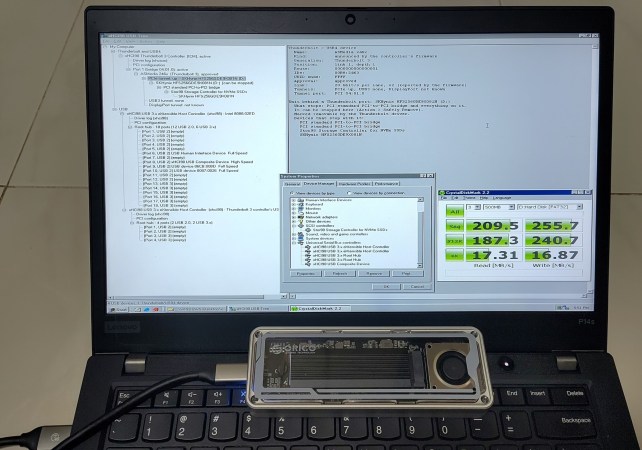
This builds on [Yeo Kheng Meng]’s work on xHCI drivers for USB2.0 support, which we covered at the time. Like that hack, this one applies to Windows 98 through 7, and has a similar level of LLM-wrangling involved. There are actually a few parts to it– one is a USB3.0 driver, which replaces the old xHCI98 driver and is available on GitHub. On Windows98, USB3.0 speed caps out around 200 MB/s, likely restricted by Windows98’s maximum request limit of 64kB on USB transfers. Even with the faster bus in action, it can only gobble those tiny blocks of data so fast.

There’s also experimental USB4.0/Thunderbolt support, as stated above. While not as stable as the USB3.0 portion, we’re kind of impressed it runs at all. Thunderbolt is more than just a faster data bus, after all– you have to support multiple protocols. To handle all that you can install xhcicm.sys and have the surreal experience of accessing an docked NVMe drive from the last century’s best Windows via his Stor98 driver. That’s based largely on [SweetLow]’s NVMe9x project, which he forked but is going to be bundled into the main repo.

What might be more helpful to the community than these drivers is [Yeo Kheng Meng]’s fork of QEMU11 that emulates USB4/Thunderbolt hosts and devices. Having a working emulator seems like it would be a huge boon for this sort of semi-automated development. That’s available in its own repo.

Aside from the already-linked USB2.0 drivers, [Yao Kheng Meng] has an impressive retro-computing record, that includes Swift on the Apple II and turning DOS into llama.c habitat. It should be noted that that llama.c’s TinyStories is not the LLM that assisted with this project.

Thanks to [Yeo Kheng Meng] for the tip!

Hackaday Links Column Banner

Hackaday Links: October 17, 2026

While Hackaday doesn’t maintain a crime blotter, we couldn’t help but start this week’s post off with a bit of civil disobedience — a retired professor from the University of Pennsylvania was arrested earlier this week for standing in front of a delivery robot.

Granted, she was standing there for long enough that the police were eventually called, but still. Previous reporting indicates that Carolyn Marvin has a history of blocking delivery robots as a form of protest, but this is the first time law enforcement got involved. We’re not lawyers here at Hackaday, so we can’t say for sure whether or not blocking the progress of a robot engaged in commercial operation actually violates any laws. But we do know that refusing a lawful request from a police officer will get you in trouble, and that seems to be what Marvin was actually charged with when she refused to move.

Continue reading “Hackaday Links: October 17, 2026” →

Off-Grid Refrigeration Using Fire And Salt

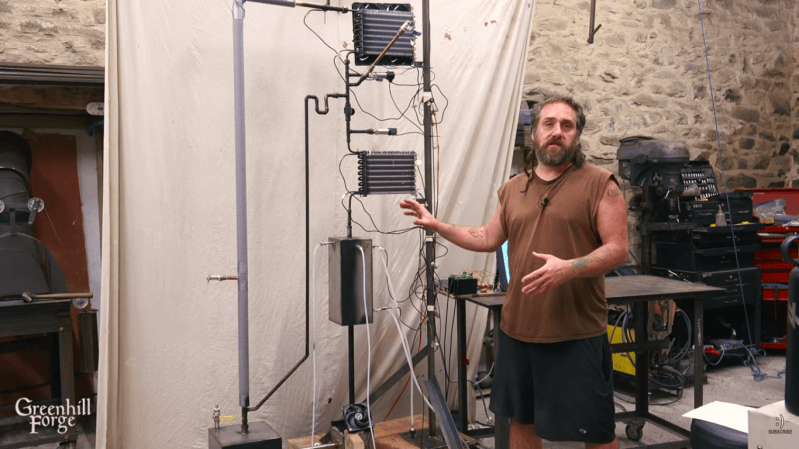
Refrigeration has been a challenge for humanity since the start. Ancient civilizations in dry climates like Persia and Egypt could use evaporative cooling on a large scale with specialized architecture, and with easy access to electricity modern civilization can cool down almost anything it wants. But whether in a refrigerator or heat pump, the electricity demands can get out of hand quickly, and heat-driven systems often require dangerous or hard-to-get chemicals. But [Greenhill Forge] has crafted a system that creates effective refrigeration with only fire and salt… and a bit of electricity.

Heat-driven systems are called absorption coolers. In this design, water is used as a refrigerant and forced to a very low pressure so that it can boil at a low temperature. When it boils it absorbs heat from the surrounding environment, and then that water vapor can be moved and condensed where it gives off that heat. The build has a few distinct loops to make all of this happen. The generator loop holds the heat source and a tank of water mixed with road salt. Boiled water travels up a tube to a condenser. A valve here is opened slightly to allow the water to drip into the absorber section, where it is under low pressure and boils rapidly. The vapor is carried away by the third system, which uses a shower of the salt solution to quickly suck up the vapor and move it away from the cooled area.

There is a small amount of electricity needed to run pumps and fans, but to keep this off-grid this requirement is easily met by a small solar panel or battery. The bulk of the energy is from the fire which boils the saltwater solution. [Greenhill Forge] added a number of temperature and pressure sensors to monitor and control the system as well, and in his firsts tests the refrigeration system was able to get to about 5° C with an ambient temperature around 16° C. That’s not quite the temperature needed for a refrigerator, but not bad for only salt and fire. [Greenhill Forge] has a number of other ingenious off-grid builds like this sawdust stove and a magnetic induction water heater.

Continue reading “Off-Grid Refrigeration Using Fire And Salt” →