An RV On A Bike

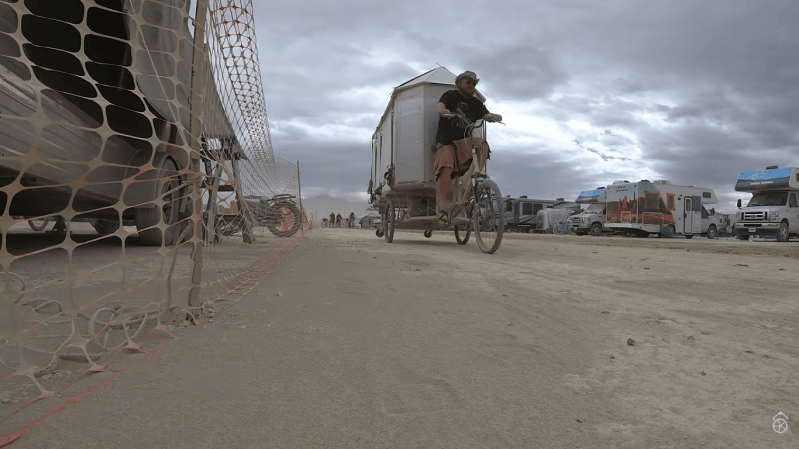
Bicycles are the ultimate form of transportation freedom. They’re easy to repair, parts are cheap, and they will travel almost anywhere for free, as long as the rider has enough calories. Their only real downside is dealing with car-dependent societies, but once a year there’s a place in the American desert that eschews all of this and [Attoparsec] decided to take this custom cargo bike modified into an RV out to Burning Man, a place and time that would be perfect for a build like this.

The build started out as a cargo bike, but not many of them have cargo areas long enough to support a sleeping human. To increase this storage capacity, the bed was extended towards the rear. Without moving the axle further back, though, this created a problem with tail-heaviness so two trailer jacks with wheels were added to the back to keep it from occasionally tipping up too far. The sleeping enclosure was built with rigid foam insulation and taped together, in a modified style common to the Burning Man event which helps keep out sun and playa dust. The bicycle recived one last upgrade to the chain to support the extra weight, and a solar-powered refrigerator, and then it was off to the desert.

The bike RV worked well in the end, and even handled a rain storm without the roof leaking. There were some problems with the customized drive train which were solved in the short term by pounding on one of the wheels occasionally with a hammer. [Attoparsec] left the event early for other reasons, though, and might not be back for a while. But vehicles like these are gaining in popularity, presuming there are safe places to ride them. [Paul Elkins] is often making ones like this gas-powered bicycle and trailer camper.
Continue reading “An RV On A Bike” →

Meshtastic Sniffer For DragonOS

Meshtastic has gained a lot of popularity over the last few years thanks to its low barrier of entry. No licenses are needed and the hardware is dirt cheap, at least when compared to a lot of ham radio gear. But while that physical barrier is low, there is a bit of a learning curve. Part of that comes from the fact that there are a lot of channels and modes that people could be communicating on, and unless the user knows that information up front it can be hard to find where the conversations are happening. [cemaxecuter] noticed this problem and built a Meshtastic sniffer into his radio-forward Linux distribution, DragonOS.

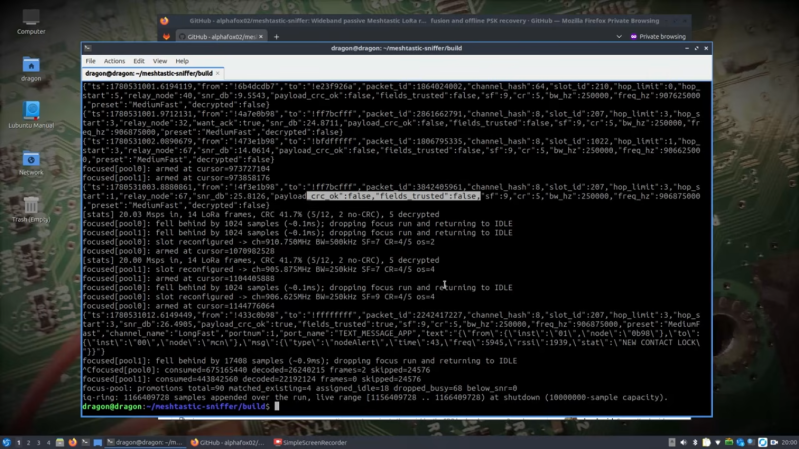
The sniffing software is built in C and comes as a complete standalone binary and does not rely on GNU Radio. With DragonOS up and running and the software loaded, it can look at the entire bandwidth that Meshtastic operates on and detect any traffic and decode it (as long as the key is known). [cemaxecuter] is using a HackRF as a software-defined radio for this project, which he notes doesn’t quite have enough bandwidth to cover every Meshtastic operating frequency, but it can get most of them. After firing up his own node, the software quickly detects it and shows its details in the terminal.

Software like this opens up a lot of opportunities for things that would be tedious, difficult, or impossible to do with with a standard Meshtastic node. Besides finding places where conversations are happening more easily, [cemaxecuter] also suggests that it could be used for wardriving and for locating or finding other networks much more easily. For those who still haven’t tried it out, take a look at this 2023 treatise on the protocol and hardware and then dive right in.

Continue reading “Meshtastic Sniffer For DragonOS” →

An Open Micro-Maniplulator Improved

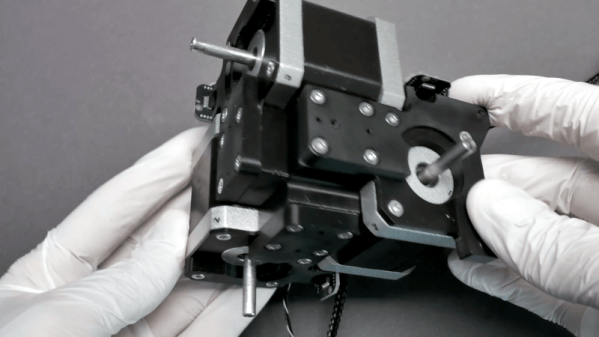
If you need a micro-manipulator, you probably already have a good idea of what it does. For example, you might be moving a probe over an IC die or wafer. You might be looking at something through a microscope. The key is moving something in very small, precise increments along three axes. An open-source design for a micro-manipulator has seen significant improvements lately. You can see several videos about the device below.

The device uses stepper motors, parallel kinematics, and miniature ball joints to achieve precise motion. The recent version 4.0 update fixes a few problems. According to the GitHub page:

  • Self-collision during homing fixed.
  • Connection of the ball joint block with screws only was not well constrained and could be rotated a bit.
  • No reliable way to ensure consistent linkage rod length
  • Unnecessary ball joint friction
  • Accurate ball position heavily dependent on print quality and corner rounding
  • Rubber bands could not be changed or removed once glued in.

Continue reading “An Open Micro-Maniplulator Improved” →

One-stop Tool Shows Apple Intelligence The Door

Don’t want AI features on your Mac? Tough luck, unless one wants to imperfectly do it by hunting down settings in about a dozen different places. Even then, the multi-gigabyte models stay on disk. Unsatisfied by this state of affairs, [omlahore] created RemoveMacAI, a one-stop-shop debloater that shows Apple Intelligence the door, reclaiming its disk space on the way out.

With RemoveMacAI one has a single location from which to turn individual AI features off, delete the models behind them, and block MacOS from downloading them again by redirecting attempts to a closed local port.

What’s refreshingly nice about the tool is how transparent it is about what each setting or preset will change, and communicates clearly what exactly one loses access to by disabling it. Want it all gone? Easy. Use one or two features, but don’t want the rest? No problem. All changes are shown up-front before the tool changes anything, and all alterations are reversible.

Released only a couple weeks ago, to say the tool is popular would be an understatement. Windows 11 also got a “remove AI features” tool, and it requires constant updating to stay functional. Will a future MacOS update interfere similarly with RemoveMacAI? Probably, but one thing that is clear is that a tool like this resonates deeply with a nontrivial number of users.

Charlotte’s New Runway Gets A Digital Twin

The first viable powered aircraft predated the first proper runway by two decades. While it’s entirely possible to launch some planes from austere dirt or grass strips, the aviation world eventually realized that aircraft would be better off launching from a flat, paved surface.

Over the years, paving technology has gradually improved in the aviation world as it has for roads and highways. Now, there’s a project being built in Charlotte with new digital features that hopes to push the state of the art of runways even further.

Continue reading “Charlotte’s New Runway Gets A Digital Twin” →

An LCR Meter With Compromises

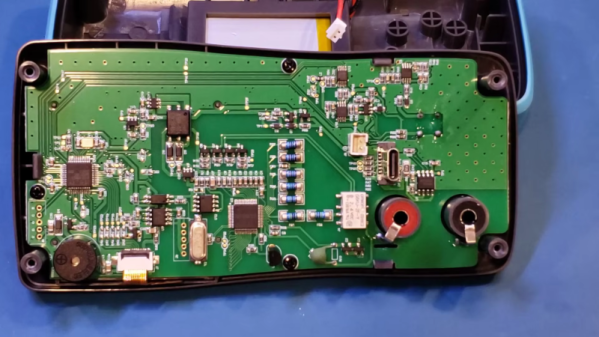
YouTube, like the Internet, has its plusses and minuses. On the plus side, you can find information on just about anything. On the minus side, you don’t always know if that information is of any value. On the plus side, you can connect to experts who have an uncanny knack for explaining things. On the negative side, you can find people who — let’s just say aren’t. Lucky for us, [Kerry Wong] is very knowledgeable about test instruments, so when we see a review from him, like the one for the ZOYI ZT-XC1 LCR meter and multimeter, we know we will get good information. Check out that review in the video below.

It used to be unusual to have an LCR meter that could measure inductance or capacitance in a home lab. But now it isn’t a big deal, and many multimeters and testers can at least attempt to read these quantities.

Continue reading “An LCR Meter With Compromises” →

A shiny, silver vehicle with tools on a mesh rack on the back half and a large open cab up front drives across a grassy field under blue, partly cloudy skies. A person in a black shirt stands in the background with a drone hovering above their head. Two women in white helmets are piloting the vehicle from the cab.

Driving On The Moon At A Blistering 11.6 MPH

As NASA continues humanity’s slow march back to the Moon, different pieces of the puzzle of establishing a more permanent base there are falling into place. One of these pieces is the the Lunar Terrain Vehicle (LTR), and [Cleo Abram] and [Michelle Khare] got a look at the LTR candidate from Lunar Outpost.

Designed to help astronauts traverse the lunar surface as well as function as a semi-autonomous rover when uncrewed, the LTR will be an integral part to any future Moon base. NASA announced earlier this year that it would be moving forward with the LTR featured in this video and another from competitor Astrolab. Regardless of manufacturer, the LTR will have to deal with some wild conditions in the lunar environment.

Lunar dust is abrasive, so the LTR generates an electric current to pull the dust under the truck to prevent it from entering the cab of the vehicle as it moves along. Given the extreme temperature swings on the moon (-200˚C to 200˚C), the space truck will also be fitted with wire mesh tires as nobody wants to be changing a flat in space. The two seats in the cab are oversized and can help lift the astronauts up as space suits hamper their agility to a significant degree. There are compartments for storing samples, and the truck has a robot arm that can grab samples to bring back if no one is along for the ride.

We’ve still got a few years before crews arrive on the moon, but when they do, there’s a good chance they’ll be using the LTR to explore the lunar south pole in hopes of water.

Continue reading “Driving On The Moon At A Blistering 11.6 MPH” →