A Programming Language That Lets You Code With Pixels

This programming language gives you programs that resemble modern art. It’s fortunately a feature of the language, dubbed Piet after the famed abstract painter Piet Mondrian.

The language uses 20 distinct colors, with the colors cycling from red to yellow to green to cyan to blue to magenta and the lightness cycling from light to normal to dark. The code is formed from graphics made of the recognized colors, with individual pixels holding much of the information. Stacks are used for storing data values, that can exist as integers or as Unicode characters with the proper commands applied.
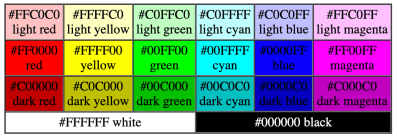
Numbers in the program are represented by colors, while black blocks indicates edges and white blocks indicate free zones. The interpreter physically slides through blocks in the direction of the Direction Pointer (DP), with hue changes indicating different commands based on the steps of the change.

To execute a program, the Piet language interpreter begins in the upper left codel (or individual code block) of the program, maintaining a DP initially pointed to the right and a Codel Chooser (CC) initially pointed to the left. The DP and CC turn right, left, down, or up depending on the execution.

There is currently a small community of coders developing sample programs, interpreters, IDEs, and compilers for the language. You can check out some of the sample programs here.


Prolific Videos Show Altair 8800 Recreation

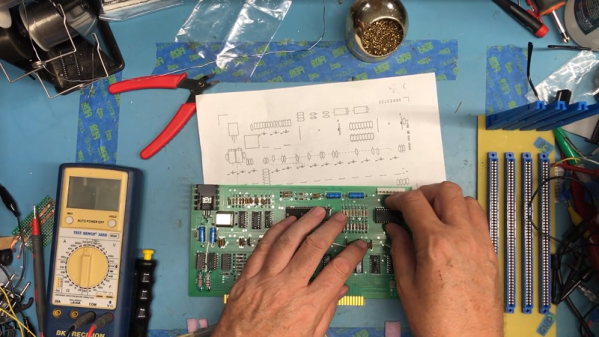
The January 1975 issue of Popular Electronics introduced the Altair 8800 and hit the newsstands in December of 1974, so it is only natural that around the New Year people start thinking about the old computer. [Shadowtron] did more than think about it. He ordered some replica PCBs and is building a new one. Even better, he’s posted an amazing number of videos (up to number 56 as I write this) detailing his progress. You can find part 1, below.

The boards are from Trailing Edge Technology. There’s a backplane board (about $100) as well as a few boards to fit it available for about $30 each — unpopulated, of course.

Continue reading “Prolific Videos Show Altair 8800 Recreation”

LC Oscillators, Animated

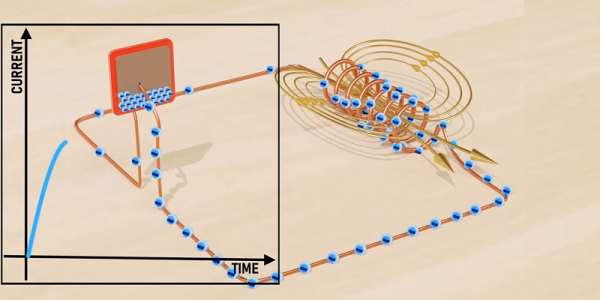
We wish that all the beautiful animations that are available today to understand math and electronics had been around when we were in school. Nonetheless, they are there for today’s students and [Learn Engineering] has another gorgeous one covering LC oscillation. Check it out, below.

If you are thoroughly grounded — no pun intended — in LC circuits, you probably won’t learn anything new. However, the animations are worth watching, just to admire them, if nothing else.

Continue reading “LC Oscillators, Animated”

A Wireless Method For Pressing Tofu

Tofu is a fairly common food in East and Southeast Asian cuisines, but it has also been making its way around vegetarian circles as a meat substitute. While it may be a more environmentally friendly source of protein than meat, it does have the unfortunate side effect of being fairly tedious to cook. To reach the right consistency, tofu requires hours of pressing to drain excess water, which tends to be tedious for most amateur cooks.

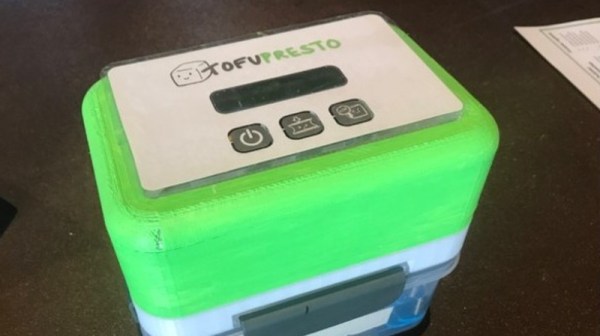
A team of students at HackMIT developed a contraption that incrementally presses tofu for you, using signals sent over WiFi to initialize the device. Several 3D-printed components extend an existing food container, along with a stepper motor, motor shield, Adafruit Feather HUZZAH, and a screen.

The motor steps at a rate of 30rpm once a signal is sent from a mobile application, causing four connected threaded rods to begin rotating. The tofu tray travels upwards to press against its lid, draining out excess water. A central gear box containers complementary cutouts that allow the tofu platform to travel vertically when shafts are rotated, pushed by nuts below the platform. The students also included a screen indicating time remaining, as well as a notification sent to the user once the tofu is finished being pressed.

It’s certainly a useful solution that will hopefully increase the popularity of tofu-based recipes!

DIY Trommel Sifts Compost In Style

Composting is a great idea that helps you and the planet at the same time. But all that stuff is going to break down at different rates, and depending on what you put in there and how soon you want to use the compost, you’ll probably have to sift out some unwanted stuff first.

[Minnear Knives] had a bunch of apricot stones in his compost pile, and it was the pits. He did some research and decided to build his own rotary trommel to tumble out the trash. As you will see in the video after the break, it works really well. All he has to do is turn on the motor and shovel raw compost or dirt into one end. Bad stuff tumbles out the other end into a wheelbarrow, while the good stuff is sifted down into a pile under the cylinder. Just look at that rich, fluffy compost.

The best part is that he was able to make it mostly from stuff he had lying around, though he did trade some beer for the v-belt pulley. The cylinder is essentially made from mesh that’s zip-tied to bicycle rims. A 1/4 horsepower motor mounted up top uses that v-belt pulley to spin the cylinder’s rims against casters that are mounted to the frame. Thanks to the pair of bike wheels on the back, he can cart it around the ranch unassisted.

Composting doesn’t have to be any more difficult than a pile in the backyard. But if you don’t have a backyard, why not build a rotating bin that you can monitor from your phone?

Continue reading “DIY Trommel Sifts Compost In Style”

Assistive Technolgy Switch Is Actuated Using Your Ear Muscles

Assistive technology is extremely fertile ground for hackers to make a difference, because of the unique requirements of each user and the high costs of commercial solutions. [Nick] has been working on Earswitch, an innovative assistive tech switch that can be actuated using voluntary movement of the middle ear muscle.

Most people don’t know they can contract their middle ear muscle, technically called the tensor tympani, but will recognise it as a rumbling sound or muffling effect of your hearing when yawning or tightly closing eyes. Its function is actually to protect your hearing from loud sounds screaming or chewing. [Nick] ran a survey and found that 75% can consciously contract the tensor tympani and 17% of can do it in isolation from other movements. Using a cheap USB auroscope (an ear camera like the one [Jenny] reviewed in November), he was able to detect the movement using iSpy, an open source software package meant for video surveillance. The output from iSpy is used to control Grid3, a commercial assistive technology software package. [Nick] also envisions the technology being used as a control interface for consumer electronics via earphones.

With the proof of concept done, [Nick] is looking at ways to make the tech more practical to actually use, possibly with a CMOS camera module inside a standard noise canceling headphones. Simpler optical sensors like reflectance or time-of-flight are also options being investigated. If you have suggestions for or possible use case, drop by on the project page.

Assistive tech always makes for interesting hacks. We recently saw a robotic arm that helps people feed themselves, and the 2017 Hackaday Prize has an entire stage that was focused on assistive technology.

Tony Brooker And Autocode – The First High-level Language

The field of computer science has undeniably changed the world for virtually every single person by now. Certainly for you as Hackaday reader, but also for everyone around you, whether they’re working in the field themselves, or are simply enjoying the fruits of convenience it bears. What was once a highly specialized niche field for a few chosen people has since grown into a discipline that not only created one of the biggest industry in modern times, but also revolutionized every other industry, some a few times over.

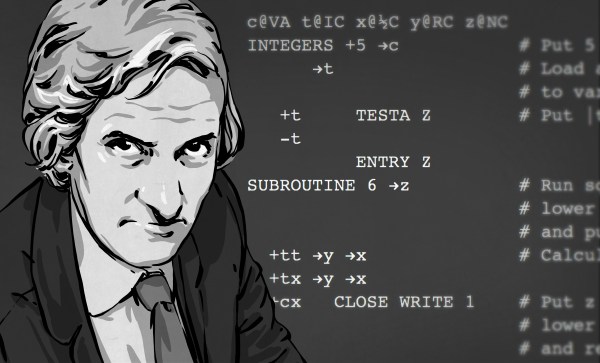
The fascinating part about all this is the relatively short time span it took to get here, and with that the privilege to live in an era where some of the pioneers and innovators, the proverbial giants whose shoulders every one of us is standing on, are still among us. Sadly, one of them, [Tony Brooker], a pioneer of the early programming language concept known as Autocode, passed away in November. Reaching the remarkable age of 94, the truly sad part however is that this might be the first time you hear his name, and there’s a fair chance you never heard of Autocode either.

But Autocode was probably the first high-level computer language, and as such played a fundamental role in the development of whatever you’re coding in today. So to honor the memory of [Tony Brooker], let’s remember the work he did with Autocode, and the leap in computer science history that it represented.

Continue reading “Tony Brooker And Autocode – The First High-level Language”