Supercapacitors Propel Rocket To The Skies

OK, so this isn’t really a rocket. In the strictest definition, rockets are vehicles or projectiles that propel themselves through jettisoning mass, usually through the combustion of fuel. But with electric motors getting stronger and stronger, folks are building craft that look a lot more like rockets than airplanes. [Tom Stanton] is one such person (Youtube link, embedded below).

We’ve seen “electric rocket” builds before, but where others have used lithium batteries, [Tom] has used supercapacitors instead. Six supercaps are installed in a 3D printed mount, and supply power to a 500 W brushless outrunner motor which gives the rocket the thrust to climb into the sky.

In testing, [Tom] estimates the rocket was able to reach an altitude of approximately 60 m, or 200 ft. That’s not particularly astounding, but it does prove that supercaps can run a high current load in a real world situation. Additionally, their fast recharge rate allows [Tom] to make a repeat flights in just about the time it takes to repack the parachute. Video after the break.

Continue reading “Supercapacitors Propel Rocket To The Skies”

How Art Became Science In Machining

Machining is one of those fascinating fields that bridges the pre-scientific and scientific eras. As such, it has gone from a discipline full of home-spun acquired wisdom and crusty old superstitions to one of rigorously analyzed physics and crusty old superstitions.

The earliest machinists figured out most of what you need to know just by jamming a tool bit into spinning stock and seeing what happens. Change a few things, and see what happens next. There is a kind of informal experimentation taking place here. People are gradually controlling for variables and getting better at the craft as they learn what seems to affect what. However, the difference between fumbling around and actually knowing something is controlling for one’s own biases in a reproducible and falsifiable way. It’s the only way to know for sure what is true, and we call this “science”. It also means being willing to let go of ideas you had because the double-blinded evidence clearly says they are wrong.

That last part is where human nature lets us down the most. We really want to believe things that confirm our preconceived notions about the world, justify our emotions, or make us feel better. The funny thing about science, though, is that it doesn’t care whether you believe in it or not. So go get your kids vaccinated, and up your machining game with scientific precision. Let’s take a look.

Continue reading “How Art Became Science In Machining”

Lots Of Blinky! ESP32 Drives 20,000 WS2812 LEDs

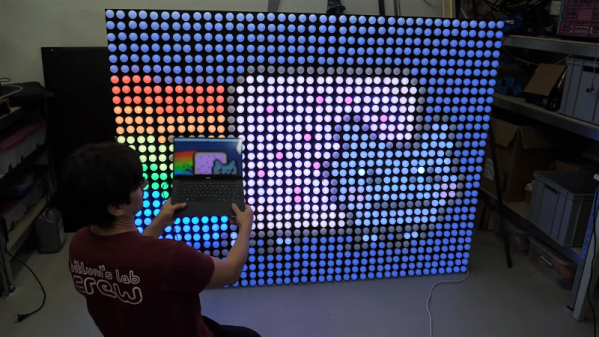
20,000 LEDs sounds like an amazing amount of blink. When we start to consider the process of putting together 20,000 of anything, and then controlling them all with a small piece of electronics the size of a postage stamp, we get a little bit dizzy. Continue reading “Lots Of Blinky! ESP32 Drives 20,000 WS2812 LEDs”

Add USB-C To Your Laptop (Almost)

It’s a very brave person who takes a Dremel or similar to the case of their svelte new laptop in the quest for a new connector, it sounds as foolhardy as that hoax from a while back in which people tried to drill a 3.5mm jack into their new iPhones. But that’s what [BogdanTheGeek] has done, in adding a USB-C port to his Acer.

Of course, the port in question isn’t a fully functioning USB-C one, it’s a power supply jack, and it replaces the extremely unreliable barrel jack the machine was shipped with. He’s incorporated one of those little “ZYPDS” USB-C power delivery modules we’ve no-doubt all seen in the usual cheap electronic sources, and in a move of breathtaking audacity he’s cut away part of the Acer mainboardĀ  to do so. He’s relying on the laptop’s ability to accept a range of voltages, and presumably trusting his steady hand with a rotary tool. Some Kapton tape and a bit of wire completes the work, and with a carefully reshaped hole in the outer case he’s good to go.

The result is beautifully done, and a casual observer would be hard pressed to know that it hadn’t always been a USB-C port. We’re sure there will come a moment at which someone will plug in a USB-C peripheral and expect it to work, it’s that good.

If you’d like to know a little bit more about USB-C, we’d like to direct you to our in-depth look at the subject.

Super Mario Land DX Game Boy

Super Mario Land DX ROM Hack Shows What Game Boy Could Have Looked Like

It was about time (Mario Time) that Super Mario Land for the original Game Boy was revisited. The game served as the entry point into the world of portable gaming for millions, and it was an early example of the type of adventure players could expect from a handful of AA batteries. The original Game Boy system itself may have only been able to display four shades of grey, however, that never stopped players of Super Mario Land from imagining what the game would have looked like in stunning color. Now thanks to [toruzz] we no longer have to imagine, because their Super Mario Land DX ROM Hack does just that…and then some.

The Super Mario Land DX ROM hack adheres to the Game Boy Color’s 16-bit color palette, so it actually runs on real hardware. No changes to the gameplay were made and it also runs in the native 10:9 aspect ratio for the Game Boy. According to the patch readme file, it is recommended to use a legally sourced dump of the 1.0 version of Super Mario Land and utilize Lunar IPS to apply the patch. Additionally a CRC check sum is provided to ensure everyone is working from the same starting point.

Super Mario Land was a launch title for the Game Boy in 1989, but there was another handheld game system that released that year as well (the Atari Lynx). The Lynx featured a full color backlit LCD display, so it was not as if handheld game systems of the era were restricted to being monochromatic. Granted the Lynx came with a price tag nearly twice that of the Game Boy, but a transformative ROM hack such as the Super Mario Land DX one can serve almost as an alternate history. An alternate history that we all can experience now be it on a desktop or in true portable form.

To see the Super Mario Land DX ROM Hack in motion, there is the gameplay video from YouTube user Vincent Hernandez below:

Continue reading “Super Mario Land DX ROM Hack Shows What Game Boy Could Have Looked Like”

Getting That Neon Sign Look Without All The Hassle

We all love the look of neon signage, but the between the glassblowing equipment, gas cylinders, high voltage, and the associated skill set, it’s not practical for everyone. Luckily, these days there’s a good alternative: “neon” flexible LED strips. This is the approach [Benni] recently took in making a large logo display, and the results speak for themselves.

[Benni] sourced the strips from AliExpress. They’re 8 mm wide and can be cut to length in multiples of 4.2 cm. Inside, there are strips of RGB LEDs, making the displays that much more versatile than actual neon. Covering the LEDs is a silicone diffuser strip that completes the illusion of a neon tube. The flexibility of the strips make them easy to bend into different shapes, but also mean a solid substrate of some sort is required to make them hold their shape. In [Benni]’s case, he used a metal frame to which he glued the strips with cyanoacrylate adhesive. He used zip ties to clamp the strips in place while the glue cured, and the fact that he clipped the tails of the zip ties is a testament to his detail-oriented nature; we would probably have left them on. All of the attention payed off though because the end product looks awesome. The finishing touches are supplied by some 3D-printed bezels carrying acrylic diffuser panels and traditional LED strips for the eyes, plus a DMX LED controller.

We’ve seen [Benni]’s work before, like this slick USB rotary encoder peripheral, and like that time, there’s a video which really shows off the project. Have a look, after the jump.

Continue reading “Getting That Neon Sign Look Without All The Hassle”

Thumbs Up For This CRT Handheld Gaming Console

Despite all the progress video game graphics have made, it is safe to say that we won’t see any decline in oldschool 8-bit games any time soon. For some it’s about nostalgia, for others it’s just a great and simple-enough first step into game development itself. For [gocivici] it was a bit of both when he built this camcorder style, one-button gaming console.

With a Raspberry Pi Zero running PICO-8 at its core, [gocivici] salvaged the viewfinder of an old camcorder for the display, and that way turned it into a whole other kind of handheld console. For full ergonomic handling, one single, thumb-operated push button serves as only control option. This of course makes it a bit challenging to re-use existing games that would require more input options, so he and some friends decided to just write a suitable game on their own with the hopes that others might follow.

Unfortunately we don’t see a lot of projects using these old camcorder viewfinders, and considering modern LCD and OLED options it’s not really that surprising, but there’s just something intriguing about these tiny CRTs. So in case you want to see more of them, have a look at this tiny Atari display, and the DIY night vision monocle from a few years back. And to keep your eyes safe and sound, [gocivici] got you covered as well.

Continue reading “Thumbs Up For This CRT Handheld Gaming Console”