The world of radio controlled aircraft used to be an expensive and exclusive hobby, limited to those with the time and money to invest in difficult builds and pricey radio gear. More recently, the hobby has become more accessible, with cheap ready to fly planes available that can be flown in smaller spaces like suburban parks. [Ravi Butani] has built just such a plane, and you can even fly it with your smartphone!
An ESP8266 does double duty here as both the brains and the communication system. A custom smartphone app communicates with the plane over WiFi. Touching the screen increases the throttle, while steering is achieved through tilting the phone. There’s also monitoring of signal strength and battery level, with the phone vibrating if the plane is getting out of range or low on battery.
Flight control is via differential thrust, with power coming courtesy of two small DC motors controlled by tiny SMD MOSFETs. The plane flies remarkably well in still conditions, and the WiFi connection is stable in an open park environment. [Ravi] reports that control is possible at a range of around 70 meters using a Motorola G5S smartphone.
Despite the simplicity of the build and the low cost of the components, the final product performs admirably. It would be a great weekend project, and at the end of it, you get to go and fly your new plane! If you’re worried about keeping your batteries charged, don’t worry – there’s a solution for that. Video after the break.
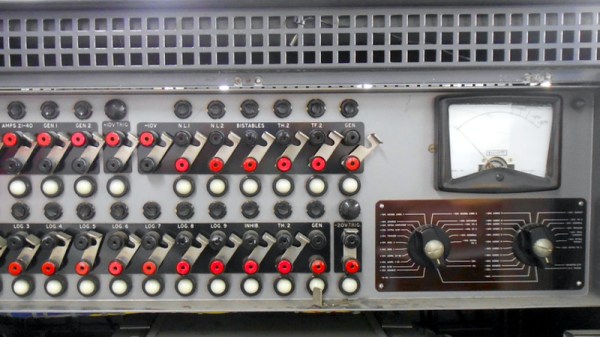
When I read old books, I like to look for predictions of the future. Since we are living in that future, it is fun to see how they did. Case in point: I have a copy of “The New Wonder Book of Knowledge”, an anthology from 1941. This was the kind of book you wanted before there was a Wikipedia to read in your spare time. There are articles about how coal is mined, how phonographs work, and the inner workings of a beehive. Not the kind of book you’d grab to look up something specific, but a great book to read if you just want to learn something interesting. In it there are a few articles about technology that seemed ready to take us to the future. One of those is the Televox — a robot from Westinghouse poised to usher in an age of home and industrial mechanical servants. Robots in 1941? Actually, Televox came into being in 1927.
If you were writing about the future in 2001, you might have pictured city sidewalks congested with commuters riding Segways. After all, in 2001, we were told that something was about to hit the market that would “change everything.” It had a known inventor, Dean Kamen, and a significant venture capitalist behind it. While it has found a few niche markets, it isn’t the billion dollar personal transportation juggernaut that was predicted.
But technology is like that. Sometimes things seem poised for greatness and disappear — bubble memory comes to mind. Sometimes things have a few years of success and get replaced by something better. Fax machines or floppy drives, for example. The Televox was a glimpse of what was to come, but not in any way that people imagined in 1941. Continue reading “Televox: The Past’s Robot Of The Future”→
We’re not exactly what you’d call naturalists here at Hackaday, so to us, the idea that hot pepper seeds need to germinate in hot conditions sounds suspiciously like a joke. The sort of thing somebody might tell you right before they try to sell you an elevator pass, or cram you into a locker. But we don’t think [Dean] would have gone through so much trouble if it wasn’t true. You’re still not going to sell us an elevator pass, though. Not again.
According to [Dean], the Carolina Reaper pepper seeds he bought from Puckerbutt Pepper Company (truly a name you can trust) recommend that they be germinated at a temperature between 80 and 85 degrees Fahrenheit for up to eight weeks. To make sure they were maintained at the optimal temperature for as long as possible, he decided to get a heating pad he could place under the seeds to keep them warm. He just needed some way to make sure the heat only kicked on once the soil temperature fell out of the sweet spot.
To get an accurate reading, [Dean] ended up going with a waterproof K-type thermocouple connected to a SainSmart MAX6675 module that could be buried amongst the seeds. When the soil temperature drops below 82.5 F, it kicks on the heating mat through an IoT Relay by Digital Loggers. He even added in a capacitive soil moisture sensor and a couple of LEDs so he could tell from across the room if he needed to water what he loving refers to as his “Hell Berries”
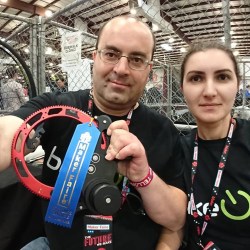
Cyphercon 4.0 came to life in Milwaukee, Wisconsin on Thursday and the conference badge is a brilliant and engaging design. At first glance it looks like a fairly mundane rectangular badge. But a closer look reveals simplistic elegance wrapping around some clever mechanical design and the awesome interactive mechanism of being able to read paper tape.
That’s right, this badge can read the series of holes punched in the long paper strips you normally associate with old iron of 50 years ago.
Everything’s internet connected these days, garage doors, baby monitors, and the kitchen sink are all hooked up. There are benefits to having everything online, but also several pitfalls. Maintaining security on a home network is an ongoing job, made more difficult by the number of devices that must be kept track of. Sometimes all the hassle isn’t worth it, and you just want a non-connected solution. [Dilshan] found himself in just that camp, and built a simple programmable light controller that doesn’t connect to the Internet.
At the core of the project is an ATMEGA8 microcontroller, which is cheap, readily available, and can do the job. It’s combined with a DS1307 real time clock IC to keep track of time. The circuit is designed for 24V power, to allow it to be run from the same supply as the LED light modules it is designed to control.
The design was initially prototyped with through-hole parts on the breadboard, with the final design being built with surface mount parts on a custom PCB. Light is courtesy of a 7W warm white LED module. 3 push buttons and a 4-digit, 7-segment display act as the user interface, with an LDR to allow the light to also react to its surroundings.
It’s a build that goes against current trends, lacking WiFi connectivity, Twitter functionality, or cloud-based logging. It goes to show that the right solution isn’t always putting everything online. Sometimes the old methods are enough to do the job, and do it well.
Over the past 30 years the price of hardware has slowly but surely come down, and it’s now possible to buy all manner of widgets and gizmos online for less than the price of a fancy Italian dinner. By and large this is a good thing, but it’s not uncommon to find that your new tools are let down by the software side of things. Of course, you can always develop your own solution – and in [ThePhil]’s case, that’s exactly what he did.
The hardware in question was a PCE-174 luxmeter, which came with an uncooperative Windows application as standard. This simply wouldn’t do, so [ThePhil] set about developing a Linux version in Python. This was achieved through the aid of documentation, not of the PCE-174, but its sibling from another corporation – the Extech HD450. The two meters were similar enough that the Extech’s better documentation was able to fill in the gaps of [ThePhil]’s understanding.
[ThePhil] has diligently implemented the full feature set of the PCE-174, and has documented the project well. There are even notes on the version numbers of various dependencies, which will surely be a great help if someone’s trying to run the code five years down the track.
It’s a great lesson that one need not be at the mercy of the software one is given. For a great many cases, it’s possible to roll your own solutions that are robust and get the job done. This approach can be taken to great lengths – you can go so far as replacing an entire camera firmware, if you so wish.
Some bittersweet news today as we get word that Israel’s Beresheet spacecraft unfortunately crashed shortly before touchdown on the Moon. According to telemetry received from the spacecraft right up until the final moments, the main engine failed to start during a critical braking burn which would have slowed the craft to the intended landing velocity. Despite attempts to restart the engine before impact with the surface, the craft hit the Moon too hard and is presumably destroyed. It’s likely that high resolution images from the Lunar Reconnaissance Orbiter will eventually be able to give us a better idea of the craft’s condition on the surface, but at this point the mission is now officially concluded.
The Beresheet Lander
It’s easy to see this as a failure. Originally conceived as an entry into the Google Lunar X Prize, the intended goal for the $100 million mission was to become the first privately funded spacecraft to not only touch down on the lunar surface, but navigate laterally through a series of powered “hops”. While the mission certainly fell short of those lofty goals, it’s important to remember that Beresheet did land on the Moon.
It didn’t make the intended soft landing, a feat accomplished thus far only by the United States, Russia, and China; but the fact of the matter is that a spacecraft from Israel is now resting on the lunar surface. Even though Beresheet didn’t survive the attempt, history must recognize Israel as the fourth country to put a lander on the surface of our nearest celestial neighbor.
It’s also very likely this won’t be the last time Israel reaches for the Moon. During the live broadcast of the mission, after it was clear Beresheet had been lost, Prime Minister Benjamin Netanyahu vowed his country would try again within the next two years. The lessons learned today will undoubtedly help refine their next mission, and with no competition from other nations in the foreseeable future, there’s still an excellent chance Israel will be able to secure their place in history as the fourth country to make a successful soft landing.
Beresheet’s view during descent
Of course you’ve got to get to the Moon before you can land on it, and in this respect, Beresheet was an unmitigated success. We previously covered the complex maneuvers required to put the craft into lunar orbit after riding to space as a secondary payload on the Falcon 9 rocket; a technique which we’ll likely see more of thanks to the NASA’s recent commitment to return to the Moon. Even if Beresheet never attempted to land on the surface, the fact that it was able to enter into a stable lunar orbit and deliver dramatic up-close images of the Moon’s surface will be a well deserved point of pride for Israel.
This won’t be the last time that hundreds of millions of dollars worth of high-tech equipment will be lost while pushing the absolute edge of the envelope, and that’s nothing to be upset over. Humans have an insatiable need to see what’s over the horizon and that means we must take on a certain level of risk. The alternative is stagnation, and in the long run that will cost us a lot more than a few crashed probes.