Talking Washer Is A Clean Solution For The Visually Impaired

Have you shopped for an appliance lately? They’re all LEDs, LEDs everywhere. You might say that manufacturers are out of touch with the utility of tactile controls. [Wingletang]’s fancy new washing machine is cut from this modern cloth. While it does have a nice big knob for selecting cycles, the only indication of your selection is an LED. This isn’t an issue for [Wingletang], but it’s a showstopper for his visually impaired wife.

They tried to make tactile signposts for her most-used cycles with those adhesive rubber feet you use to keep cabinet doors quiet. But between the machine’s 14(!) different wash cycles and the endlessly-rotating selector knob, the tactile map idea was a wash. It was time to make the machine talk.

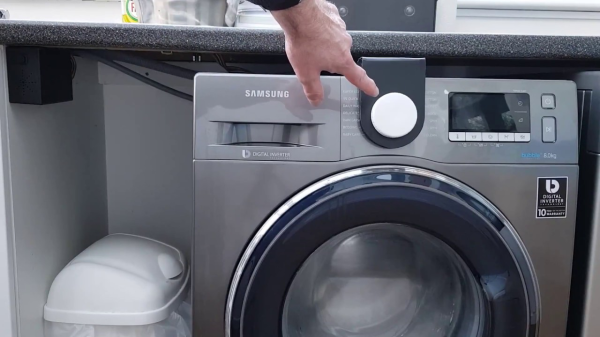
For his very first microcontroller project, [Wingletang] designed a completely non-invasive and totally awesome solution to this problem. He’s using LDRs arranged in a ring to detect which LED is lit. Recycled mouse pad foam and black styrene keep ambient light from creating false positives, and double as enclosure for the sensor and support boards. As [Mrs. Wingletang] cycles through with the knob, an Arduino clone mounted in a nearby project box determines which program is selected, and a Velleman KA02 audio shield plays a recorded clip of [Wingletang] announcing the cycle number and description.

The system, dubbed SOAP (Speech Output Announcing Programmes), has been a great help to [Mrs. Wingletang] for about the last year. Watch her take it for a spin after the break, and stick around for SOAP’s origin story and walk-through videos.

It’s baffling that so few washers and dryers let you know when they’re finished. Don’t waste your time checking over and over again—Laundry Spy waits for the vibrations to end and sends you a text.

Continue reading “Talking Washer Is A Clean Solution For The Visually Impaired”
Utterly Precise Light Painting, Thanks To CNC And Stop Motion

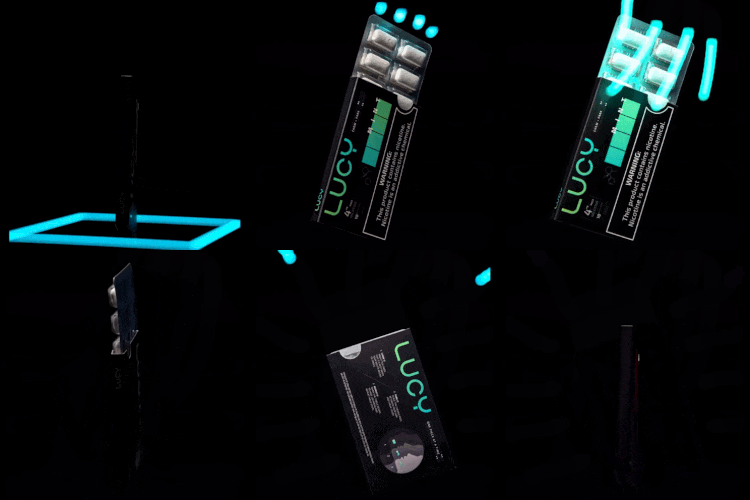
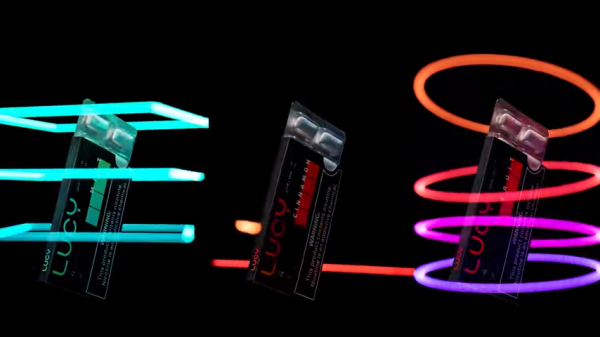
Light painting is the process of moving a light while taking a long-exposure photograph, which creates a sort of drawing from the path of the light source. It’s been done in one way or another since at least the early-to-mid 1900s, but modern hardware and methods have allowed for all kinds of new spins on this old idea. [Josh Sheldon] demonstrates just how true this is with the light painting he did for a gum ad, showing what’s possible with a single multicolor LED under CNC control combined with stop-motion animation techniques. The rest of the magic comes from the software. [Josh] designs the animations in Blender, and the paths are then exported and used as the instructions for his self-made Light Painting Machine. The machine therefore recreates the original animation with lights and camera and not a single computer-generated graphic.

[Josh] is no stranger to light painting in this way. We’ve seen his fantastic machine at work before and we’re glad he shared the details behind his latest work. Embedded below is a concise video that shows the whole process, but if you’re in a hurry and just want to see the end product, here’s a shortcut to the results.

For those of you who would like to know more, there are plenty of details on [Josh]’s Light Painting Machine on GitHub along with a more in-depth description of the workflow and software, so check it out.

Continue reading “Utterly Precise Light Painting, Thanks To CNC And Stop Motion”

How To Build A Small Metal Furnace At Home

Casting is a great way to make your own custom metal parts. However, casting requires some manner of furnace capable of generating high enough temperatures to melt the metal in question. Few of us have these just lying around, but never fear. It’s possible to build a basic gas-powered furnace at home, with commonly available materials (Youtube link, embedded below).

This furnace is the work of [Ahmed Ghr], and is as simple a build as they come. The idea is to produce a mold in which to cast concrete to create the furnace. A steel bucket is cut up and used as the outside of the mold, with a pipe inserted in the base to act as a feeder for air and gas. A plastic bucket is then inserted within the steel bucket and held in place with spacers, to create the inner combustion cavity. Concrete is poured in and allowed to set. Once finished, the steel bucket is cut away, and a fire is built over the furnace to melt away the plastic inside. Similar techniques are used to produce the lid, and the furnace is completed.

It’s a build that is executed with the most basic of tools, and should serve as a capable furnace for lower melting point metals at the very least. We’ve seen a lot of cement projects lately, as it turns out. Video after the break.

Continue reading “How To Build A Small Metal Furnace At Home”

Rotary Phone Gets Bluetooth Upgrade

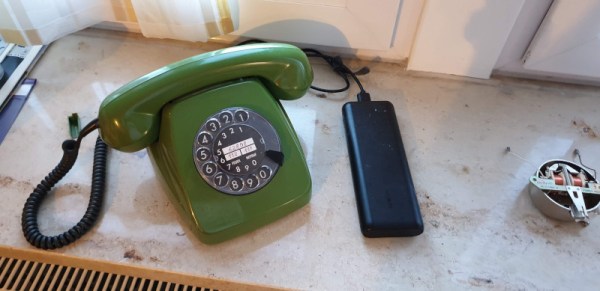
Rotary dial phones have a certain romantic charm about them; something never quite captured in the post-Touch Tone era. With landline phone services less popular than ever, these old workhorses aren’t really cut out for daily use anymore. However, with a modern brain transplant, they can still get the job done just fine.

[Xabier Zubizarreta] has undertaken to retrofit his FeTAp-611 rotary phone with a Bluetooth rig, allowing it to be used with smartphones to place and receive calls. A Raspberry Pi Zero W serves as the brains of the operation, chosen for its compact size and onboard Bluetooth and WiFi. Getting the Pi to work effectively with an Android phone as a Bluetooth audio device requires some trickery, but it’s nothing that can’t be fixed by custom compiling a few off-the-shelf tools. [Xabier]’s next big hurdle is finding a tidy way to generate a 30 VAC signal to drive the original ringer, something that proves difficult for most similar projects.

We love to see these telecommunication relics kept ticking, so if you happen to be building a vintage telephone exchange in your garden shed – be sure to let us know.

Swiss Cheese Metamaterial Is An Analog Computer

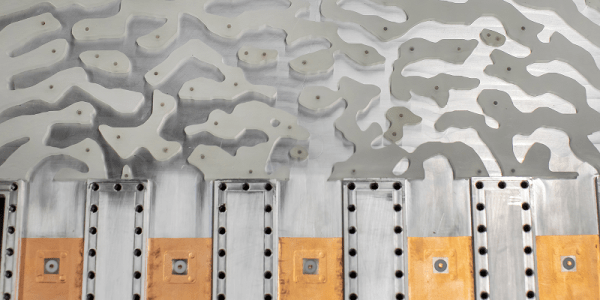
If you have had trouble with ordinary calculus, you may not be pleased to hear about “photonic calculus” — a recent idea from [Nader Engheta] of the University of Pennsylvania. The idea is that materials with certain properties could manipulate an electromagnetic wave in a way to solve a specific mathematical equation. [Engheta] proposed this idea back in 2014 and recently announced that he and his team have a demonstration device that proves the concept. The analog computer is about twice the size of an airplane’s tray table and made of CNC-shaped polystyrene. It solves Fredholm integral equations of the second kind.

The analog computer uses microwaves for the input and the polystyrene acts as a dielectric full of air holes. The team likens its structure to that of Swiss cheese. The shape is generated through an inverse design process which builds the shapes from known solutions to the equations. That means a particular set of shapes will do one specific equation. The equation could, for example, model the sound volume in a concert hall. You can encode certain parameters in the input wave and the output would specify the volume at different locations. However, a change to the actual equation would require a new set of plastic pieces.

The computation is very fast. Using microwaves, the answer comes out in a few hundred nanoseconds — a speed a conventional computer could not readily match. The team hopes to scale the system to use light which will speed the computation into the picosecond range. Creating a new optical analog computer could be similar to how we burn a CD or DVD today.

Analog computers predate digital ones by a lot. We really want to build one like [Bill Schweber’s]. Then again, we wouldn’t mind finding a Donner 3500 at a hamfest, either.

Full Earth Disc Images From GOES-17 Harvested By SDR

We’ve seen lots of hacks about capturing weather images from the satellites whizzing over our heads, but this nicely written how-to from [Eric Sorensen] takes a different approach. Rather than capturing images from polar satellites that pass overhead a few times a day, this article looks at capturing images from GOES-17, a geostationary satellite that looks down on the Pacific Ocean. The fact that it is a geostationary satellite means that it captures the same view all the time, so you can capture awesome time-lapse videos of the weather.  Continue reading “Full Earth Disc Images From GOES-17 Harvested By SDR”

Add A Bit Of Soviet-Era Super-Computing To Your FPGA

The MESM-6 project is focused on bringing the 1960s Soviet BESM-6 computer to the modern age of FPGAs and HDLs. At the moment the team behind this preservation effort consists out of [Evgeniy Khaluev], [Serge Vakulenko] and [Leo Broukhis], who are covering the efforts on the Russian-language project page.

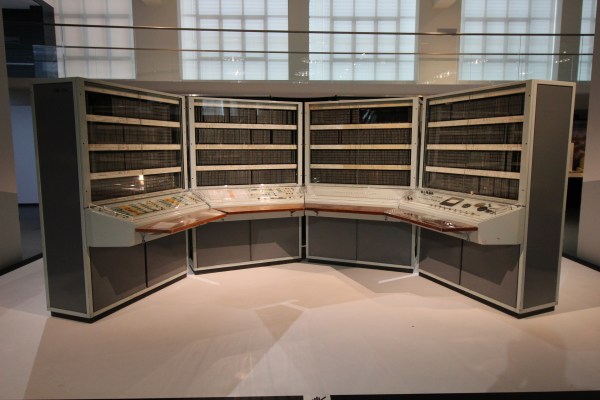
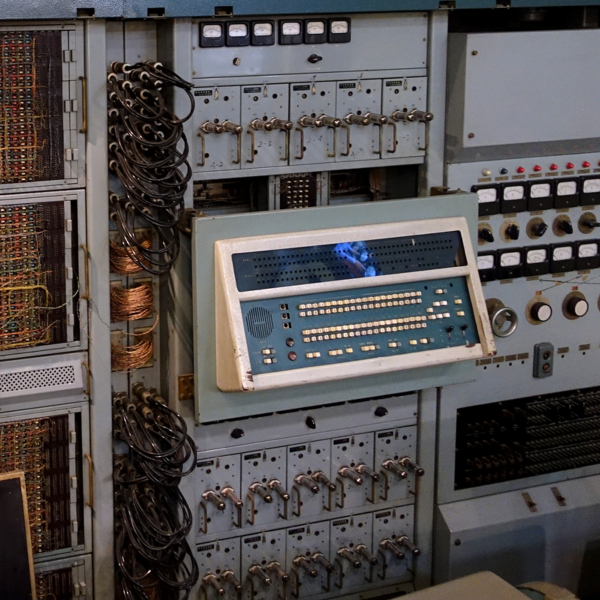
The BESM-6 (in Russian: БЭСМ-6, ‘Bolshaya Elektronno-Schetnaya Mashina’ or ‘large electronic computing machine’) was a highly performing Soviet super computer that was first launched in 1968 and in production for the next 19 years. Its system clock ran at 9 MHz using an astounding number of discrete components, like 60,000 transistors and 170,000 diodes, capable of addressing 192 kB of memory in total. Of the 355 built, a few survive to this day, with one on display at the London Science Museum (pictured above). Many more images and information can be found on its Russian Wikipedia page.

For those not gifted with knowledge of the Russian language, the machine-translated summary reveals that the project goal is to make a softcore in SystemVerilog that is compatible with user mode BESM-6, using the same Pascal compiler as originally used with that system. Further goals include at least 24 kB of data memory, 96 kB of command memory and the addition of modern peripherals such as SPI and I2C.

The system is meant to be integrated with the Arduino IDE, using the Pascal compiler to make it highly accessible to anyone with an interest in programming a system like this. Considering the MIT license for the project, one could conceivably use a bit of Soviet-era computing might in one’s future FPGA efforts.

If after watching the BESM-6 video — included below — you feel inspired to start your own Soviet-computing project, we’d like to wish you luck the Russian way: Ни пуха ни пера!

Continue reading “Add A Bit Of Soviet-Era Super-Computing To Your FPGA”