Surfboard Industry Wipes Out, Innovation Soon Follows

For decades, Gordon Clark and his company Clark Foam held an almost complete monopoly on the surfboard blank market. “Blanks” are pieces of foam with reinforcing wood strips (called “stringers”) in a rough surfboard shape that board manufacturers use to make a finished product, and Clark sold almost every single one of these board manufacturers their starting templates in the form of these blanks. Due to environmental costs, Clark suddenly shuttered his business in 2005 with virtually no warning. After a brief panic in the board shaping industry, and a temporary skyrocketing in price of the remaining blanks in existence, what followed next was rather surprising: a boom of innovation across the industry.

Continue reading “Surfboard Industry Wipes Out, Innovation Soon Follows”

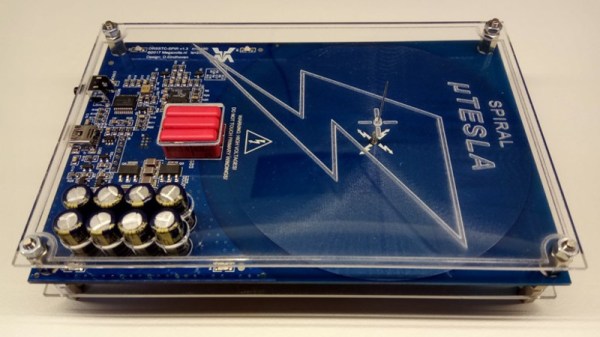
PCB Tesla Coil Is Perfect Desk Toy

A Tesla coil easily makes it to the top spot on our list of “Mad Scientist” equipment we want for the lab, second only to maybe a Jacob’s Ladder. Even then, it’s kind of unfair advantage because you know people only want a Jacob’s Ladder for that awesome sound it makes. Sound effects not withstanding, it’s Tesla coil all the way, no question.

Unfortunately, winding your own Tesla coil is kind of a hassle. Even on relatively small builds, you’ll generally need to setup some kind of winding jig just to do the secondary coil, which can be a project in itself. So when [Daniel Eindhoven] sent his no-wind Tesla coil into the tip line, it immediately got our attention.

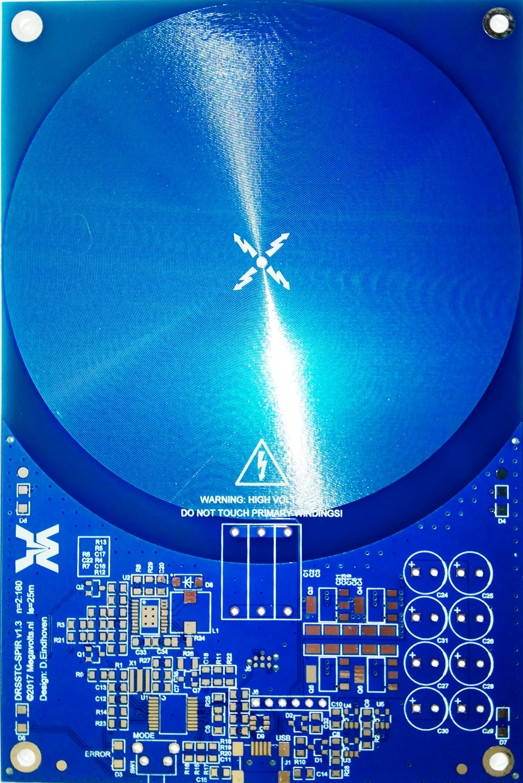
The genius in his design is that the coils are actually etched into the PCB, completely taking the human effort out of the equation. Made up of 6 mil traces with 6 mil separation, the PCB coil manages to pack a 25 meter long, 160 turn coil into an incredibly compact package. As you might expect, such a tiny Tesla coil isn’t exactly going to be a powerhouse, and in fact [Daniel] has managed to get the entirely thing running on the 500 mA output of your standard USB 2.0 port.

In such a low-power setup, [Daniel] was also able to replace the traditional spark gap pulse generator with a PIC18F14K50 microcontroller, further simplifying the design. An advantage of using a microcontroller for the pulse generator is that it’s very easy to adjust the coil’s operating frequency, allowing for neat tricks like making the coil “sing” by bringing its frequency into the audible range.

For those looking to build their own version, [Daniel] has put the PCB schematic and firmware available for download on his site. He also mentions that, in collaboration with Elektor magazine, he will be producing a kit in the near future. Definitely something we’ll be keeping an eye out for.

Incidentally, this isn’t the first time [Daniel] has demonstrated his mastery of high voltage. He scared impressed us all the way back in 2010 with his 11,344 Joule capacitor bank, perfect for that laptop-destroying rail gun you’ve been meaning to build.

Continue reading “PCB Tesla Coil Is Perfect Desk Toy”

This Drone Can Fly, Swim, And Explode….. Wait, What?

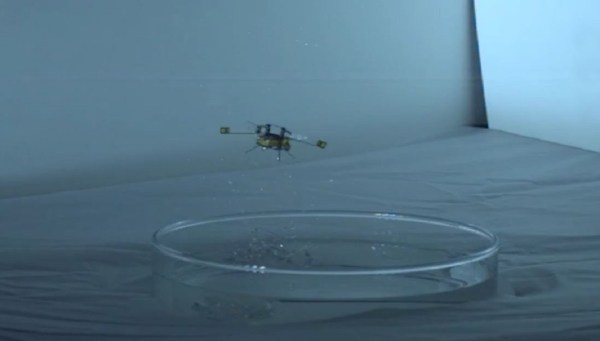
You’ve probably heard of micro-drones, perhaps even nano-drones, but there research institutions that shrink these machines down to the size of insects. Leading from the [Wiss Institute For Biologically Inspired Engineering] at Harvard University, a team of researchers have developed a miniscule robot that — after a quick dip — literally explodes out of the water.

To assist with the take off, RoboBee has four buoyant outriggers to keep it near the water’s surface as it uses electrolysis to brew oxyhydrogen in its gas chamber. Once enough of the combustible gas has accumulated — pushing the robot’s wings out of the water in the process– a sparker ignites the fuel, thrusting it into the air. As yet, the drone has difficulty remaining in the air after this aquatic takeoff, but we’re excited to see that change soon.

Looking like a cross between a water strider and a bee, the team suggest this latest version of the RoboBee series  — a previous iteration used electrostatic adhesion to stick to walls — could be used for search and rescue, environmental monitoring, and biological studies. The capacity to transition from aerial surveyor, to underwater explorer and back again would be incredibly useful, but in such a small package, it is troublesome at best. Hence the explosions.

Continue reading “This Drone Can Fly, Swim, And Explode….. Wait, What?”

Scratch That SDR!

When you think of a software defined radio, what language might you consider reaching for to create the software part of the equation? C? C++, maybe?

How about Scratch?

“What, Scratch as in the visual programming language aimed at young people?”, we hear you cry incredulously. It’s not exactly the answer you’d expect for an SDR, but thanks to [Andrew Back]’s work there is now ScratchRadio, a set of Scratch extensions for software defined radio. Why on earth do this? The aim is to lower the barrier to entry for software defined radio as far as possible, and to place it in a learning environment such as Scratch seems an ideal way to achieve that.

Of course, Scratch itself isn’t powerful enough for the heaviest of heavy lifting, so in reality this is a Scratch wrapper for a LuaRadio backend. It was created with the LimeSDR Mini in mind, but given that LuaRadio is not specific to that hardware we’d expect it to work with other SDRs such as the ever-popular RTL chipset TV sticks. It gives an owner of a Raspberry Pi 3 the ability to experiment with SDR coding without the need for a huge level of experience, and that to our mind can only be a good thing.

If you fancy trying ScratchRadio, you can find the code in its GitHub repository, and take it from there. Meanwhile we covered LuaRadio last year, so if Scratch is a little basic for you and GNU Radio too advanced, give it a try.

Radio icon: [Sakurambo], (CC BY-SA 3.0).

Scratch cat logo: MIT Media Lab.

Water Slide + Ferris Wheel = SlideWheel

This might be German engineering at its funnest. [Wiegand Maelzer GmbH] have created a new type of amusement park ride that combines the thrill of a water slide with the gentle revolutions of a Ferris wheel.

Inspired by the wish of a young Swiss boy in 2012, the whimsical feat of engineering known as the SlideWheel was realized this year. This is isn’t quite the giant sloshing drowning machine it appears to be on first blush, though. It begins and ends at the same shallow pool, where three- and four-person rafts are lifted into the ride by conveyor belt. What happens next is difficult to describe. It’s easier just to watch the first-person video below that demonstrates the pendulum-like motion that comes from floating while rotating.

SlideWheel moves at a modest 3 RPM, though this can be adjusted. Travel speed through the tube maxes out at 40 KPH/ 25 MPH, but will vary depending on the raft’s location, the position of the wheel, and gravity. The ride can handle up to three rafts at a time and delight 720 people per hour. A trip through the tube lasts a mere two minutes, but all those who’ve tried it say the experience seems much longer. [Wiegand Maelzer] have already received a few orders and are working on a dry version for malls and indoor amusement parks.

Not enough of an engineering feat, you say? Here’s a car-juggling robot.

Continue reading “Water Slide + Ferris Wheel = SlideWheel”

Hackaday Links Column Banner

Hackaday Links: ???? ???? Spooky Edition, 2017

A few links posts ago, we wrote something about a company selling huge LED panels on eBay, ten panels for $50. Those panels are gone now, but a few lucky hackers got their hands on some cool hardware. Now there’s a project to reverse engineer these Barco NX-4 LED panels. Who’s going to be the first to figure out how to drive these things? Doesn’t matter — it’s a group project and we’re all made richer by the contributions of others.

Prague is getting a new hackerspace.

A year and a half ago, a $79 3D printer popped up on Kickstarter. I said I would eat a hat if it shipped by next year. Seeing as how it’s basically November, and they’re not selling a $79 printer anymore — it’s $99 — this might go down as one of my rare defeats, with an asterisk, of course. I’m going to go source some very large fruit roll-ups and do this at Supercon. Thanks, [Larry].

Speaking of bets, this week Amazon introduced the most idiotic thing ever invented. It’s called Amazon Key. It’s an electronic lock (dumb), connected to the Internet (dumber), so you let strangers into your house to deliver packages (dumbest). CCC is in a few months, so I don’t know if Amazon Key will be hacked by then, but I’m pretty confident this will be broken by March.

The Lulzbot Taz is one of the best printers on the market, and it is exceptionally Open Source. The Taz is also a great printer for low-volume production. It was only a matter of time until someone built this. The Twoolhead is a parallel extruder for the Taz 6. Instead of one extruder and nozzle, it’s two, and instead of printing one object at a time, it prints two. Of course it limits the build volume of the printer, but if you need smaller parts faster, this is the way to go.

Hey, did you hear? Hackaday is having a conference the weekend after next. This year, we’re opening up the doors a day early and having a party at the Evil Overlord’s offices. Tickets are free for Supercon attendees, so register here.

At CES this year, we caught wind of one of the coolest advances in backyard astronomy in decades. The eVscope is ‘astrophotography in the eyepiece’, and it’s basically a CCD, a ton of magic image processing, and a small display, all mounted inside a telescope. Point the scope at a nebula, and instead of seeing a blurry smudge, you’ll see tendrils and filaments of interstellar gas in almost real-time. Now the eVscope is on Kickstarter. It’s a 4.5 inch almost-Newtonian (the eyepiece is decoupled from the light path, so I don’t even know how telescope nomenclature works in this case), an OLED display, and a 10-hour battery life.

Is the fidget spinner fad over? Oh, we hope not. A technology is only perfected after it has been made obsolete. Case in point? We can play phonographs with lasers. The internal combustion engine will be obsolete in automobiles in twenty years, but track times will continue going down for forty. Fidget spinners may be dead, but now you can program them with JavaScript. What a time to be alive!

Audio tomphoolery even an idiot tech blogger can see through! I received a press kit for a USB DAC this week that included the line, “…low drop out voltage regulators running at 3.3 V, meaning the 5 V USB limit is well preserved.” Yes, because you’re running your system at 3.3 V, you won’t draw too much current from a USB port. That’s how it works, right?

[Peter Sripol] is building an ultralight in his basement. The last few weeks of his YouTube channel have been the must-watch videos of the season. He’s glassed the wings, installed all the hardware (correctly), and now he has the motors and props mounted. This is an electric ultralight, so he’s using a pair of ‘150 cc’ motors from HobbyKing. No, that’s not displacement, it’s just a replacement for a 150 cc gas engine. On a few YouTube Live streams, [Peter] did what was effectively a high-speed taxi test that got out of hand. It flew. Doing that at night was probably not the best idea, but we’re looking forward to the videos of the flight tests.


Magnetic Tape Storage May Not Be Retro

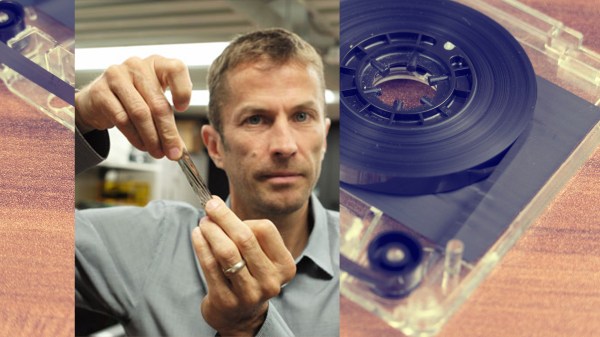
Magnetic storage is quickly becoming an antiquated technology but IBM may have given it a few more years. Currently, magnetic storage is still manufactured as hard disk drives (HDDs) but you won’t find a tape drive in a modern consumer computer. That’s not likely to change but IBM is pushing the envelope to make a tape drive that will be smaller and more economical than other massive storage options. In many ways, they’re the antithesis of solid state drives (SSDs) because tape drives are slow to retrieve data but capable of holding a lot inexpensively.

Three advances are responsible for this surge in capacity. Firstly, the tape “grains,” where each bit is recorded, have been shrunk by sputtering metal to a film instead of painting it on. Secondly, better servo control allows the reading mechanisms to read those tiny grains with the necessary accuracy. Lastly, stronger computation is used to read the data by using error detection and correction because when your tape is traveling four meters per second, it takes a long time to go back and double-check something.

IBM’s tape drive won’t replace your hard drive but it could back it up daily, many times over.

Check this out if your wetware needs a memory boost or this if your breakfast needs a memory boost.