Building The Hackaday Superconference Badge

The best hardware conference is just a few weeks away. This is the Hackaday Superconference, and it’s two days of talks, an extra day of festivities, soldering irons, and an epic hardware badge. We’ve been working on this badge for a while now, and it’s finally time to share some early details. This is an awesome badge and a great example of how to manufacture electronics on an extremely compressed timetable. This is badgelife, the hardware demoscene of electronic conference badges.

So, what does this badge do? It’s a camera. It has games, and it’s designed by [Mike Harrison] of Mike’s Electric Stuff. He designed and prototyped this badge in a single weekend. On board is a PIC32 microcontroller, an OV9650 camera module, and a bright, crisp 128×128 resolution color OLED display. Tie everything together with a few buttons, and you have a badge that’s really incredible.

So, how do you get one? You’ve got to come to the Hackaday Superconference. This year we’re doing things a bit differently and opening the doors a day early to get the hacker village started with badge hacking topped off by a party that evening and everyone coming to Supercon is invited! This is a badge full of games, puzzles, and video capture and isn’t something to miss. We have less than 30 tickets left so grab your ticket now and read on.

Continue reading “Building The Hackaday Superconference Badge”
Dollar Tree LED Bulb Tear Down

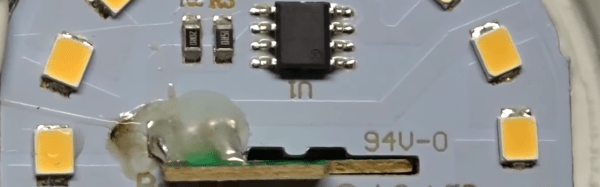
It is hard to remember now, but there was a time when electronics were expensive. [Adrian Black] found some 9W (60W equivalent) LED light bulbs at the Dollar Tree (a U.S. store where everything costs a dollar). Naturally, they cost a dollar, and he wanted to see what was inside of them. You can see the resulting video, below.

Apparently where [Adrian] lives there is a subsidy paid to retailers for selling LED lighting, so you may not be able to get the same bulbs at that price. Still, the price of these bulbs has dropped like a rock over the last few years.

Continue reading “Dollar Tree LED Bulb Tear Down”

2.5D Printing?

Casio — the company famous for calculators, watches, and calculator watches — is touting a 2.5D printer. We aren’t sure we are impressed with the marketing hype name, but it is an interesting innovation for people prototyping new designs. The printer can create material that appears to be leather, fabric, and other materials. With some additional work, the printer can even mimic hard materials like stone or wood. You can see a video about the machine below.

The Mofrel printer uses special “digital sheets” that appear to be thick paper or PET plastic, but are really a sandwich of different materials. When you heat an area of the sheet, particles inside the sandwich expand allowing the printer to apply a texture.

Continue reading “2.5D Printing?”

Addition On The Strangest Vacuum Tube

[Uniservo] made a video of a tube he’s been trying to acquire for a long time: a Rogers 6047 additron. Never heard of an additron? We hadn’t either. But it was a full binary adder in a single vacuum tube made in Canada around 1950. You can see the video below.

The unique tubes were made for the University of Toronto Electronic Computer (UTEC). A normal tube-based computer would require several tubes to perform an addition, but the additron was a single tube that used beam switching to perform the addition in a single package. [Uniservo] points out how the tube could have revolutionized tube computing, but before it could really appear in real designs, transistors — and later, integrated circuits — would take over.

Continue reading “Addition On The Strangest Vacuum Tube”

Cleaning Up A Low-Cost Buck-Boost Supply

Cheap DC-DC converters have been a boon on the hobbyist bench for a while now, but they can wreak havoc with sensitive circuits if you’re not careful. The problem: noise generated by the switch-mode supply buried within them. Is there anything you can do about the noise?

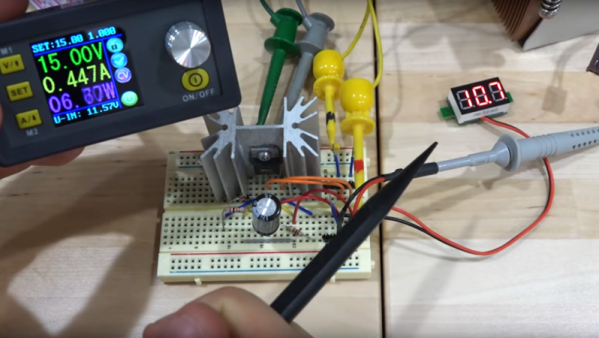
As it turns out, yes there is, and [Shahriar] at The Signal Path walks us through a basic circuit to reduce noise from DC-DC converters. The module under the knife is a popular buck-boost converter with a wide input range, 0-32 VDC output at up to 5 amps, and a fancy controller with an LCD display. But putting the stock $32 supply on a scope reveals tons of harmonics across a 1 MHz band and overall ripple of about 66 mV. But a simple voltage follower built from a power op-amp and a Zener diode does a great job of reducing the spikes and halving the ripple. The circuit is just a prototype and is meant more as a proof of principle and launching point for further development, and as such it’s far from perfect. The main downside is the four-volt offset from the input voltage; there’s also a broad smear of noise at the high end of the spectrum that persists even with the circuit in place. Centered around 900 MHz as it is, we suspect a cell signal of some sort is getting in. 900 kHz.

If you haven’t checked out the videos at The Signal Path, you really should. [Shahriar] really has a knack for explaining advanced topics in RF engineering, and has a bench to die for. We’ve covered quite a few of his projects before, from salvaging a $2700 spectrum analyzer to multiplexing fiber optic transmissions.

Continue reading “Cleaning Up A Low-Cost Buck-Boost Supply”

Build Your Own Wave Tank

Wave tanks are cool, but it’s likely you don’t have one sitting on your coffee table at home. They’re more likely something you’ve seen in a documentary about oil tankers or icebergs. That need no longer be the case – you can build yourself a wave generator at home!

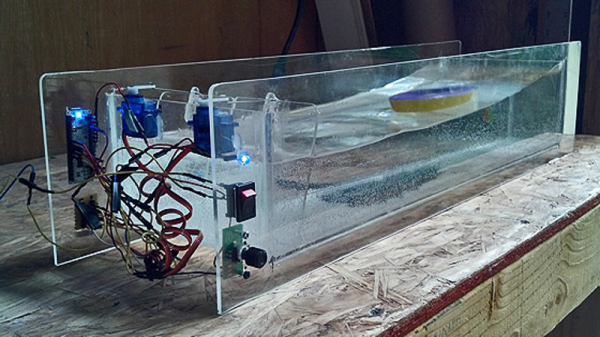
This build comes to use from [TVMiller] who started by creating a small tank out of acrylic sheet. Servo-actuated paddles are then placed in the tank to generate the periodic motion in the water. Two servos are controlled by an Arduino, allowing a variety of simple and more complex waves to be created in the tank. [TVMiller] has graciously provided the code for the project on Hackaday.io. We’d love to see more detail behind the tank build itself, too – like how the edges were sealed, and how the paddles are hinged.

A wave machine might not be the first thing that comes to mind when doing science at home, but with today’s hardware, it’s remarkable how simple it is to create one. Bonus points if you scale this up to the pool in your backyard – make sure to hit the tip line when you do.

Neural Network Gimbal Is Always Watching

[Gabriel] picked up a GoPro to document his adventures on the slopes and trails of Montreal, but quickly found he was better in front of the camera than behind it. Turns out he’s even better seated behind his workbench, as the completely custom auto-tracking gimbal he came up with is nothing short of a work of art.

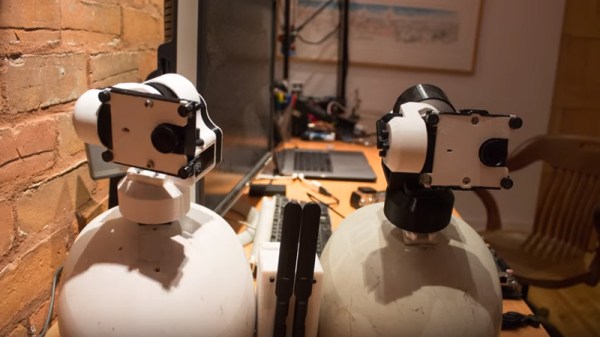
There’s quite a bit going on here, and as you might expect, it took several iterations before [Gabriel] got all the parts working together. The rather GLaDOS-looking body of the gimbal is entirely 3D printed, and holds the motors, camera, and a collection of ultrasonic receivers. The Nvidia Jetson TX1 that does the computational heavy lifting is riding shotgun in its own swanky looking 3D printed enclosure, but [Gabriel] notes a future revision of the hardware should be able to reunite them.

In the current version of the system, the target wears an ultrasonic emitter that is picked up by the sensors in the gimbal. The rough position information provided by the ultrasonics is then refined by the neural network running on the Jetson TX1 so that the camera is always focused on the moving object. Right now the Jetson TX1 gets the video feed from the camera over WiFi, and commands the gimbal hardware over Bluetooth. Once the Jetson is inside the gimbal however, some of the hardware can likely be directly connected, and [Gabriel] says the ultrasonics may be deleted from the design completely in favor of tracking purely in software. He plans on open sourcing the project, but says he’s got some internal house keeping to do before he takes the wraps off it.

From bare bones to cushy luxury, scratch-built camera gimbals have become something of a right of passage for the photography hacker. But with this project, it looks like the bar got set just a bit higher.

Continue reading “Neural Network Gimbal Is Always Watching”