Pi Cart: 2,400 Games In One

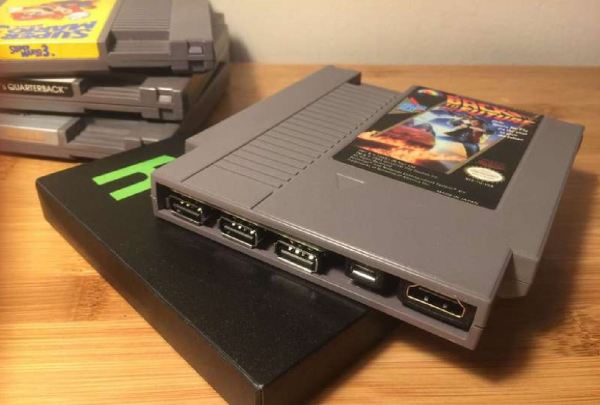
What’s the quickest way to turn one game into 2,400? Cram a Raspberry Pi Zero running RetroPie into an NES cartridge and call it Pi Cart.

This elegant little build requires no soldering — provided you have good cable management skills and the right parts. To this end, [Zach] remarks that finding a USB adapter — the other main component — small enough to fit inside the cartridge required tedious trial and error, so he’s helpfully linked one he assures will work. One could skip this step, but the potential for couch co-op is probably worth the effort.

Another sticking point might be Nintendo’s use of security screws; if you have the appropriate bit or screwdriver, awesome, otherwise you might have to improvise. Cutting back some of the plastic to widen the cartridge opening creates enough room to hot glue in the USB hub, a micro USB port for power, and an HDMI port in the resulting gap. If you opted to shorten the cables, fitting it all inside should be simple, but you may have to play a bit of Tetris with the layout to ensure everything fits.

Continue reading “Pi Cart: 2,400 Games In One”

Hams In Space Part 2: The Manned Spaceflights

Whether it’s trying to make contacts across the planet with a transmitter that would have a hard time lighting an LED, or blasting signals into space and bouncing them off the moon, amateur radio operators have always been on the forefront of communications technology. As mankind took to space in the 1950s and 1960s, hams went along for the ride with the first private satellites. But as successful as the OSCAR satellites were, they were still at best only beacons or repeaters in space. What was needed was the human touch – a real live operator making contacts with people on the ground, showing the capabilities of amateur radio while generating public interest in the space program. What was needed was a ham in space. Continue reading “Hams In Space Part 2: The Manned Spaceflights”

FingerRing Is Simplest Multichannel Mixer

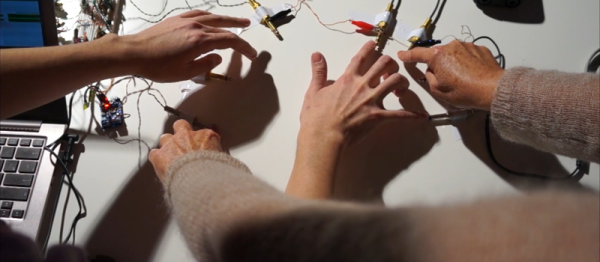
It’s hard to make an audio mixer with any less technology than FingerRing (YouTube video, embedded below). We’re pretty sure that [Sergey Kasich] isn’t going to get a patent on this one. But what he does get is our admiration for pushing a simple idea far enough that it’s obviously useful.

The basic idea is transmitting signals using the human body as a conductor. What [Sergey] does is lay out multiple sound sources and sinks on the table, and then play them like a mixer made musical instrument. Pressing harder reduces the resistance, and makes the sound louder. Connecting to two sources mixes them (in you). Watch the video — he gets a lot of mileage out of this one trick.

Continue reading “FingerRing Is Simplest Multichannel Mixer”

Web Matrix Control Proves Power Of ESP8266

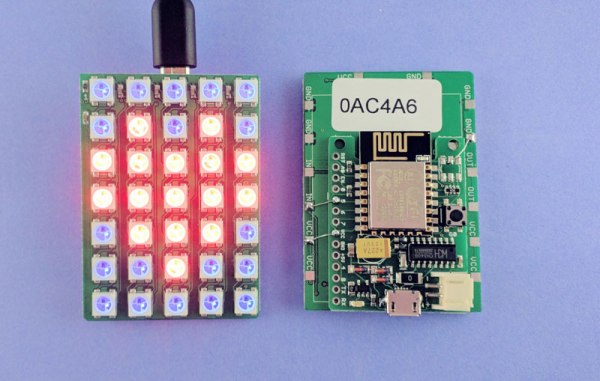
LED matrix projects are all over the place, but this one is interesting for its simplicity: it’s an LED matrix that is driven straight from an ESP8266 board. [Ray] put it together as a quick project for his students to teach the basics of LED programming.

It’s built using a WS2812 LED matrix board he designed himself and his own ESPToy ESP8266 dev board. But the gist of the hardware is simply an ESP8266 and some WS2812’s. Where this gets interesting is with the user interaction side of things. The ESP makes WiFi and web serving easy, and [Ray] has build a simple HTTP GET API into the firmware. This is a great combination for the web dashboard and JavaScript-based animation programs [Ray] is demonstrating in the video below.

Just get on the same network and load up the module’s WiFi address for a graphical representation of the 5×7 LED matrix. Pick a color, turn pixels on or off, or choose a predefined pattern and send it to the hardware. This is a powerful way to get use input and with this as a guide it’s fast to set up for pretty much an application you can think of. Just work your way through the documents he put together for the workshop (Zip file link), including all of the code and the slides he used to run the workshop.

Continue reading “Web Matrix Control Proves Power Of ESP8266”

SpeedyCopter driving on the road

Vietnam War Helicopter Turned Amphibious Racecar

Our hats off to [SpeedyCop] and his [Gang of Outlaws] for turning a junked former Vietnam War helicopter into both an amphibious vehicle and a road race car. Yes, that’s right. It’s both driven on water and raced in the 24 Hours of LeMons at New Jersey Motorsports Park.

It started life as a 1969 Bell OH-58 Kiowa (US Army Vietnam Assault helo) and had not only served in Vietnam but also for a federal drug task force. It was chopped up for parts and the body found its way to [SpeedyCop] and friends. The body now sits on an 80s Toyota van chassis, has a Mazda Miata rear suspension, and Audi 3.0 V6 engine.

The pontoons were originally added to hide the seam between the helicopter body and the van but they then inspired the idea of making it amphibious. And with the addition of a four-blade, 7000 RPM propeller from a parasail boat, the idea became reality, as you can see in the video after the break (we suspect the trailing line is a rope to pull it back to shore in case of engine failure).

Continue reading “Vietnam War Helicopter Turned Amphibious Racecar”

Handheld Sudoku (Assuming You Have Large Hands)

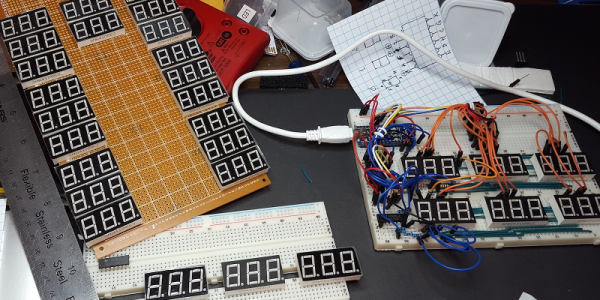
[Hari Waguna] wanted to build a computerized Sudoku game. Ordinarily, that wouldn’t be a big deal. You can buy one, of course, but what fun is that? There’s plenty of apps for phones, but again, not much of a challenge. If you want to preserve your hacker cred, you’d use a CPU board like an Arduino or a Raspberry Pi with an LCD screen, right? But if you want to grow your hacker cred, you’d follow [Hari’s] lead and use 81 seven-segment displays and a membrane keyboard.

Driving that many displays takes some doing (in this case shift registers). [Hari] uses some other tricks, like reading the keyboard using a single pin (and a resistor network). He’s made several videos about the project, including the one below.

Continue reading “Handheld Sudoku (Assuming You Have Large Hands)”

Sort Your Candy With A Raspberry Pi And Google Cloud Vision

If you have been off trick-or-treating and returned home with an embarassment of candy, what on earth can you do to mange the problem and sort it by brand?

Yes, it’s an issue that so many of us have had to face at this time of year. So much a challenge, that the folks at [Dexter Industries] have made a robotic candy-sorter to automate the task.

OK, there’s something of the tongue-in-cheek about the application. But the technology they’ve used is interesting, and worth a second look. Hardware wise it’s a Lego Mindstorms conveyor and hopper controlled by a Raspberry Pi through the BrickPi interface. All very well, but it’s in the software that the interest lies. They use the Raspberry Pi’s camera to take a picture to send off to Google Cloud Vision, which they then query to return a guess at the brand of the candy in question. The value returned is then compared to a list of brands to keep or donate to another family member, and the hopper tips the bar into the respective pile.  They provide full build details and code, as well as the video we’ve put below the break. So simple a child can explain it, sort of.

Continue reading “Sort Your Candy With A Raspberry Pi And Google Cloud Vision”