It’s no secret that we love bizarre robot locomotion, so we are naturally suckers for BALLU (YouTube link, also embedded below) the Bouyancy-Assisted Lightweight Legged Unit. The project started with a simple observation — walking robots are constrained by having to hold themselves up — and removing that constraint make success much easier. Instead of walking, BALLU almost floats and uses what little net weight it does have to push against the ground.
Listen to the amateur radio bands long enough, and you’ll likely come to the conclusion that hams never stop talking. Of course it only seems that way, and the duty cycle for a transmitter operating in one of the voice modes is likely to be pretty low. But digital modes can up the duty cycle and really stress the finals on a rig, so this field-expedient heat sink for a ham transceiver is a handy trick to keep in mind.
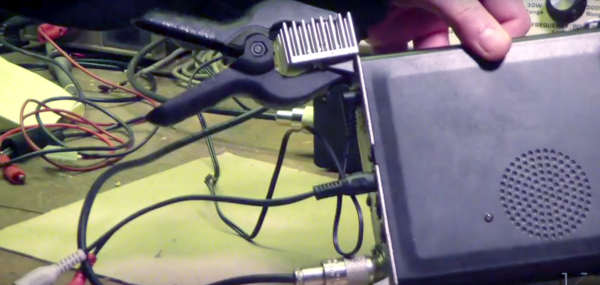
This hacklet comes by way of [Kevin Loughin (KB9RLW)], who is trying to use his “shack-in-a-box” Yaesu FT-817 for digital modes like PSK31. Digital modes essentially turn the transceiver into a low-baud modem and thus messages can take a long time to send. This poses a problem for the 5-watt FT-817, which was designed for portable operations and doesn’t have the cooling fans and heavy heatsinks that a big base station rig does. [Kevin] found that an old 486 CPU heatsink clamped to a lug on the rear panel added enough thermal mass to keep the finals much cooler, even with a four-minute dead key into a dummy load at the radio’s full 5-watt output.
[Gerald Musy] wanted to investigate the source of electromagnetic interference (EMI) in his switching power supply design. Stymied by the high cost of EMI probes, he decided to build his own. Lucky for us, he wrote up his results of experimenting with four different designs.
The probes include an unshielded loop, a shielded loop, a ferrite core probe, and an electric field probe. None of these are especially complex to build–the ferrite core one is probably the most involved–you can see from the scope traces that the different probes pick up different information.
There are times when you set out to do one thing, and though you do not achieve your aim you succeed in making something else that’s just a bit special. [TheKhakinator] sent us something he described as a fail, but even though we’re posting it as one of our Fail Of The Week series we think the result still has something of the win about it. It may not be the amazing hack he hoped it would become, but that really does not matter in this case.
On his travels in China his attention was caught by an everyday electronic gadget, an electronic calculator that speaks the numbers and operations in Chinese as you use it. He bought a few of them, hoping that when he got them back to his bench he’d find an EEPROM containing the samples, which he could replace with his own for a cheap but low bitrate sampler.
Sadly this neat hack was not to be, for when he tore the surprisingly well-built calculators down he found only an epoxy blob concealing a single chip. All was not lost though, for while investigating the device’s features he discovered that as well as speaking Chinese numbers and operands it also had a selection of alarm tunes built-in, plus a mode in which it operated as a rudimentary electronic organ. He leaves us with a couple of videos we’ve posted below the break, first his teardown, and then a virtual orchestra of calculators playing dance music as he forgets the fail and concentrates on the win.
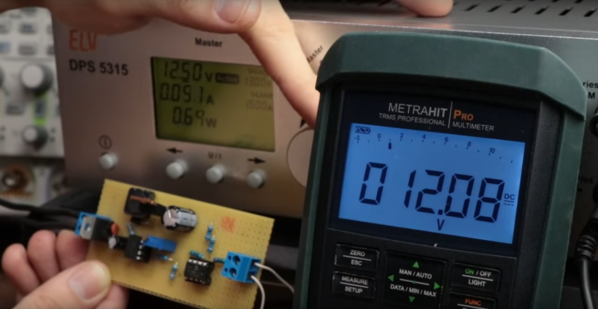
DC to DC conversion has come a long way. What was once took an electromechanical vibrator and transformer has been reduced to a PC board the size of a largish postage stamp that can be had for a couple of bucks on eBay. So why roll your own buck-boost converter for the ground up? Maybe because sometimes the best way to learn is by doing.
Open Source software has been around for decades. Over these decades, Open Source software has been the driving force behind most of the Internet, and all of the top-500 supercomputers. The product of the Open Source software movement is perhaps more important than Gutenberg’s press. But hardware has not yet fully embraced this super-charging effect of openness. Being able to simply buy an open source CPU, free of all proprietary bits and NDAs is impossible.
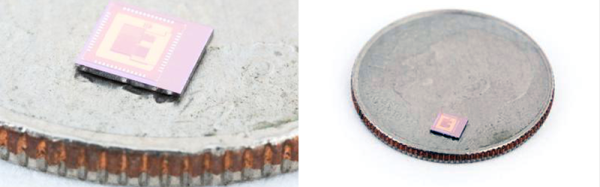
Now, this is finally changing. OnChip, a startup from a group of doctoral students at the Universidad Industrial de Santander in Colombia, have been working on mRISC-V, an open 32-bit microcontroller based on the RISC-V instruction set. It’s now a crowdfunding campaign, and yes, you can simply buy an open source chip.
We’ve taken a look at onchip’s Open microcontroller project before. The team has made significant progress of moving from something that can run on an FPGA to the tapeout of a real, physical chip. The onchip twitter timeline is a flurry of activity, with real silicon and a prediction that 50% of low-end microcontrollers will be running RISC-V in a decade.
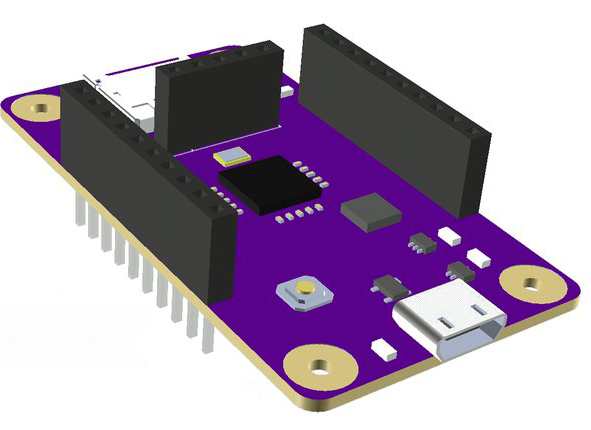
A render of the Open-V dev board
If you want to get your hands on one of these open microcontrollers, the Crowd Supply campaign is actually fairly reasonable, considering this is custom silicon. $49 USD gets you a first-run mRISC-V in a QFN-32 package. $99 gets you the mRISC-V dev board with an SD card slot, USB, regulators, and of course the micro itself.
This chip’s capabilities are almost on par with a low-power ARM Cortex M0. The chip itself runs at 160MHz, has SPI, I2C, SDIO, and JTAG, as well as a 10-bit 10MS/s ADC and a 12-bit DAC. There are 16 GPIO pins on mRISC-V. You won’t be able to build a smartphone or laptop with this chip, but you will be able to build an Internet of Things gizmo.
While OnChip’s efforts won’t result in a completely open source smartphone, there are other projects in the works that will bring an Open Source core to more powerful devices. lowRISC is a project to bring a Linux-capable System on Chip to production, and various people smarter than us have brought GCC, LLVM, and QEMU to the architecture.
Most of the efforts to bring the RISC-V architecture, and indeed most Open Source processors, have focused on the big chips — full CPUs and SoCs. Onchip’s mRISC-V goes the other direction to create a small, open microcontroller. If you’re looking to create an ecosystem of Open processors, this makes a lot of sense; there are more Honda Civics on the road than Lamborghinis, and Microchip and TI ship far more microcontrollers every year than Intel ships CPUs.
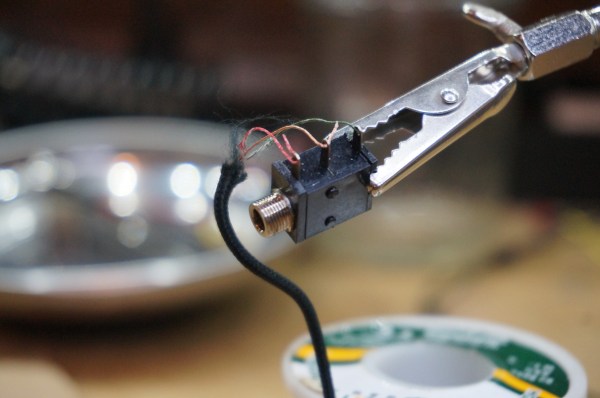
We’ve all had that treasured pair of headphones fail us. One moment we’re jamming out to our favorite song, then, betrayal. The right ear goes out. No wait. It’s back. No, damn, it’s gone. It works for a while and then no jiggling of the wire will bring it back. So we think to ourselves, we’ve soldered before. This is nothing. We’ll just splice the wire together.
So we open it up only to be faced with the worst imaginable configuration: little strands of copper enamel wire intertwined with nylon for some reason. How does a mortal solder this? First you try to untwine the nylon from the strands. It kind of works, but now the strands are all mangled and weird. Huh. Okay. well, you kind of twist them together and give a go at soldering. No dice. Next comes sandpaper, torches, and all sorts of work-a-rounds. None of them seem to work. The best you manage is sound in one ear. It’s time to give up.
Soldering this stuff is actually pretty easy. It just takes a bit of knowledge about how assembly line workers do it. Let’s take a look.